

Quick Answer: What Is the Farmers’ Dance of China’s Korean Ethnic Group?
The farmers’ dance (农乐舞, nóngyuèwǔ) of China’s Korean ethnic group combines communal music, dance and dramatic gestures. In Jilin and elsewhere in northeast China, its ties to farming appear in land offerings, harvest wishes and movements that evoke work in the fields. UNESCO inscribed the tradition in 2009. [1][2]
- Ritual: A village gathering may begin by making an offering to a land deity and praying for a good harvest. [1]
- Sound: A small gong can cue the group. Larger gongs, hourglass drums, barrel drums and wind instruments can join the ensemble. [1][2][3]
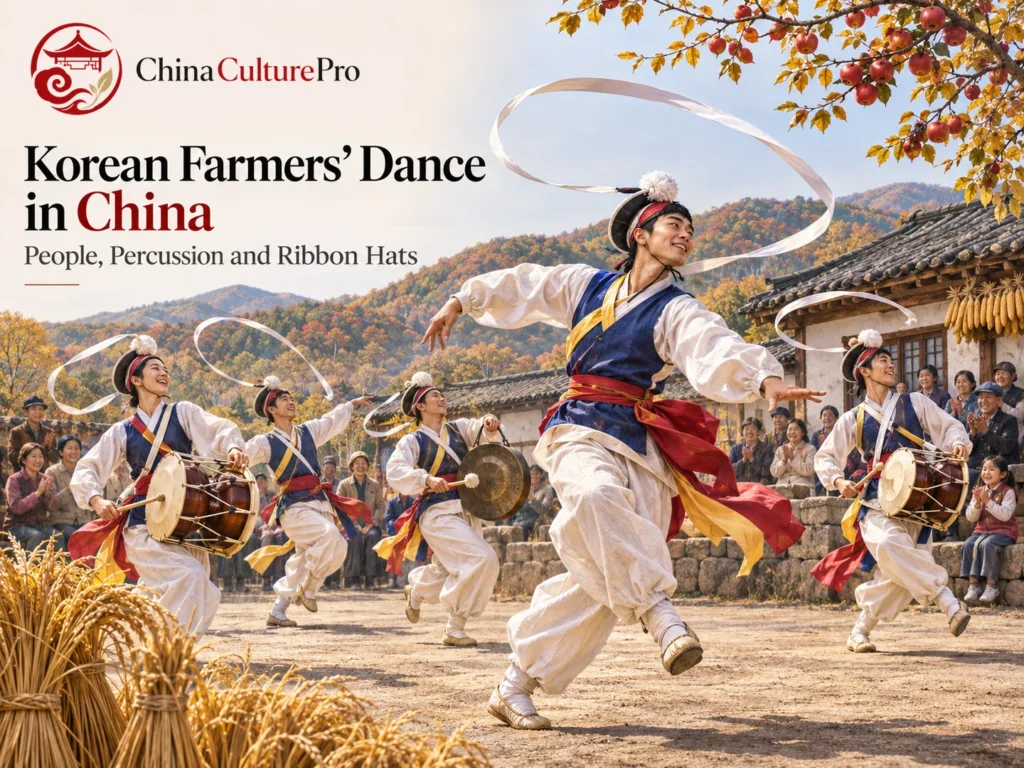
- Movement: Some dancers imitate actions associated with farming. The ribbon-hat dance (象帽舞, xiàngmàowǔ) uses head movement to trace loops with a streamer. [1][2][3]
The performers and sequence can vary. A ribbon-hat display is one part of a wider gathering.

When the leading gong sounds, watch the people behind the banners. Some carry instruments while dancing, and others take on different roles. The coordination of those roles is as revealing as the longest ribbon.
Who Does What in a Farmers’ Dance Ensemble
| Role | What you may see or hear | What it contributes |
|---|---|---|
| Banner bearers | Flags carried at the front of a procession. [2] | Establish the group’s direction and can express the value of agriculture. [2][3] |
| Small-gong player | A musician near the front, making clear rhythmic signals. [2][3] | Gives cues for a change of rhythm or movement. [2][3] |
| Other instrumentalists and dancers | Large gongs, handheld or hourglass drums, with wind instruments in some groups. [1][2][3] | Layer rhythm and melody while dancers set gestures to the beat. [1][2][3] |
| Ribbon-hat performers | Long streamers attached to hats swing around the body. [2][3] | Make timing and head movement visible to the people watching. [2][3] |
In a described Wangqing formation, the small-gong player behind the banners directs changes in the ensemble. That documented arrangement helps viewers hear how a group can change together instead of interpreting every beat as accompaniment. [2][3]
How Agricultural Work Became Performance
UNESCO describes a ritual at the beginning of some community festivals. An offering to a land deity expresses gratitude and hopes for the harvest. Actions associated with field labor are then available as parts of a performance. One gesture evokes walking the ridges between plots. Masked performers and comic gestures can bring drama into the same gathering. [1]
Wangqing County in the Yanbian Korean Autonomous Prefecture is a documented center of the ribbon-hat tradition. A dancer controls the ribbon with head movements, creating loops while stepping and turning. One performer’s accuracy is easiest to see in relation to the group’s tempo. The practice remains one aspect of Korean culture in China, which also encompasses language, food and other community traditions. [2][3]
From Village Gatherings to Public Stages
Senior community members pass on the skills, while performances also take place in urban settings. UNESCO’s account describes changes in some costumes and ensembles over time. This gives a way to understand a staged performance as part of the tradition’s history. [1][2]
Other public dance traditions, such as northern Chinese yangge, also use group movement and music. The farmers’ dance in China’s Korean communities has its own ceremonial setting and instrumental roles. For another way to distinguish a living practice from the remains of a historic place, see the guide to China’s cultural World Heritage sites. [1][2]
FAQs About China’s Korean Farmers’ Dance
Is the farmers’ dance the same as Korea’s nongak?
The traditions are related. UNESCO inscribed the farmers’ dance of China’s Korean ethnic group in 2009 and the Republic of Korea’s nongak in 2014 under separate nominations. The UNESCO entries distinguish communities and safeguarding frameworks while recording related performance forms. [1][4]
Does every performer wear the ribbon hat?
No. The ribbon hat belongs to a particular part of the performance. The full event can include banner bearers, percussion and wind players, and dancers with other roles. [1][2][3]
Where in China is the ribbon-hat dance documented?
Wangqing County in Yanbian, Jilin, is a documented center. The broader farmers’ dance is also practiced elsewhere in northeast China. [1][2]
Sources
[1] UNESCO Intangible Cultural Heritage. Farmers’ Dance of China’s Korean Ethnic Group
[2] China Intangible Cultural Heritage Network. The Farmers’ Dance and Ribbon Hats in Yanbian
[3] China Culture. Farmers’ Dance of China’s Korean Ethnic Group
[4] UNESCO Intangible Cultural Heritage. Nongak in the Republic of Korea