
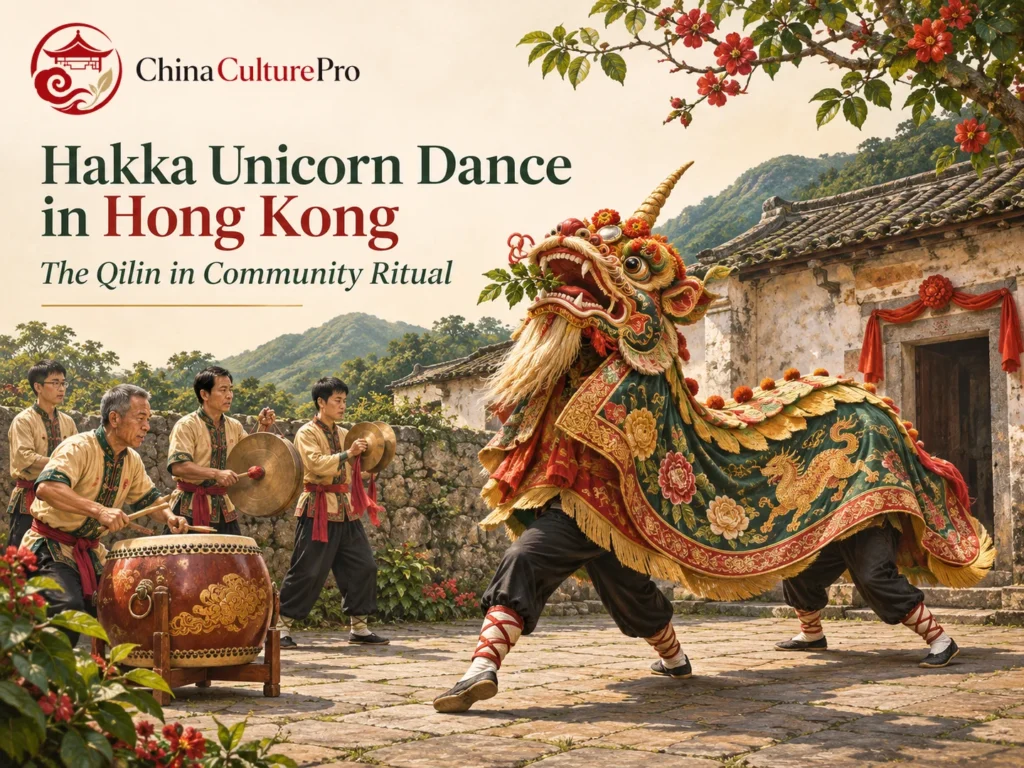

Quick Answer: What Is the Hakka Unicorn Dance in Hang Hau?
The Hakka unicorn dance in Hang Hau, Sai Kung, brings the qilin (麒麟, qílín), an auspicious creature in Chinese tradition, into community celebrations and rituals. The performers animate a costume in coordination with musicians. Local practitioners link the dance to welcoming people, honoring important occasions and expressing good wishes. [1][2]
- Figure: The creature being represented is a qilin.
- Movement: The Hang Hau form draws on local music and martial arts.
- Occasions: Heritage records describe performances at weddings, festivals and other community occasions.
The item on China’s national intangible heritage list names the local Hakka form in Hang Hau, Sai Kung. [1][3]

From a distance, an animal dance may look like a familiar festival sight. In Hang Hau, the identity of the creature and the occasion both help explain the performance.
What the Qilin Means to the Community
The English label “unicorn” translates a local name for the mythical creature. The story and symbolism to follow are those of the qilin. The heritage office describes it as a bearer of good fortune and protection in Hakka belief. That helps explain why a group might perform when welcoming guests, celebrating a wedding or marking a religious occasion. Read more about the wider traditions of Hakka culture. [1]
What to Notice in a Hang Hau Unicorn Dance
| Element | What to watch for | What it shows |
|---|---|---|
| Qilin costume | When the head turns or lowers and the body follows | How several movements create the impression of one creature |
| Accompaniment | Where performers move in time with percussion | The musicians’ contribution to the pace and phrasing |
| Place and occasion | Where the group performs and whom it greets | What the dance does in that particular celebration |
The heritage office identifies a local sequence of movements shaped by music and martial arts. The performers’ timing helps give the large figure a single presence. An animal head and percussion also appear in Chinese lion dance, but the creature, local repertoire and sponsoring group are stronger clues to which tradition you are seeing. [1][2]
Who Keeps the Dance Going?
Performers learn to share timing, handle the costume and respond to musical cues. Hong Kong’s Intangible Cultural Heritage Office names the Joint Association of Traditional Hakka Unicorn in Sai Kung and Hang Hau among the groups connected to the national listing. Community groups sustain the form by bringing experienced practitioners together with learners and finding occasions to perform. [1][3]
The Tai O Dragon Boat Water Parade offers another example of a Hong Kong heritage item whose local groups matter to its survival. In each case the people organizing the occasion help explain why the practice takes the form it does. [3][4]
FAQs About Hang Hau’s Hakka Unicorn Dance
Is the Hang Hau dance a type of lion dance?
It represents the qilin and has its own movements and ceremonial associations. The heritage inventory documents local unicorn and lion dance traditions under separate entries. [1][2]
Where is the Hang Hau tradition based?
The inscribed local form comes from Hang Hau in Sai Kung, Hong Kong. Hong Kong inventories also identify other local unicorn traditions. [1][2]
When did it enter the national heritage list?
The Hang Hau Hakka unicorn dance entered the fourth national list of intangible cultural heritage in 2014. [1][3]
Sources
[1] Hong Kong Intangible Cultural Heritage Office. Hakka Unicorn Dance in Hang Hau in Sai Kung
[2] Hong Kong Intangible Cultural Heritage Office. Intangible Cultural Heritage Inventory of Hong Kong
[3] Hong Kong Intangible Cultural Heritage Office. Items on the National List of ICH in Hong Kong
[4] Hong Kong Intangible Cultural Heritage Office. Tai O Dragon Boat Water Parade