
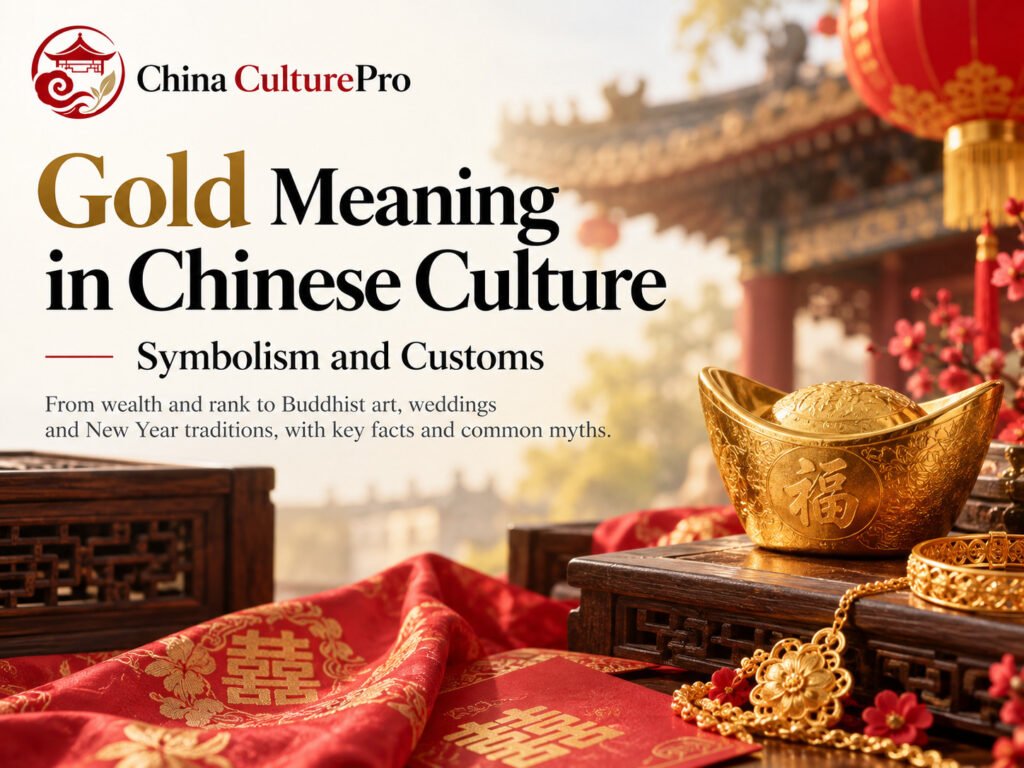

Quick Answer: What Does Gold Symbolize in Chinese Culture?
Gold in Chinese culture has no single meaning outside context. Its interpretation depends on whether the viewer is seeing precious metal, a gold-colored surface, a regulated court object, Buddhist art, or modern festival decoration.
- Wealth and material value: Real gold signifies wealth because it is scarce, durable, and economically valuable. It does not attract money by supernatural means.
- Rank and prestige: Gold objects, jewelry, and textiles may mark elite status when their period, owner, and workmanship support that reading.
- Permanence and preciousness: Gold’s resistance to tarnish supports associations with endurance, lasting value, and exceptional importance.
- Buddhist radiance: Gilded images and gold-script sutras can express the Buddha’s purity, spiritual light, and the preciousness of the teachings.
- Festival and wedding wishes: Red-and-gold decorations and wedding jewelry can convey prosperity and an abundant future in modern or regional settings.
Gold is not one of the Five Colors (五色, wǔsè), China’s traditional ritual set. In the Wuxing (五行, wǔxíng) system, the Metal phase (金, jīn) does not mean visual gold. Gold also has no universal power to bring luck, protection, love, or long life.
English uses “gold” for a metal, a color, and a visual finish. Chinese cultural objects make those distinctions important. A solid gold vessel, a gilt-bronze Buddha, a robe embroidered with metallic thread, and a modern foil-stamped New Year card may look related, but they do not carry the same material value or cultural message.
The safest rule is simple: identify the material and technique first, then read the object’s date, owner, function, imagery, and setting. That approach replaces the familiar but misleading formula that gold always means wealth, imperial power, or good luck.
Gold Is a Material, a Color and a Surface Effect
The first question is not “What does gold mean?” but “What kind of gold is this?” Museum descriptions often give the answer through precise material terms.
| Term | What it identifies | Interpretive limit |
|---|---|---|
| Gold metal (黄金, huángjīn) | A precious metal used alone or in an alloy | Material value does not prove imperial ownership or an auspicious purpose |
| Gold color (金色, jīnsè) | A yellow-gold visual effect produced by many materials | A gold-looking surface may contain no gold |
| Gilding (鎏金, liújīn) | A thin gold layer applied to a metal body, often copper alloy | A gilded object is not solid gold |
| Gold leaf (金箔, jīnbó) | Gold hammered into very thin sheets and attached to another surface | The supporting object may be wood, lacquer, plaster, paper, or metal |
| Gold thread (金线, jīnxiàn) | Metal strip or gold-wrapped material used in weaving and embroidery | “Metallic thread” may not be pure gold unless the record says so |
| Gold powder or paint (泥金, níjīn) | Finely divided gold mixed with a binder for writing or painting | It creates a luminous surface without making the support a gold object |
| Imitation gold (仿金, fǎngjīn) | Pigment, foil, plating, or printing made to resemble gold | It carries visual associations, not the rarity of precious metal |
Gold can be hammered into leaf, drawn into fine wire, alloyed, melted, engraved, chased, or ground for paint. Gilding places only a thin layer over another material, and surviving gilding may be worn or partial. These technical distinctions explain why appearance alone cannot determine an object’s value or status.[1]
For modern design, the same rule applies. A metallic ink or hot-foil effect can make a package look festive and luxurious, but it should not be described as gold material unless it actually contains gold. Cultural interpretation begins with accurate naming.
Why Gold Suggests Wealth, Rank and Permanence
Gold’s best-supported associations come from its physical properties and social history, not from mystical power. Scarcity and exchange value connect it with wealth. Luster makes it visible in dim interiors and crowded ceremonial settings. Malleability allows a small quantity to cover a broad surface or become exceptionally fine wire. Low chemical reactivity helps gold resist rust and tarnish.[1][3]
Those properties support three related but different readings:
- Wealth: The object contains a scarce, exchangeable material or displays access to it.
- Rank: Its scale, technique, imagery, or documented owner places that wealth inside a social hierarchy.
- Permanence: Its enduring surface suggests lasting value, memory, devotion, or continuity.
None of these meanings is automatic. A court gold vessel can display rank; a small personal ornament may show family wealth; gold leaf on a sacred image serves a religious purpose; imitation gold on a greeting card supplies brilliance at low cost. The material also has a history of reuse: gold objects were often melted and remade, so survival is selective rather than proof that gold was rare in every period.[1]
It is also inaccurate to call gold the supreme material of Chinese civilization at all times. Jade and bronze held foundational roles in early ritual culture. Gold gained importance through changing trade, technology, fashion, court regulation, and religious use.
How Gold’s Status Developed in Ancient China
Gold did not move through Chinese history in a straight line from “precious” to “imperial.” Its uses varied by region and period, and its meanings were repeatedly adapted.
Early Gold and Northern Cultural Exchange
In the central plains of early China, bronze ritual vessels and jade objects were more deeply embedded in established ceremonial systems than gold. Gold objects existed, but many early forms and techniques show connections with the northern steppe and borderlands rather than one isolated origin inside the central plains.
Research traces the introduction of gold objects from Europe and Central Asia through the Eurasian Steppe and China’s border regions from around the eighth century BCE. Animal-style ornaments and portable personal adornments were especially important in this movement.[2] This history makes early Chinese gold a record of contact and adaptation as well as wealth.
The point is not that China simply copied an outside tradition. Craftspeople and patrons selected, transformed, and combined forms to fit local tastes. Nor did early gold immediately replace older prestige materials. It entered a world in which bronze and jade already had powerful ritual, political, and ethical associations.
Han Gold, Elite Display and the Afterlife
During the Han dynasty (206 BCE–220 CE), gold became more visible in elite tombs, dress, gifts, and objects connected with the imagined afterlife. Archaeological research describes it as a relatively new addition to a material system in which jade already had a long Chinese history. Han patrons integrated gold into expectations of immortality and well-being rather than assigning it one independent, universal meaning.[2]
Gold-thread jade burial suits show this composite logic clearly. Gold wire joined jade plaques in exceptionally high-status burials. The suit’s meaning came from the complete funerary system: jade, gold, the deceased’s rank, burial practice, and beliefs about bodily preservation and an enduring afterlife. The gold wire alone was not a general longevity charm.
Other Han gold objects served as rewards, ornaments, stored wealth, or burial goods. Their value could signal power and status, while their durability suited elite hopes for continuity beyond death. These uses explain why “immortality” may be relevant to a particular Han tomb but should not be applied to every gold-colored object.
Court Regulation in Later Imperial China
Gold continued to circulate in jewelry, vessels, textiles, religious objects, and luxury goods after the Han. Access was shaped by cost, patronage, sumptuary rules, and occasion rather than a timeless ban that reserved every golden surface for the emperor.
During part of the Ming dynasty (1368–1644), laws restricted some uses of gold to the imperial family and officials of appropriate rank. Court objects combined gold with dragons, clouds, gems, and carefully controlled forms, so status was communicated by the whole object rather than color alone.[1] A gold ground, metallic thread, or small gilt detail therefore cannot identify an owner without supporting evidence.
Later imperial culture also used gold beyond the throne. Temples commissioned gilded images, wealthy families owned jewelry, and workshops produced objects with varying amounts of precious metal. Read “imperial” only when provenance, inscriptions, regulated motifs, workmanship, or a museum record establishes that connection.
How Gold Appears in Chinese Art
Chinese artists used gold as structure, surface, line, and light. The technique often tells the reader more than the color.
| Form | Typical construction | Common visual role | Best interpretation |
|---|---|---|---|
| Solid or high-gold object | Gold or a gold-rich alloy forms most of the object | Dense material value and refined metalwork | Wealth or status when ownership and function support it |
| Gilt metal | Gold layer over copper alloy or another metal | Bright sacred or prestigious surface | Sanctity, rank, or display depends on the object |
| Gold leaf | Thin sheets attached to wood, lacquer, plaster, paper, or metal | Broad reflective fields and highlighted details | Light, importance, and luxury without solid-gold construction |
| Gold or metallic thread | Metal strip or wrapped thread woven or embroidered into cloth | Shimmering outlines and motifs on dress or furnishing | Rank, ceremony, or celebration depends on wearer and motif |
| Gold powder or paint | Ground gold mixed with a binder | Calligraphy, painting, scripture, and inscriptions | Precious writing or visual brilliance; context controls meaning |
| Imitation gold | Non-gold pigment, foil, plating, or print | Affordable metallic appearance | Modern luxury or festivity, not precious-metal status |
Gold leaf and gilding use a small amount of metal to transform a larger surface. A gilt-bronze sculpture remains structurally bronze, while a wooden figure may receive layers of preparation and leaf. Gold thread can be made by wrapping metal around a core, and a museum may cautiously label a textile “metallic-thread embroidery” rather than claim pure gold.[1][4]
This vocabulary protects against two errors. First, a brilliant surface does not prove a solid-gold object. Second, a modest quantity of gold does not make the work culturally unimportant. Thin leaf, fine wire, and gold pigment could demand highly specialized labor and direct the viewer’s attention with exceptional efficiency.
Gold in Chinese Buddhist Art
In Chinese Buddhist art, gold can express sacred radiance rather than worldly wealth. Buddhist tradition includes a golden complexion among the Buddha’s distinguishing physical marks. Chinese interpreters understood that color as sunlike spiritual radiance, inner purity, and the immeasurable value of the teachings.[1]
Gilded Buddhist images make this idea visible. The reflective surface catches changing light and separates the sacred figure from ordinary surroundings. Gold-script sutras and gold details on ritual objects can likewise mark scripture and devotion as precious. The expense of the material may also register a patron’s offering, but expense is not the same thing as a promise of financial reward.
The religious reading has firm boundaries. It applies when the object is a Buddha, bodhisattva, sutra, altar furnishing, or other clearly Buddhist work. A gold-colored household ornament does not gain Buddhist sanctity from color alone. Chinese Buddhist sculpture was also made in stone, wood, clay, lacquer, and painted metal; gold was important, not compulsory.
Terms such as “purifying” need equal care. Gold can represent spiritual purity inside Buddhist iconography, but wearing gold-colored jewelry or placing a gilt object at home does not cleanse misfortune or provide supernatural protection.
Gold in Chinese New Year and Wedding Customs
Modern readers most often encounter gold in red-and-gold festival graphics and wedding jewelry. These are genuine cultural uses, but neither should be projected unchanged across all dynasties, regions, or families.
Red and Gold in Festival Design
At Lunar New Year, red usually carries the main festive message, while gold adds brilliance and associations with abundance or material prosperity. Contemporary couplets, packets, lantern graphics, shop displays, and digital greetings often use metallic ink, foil stamping, or flat yellow-gold printing rather than precious metal.
The pairing works visually as well as symbolically: red creates a strong celebratory field, and reflective or high-contrast gold makes characters and motifs stand out. Readers can explore the wider ritual setting in the Chinese New Year traditions guide.
This does not establish an ancient rule that every New Year design must be red and gold. Printing technology, commercial design, regional taste, and changing consumer culture helped make the pairing especially visible in modern life. It conveys a wish for a flourishing year; it does not determine luck or income.
Wedding Gold and Gift-Giving
Gold jewelry in Chinese weddings can function as a valuable gift, wearable family wealth, a sign of respect, and a wish for a secure marriage. Practices vary widely. Dragon-and-phoenix bangles are especially associated with some southern Chinese and Cantonese-speaking communities, while other families use different jewelry, amounts, or no gold at all.
Textiles create another golden effect. An early twentieth-century Chinese wedding jacket and skirt in The Met uses silk and metallic-thread embroidery, demonstrating how golden brilliance could enrich ceremonial clothing without making the garment itself a gold object.[4] The embroidery’s birds, plants, and other motifs must be read alongside the thread; gold color alone does not supply the entire wedding message.
Wedding gold is therefore not a timeless national requirement and not a guarantee of love. Its strongest meanings come from gift exchange, material security, family continuity, and public celebration in a particular community.
Gold, Jade and Auspicious Language
Hall Full of Gold and Jade (金玉满堂, jīn yù mǎn táng) now commonly evokes a prosperous household. Its classical context is more complicated. Chapter 9 of the Dao De Jing says that a hall full of gold and jade cannot be kept, then warns that pride in wealth brings trouble and recommends withdrawing after success.[5] The original passage is a caution about excess and attachment, not a formula for attracting riches.
Later usage often detached the first four characters from that warning and turned them into an auspicious wish for abundance. Visual wordplay could reinforce the new reading. Goldfish, jīnyú, sounds close to jīnyù, “gold and jade,” so images of goldfish may allude to the phrase when composition, title, or accompanying motifs support it.
Gold and jade also contribute different cultural associations. Gold readily displays monetary value, brilliance, and external splendor. Jade has deep connections with ritual history, cultivated virtue, refinement, and enduring worth. Their pairing can unite material prosperity with precious character or status. It should not be reduced to “gold color means money.” For a broader method of reading rebuses and companion motifs, see Chinese symbols and meanings.
Gold vs Yellow and Wuxing Metal
Gold, yellow, and Metal overlap in English translations and in the character 金, but they belong to different systems.
| Concept | First-use term | What it is | Main cultural basis | What not to assume |
|---|---|---|---|---|
| Gold | Gold metal or gold-colored appearance | A material, color effect, or surface technique | Rarity, luster, durability, workmanship, and context | It is not automatically imperial or lucky |
| Yellow | Yellow color, huáng | A hue used in ritual, court, religious, and ordinary objects | Historical color rules and the Earth-center correspondence | It is not identical to gold or always reserved for emperors |
| Five Colors | Five Colors (五色, wǔsè) | The traditional set of qing, red, yellow, white, and black | Ritual and cosmological classification | Gold is not a sixth orthodox color |
| Wuxing | Wuxing (五行, wǔxíng) | The Five Phases: Wood, Fire, Earth, Metal, and Water | Correlative thought about processes and relationships | It is not a palette of personal lucky colors |
| Metal | Wuxing Metal (金, jīn) | The Metal phase, associated with contraction and the west | Wuxing classification; its standard color correspondence is white | The shared character 金 does not make it “gold color” |
Yellow acquired court significance through historical color systems and regulations. Gold acquired prestige mainly through the value and appearance of a material and the labor of applying it. Wuxing Metal is an abstract phase, conventionally translated as “Metal,” not “Gold.” The distinction matters in astrology, ritual studies, museum labels, and design briefs. The Five Elements guide explains the wider system.
When Gold Means Prosperity, Longevity or Protection
These popular readings are conditional, not interchangeable.
| Proposed meaning | Does it apply? | Required context | Interpretation boundary |
|---|---|---|---|
| Prosperity | Often | Real gold, costly goldwork, an auspicious phrase, or modern festival and wedding use | It is a wish or display of value, not a mechanism for creating wealth |
| Rank or imperial power | Sometimes | Court provenance, regulated dress, official motifs, inscriptions, or documented ownership | A gold-colored surface alone proves nothing about rank |
| Permanence | Often | Durable material, memorial object, religious offering, or lasting family gift | Permanence refers to value or remembrance, not guaranteed immortality |
| Longevity | Rarely by itself | Han funerary context or a design with explicit longevity motifs and text | Ordinary gold objects do not inherently promise long life |
| Protection | Only through another system | A protective deity, inscription, amulet type, or motif that supplies that meaning | Gold itself is not a universal protective substance |
| Romantic love | Not by itself | A wedding gift or modern design that explicitly frames the relationship | Wedding gold more often signals family gift, security, and celebration |
When a work combines gold with a dragon, bat, peach, crane, longevity character, or Buddhist figure, the accompanying entity may carry the specific symbolic message. Gold can heighten value and visibility without owning every meaning in the composition.
How to Interpret Gold Correctly in Chinese Art and Design
Use this five-step method for museum objects, clothing, gifts, branding, interiors, and tattoos:
- Identify the material and technique. Distinguish solid gold, alloy, gilding, leaf, metallic thread, gold paint, and imitation gold. Do not infer composition from a photograph.
- Date and locate the object. Early borderland ornament, a Han tomb object, a Ming court vessel, a Buddhist sculpture, and modern packaging belong to different systems.
- Confirm the owner, maker, and function. Court provenance, a temple setting, a wedding use, or commercial production can change the reading more than color does.
- Read companion motifs and text. Dragons, sutra passages, auspicious characters, longevity emblems, and inscriptions may supply meanings that gold only amplifies.
- Choose the narrowest supported conclusion. If documentation is absent, describe the object as luxurious, luminous, festive, or decorative rather than declaring it imperial, sacred, protective, or lucky.
For personal design, a creator may choose gold to represent achievement, family heritage, abundance, or endurance. That is a valid modern intention when labeled as personal meaning. It should not be presented as an ancient universal rule.
Common Misreadings of Gold Symbolism
- Gold and yellow mean the same thing: Yellow is a hue with its own ritual and court history. Gold may be a metal, coating, thread, pigment, or visual effect.
- Wuxing jin means the color gold: In Wuxing, jin means the Metal phase. Its standard color correspondence is white.
- Gold was always China’s highest ritual material: Bronze and jade were central in early ritual culture. Gold’s prominence developed unevenly through exchange and later adaptation.
- Every gold-colored object was imperial: Status requires evidence from material, date, motifs, workmanship, provenance, and regulation.
- Gilded means solid gold: Gilding is a thin gold coating over another body, commonly copper alloy, wood, or prepared sculpture.
- Red and gold have always been a required New Year pairing: Gold is prominent in modern festival design, but it is an accent and prosperity wish, not a timeless compulsory rule.
- Every Chinese wedding requires gold: Wedding-gold customs vary by region, community, family, and period.
- Gold attracts wealth or protects the wearer: Those claims turn cultural symbolism into an unsupported promise. A symbol can express a wish without producing the result.
FAQs About Gold Meaning in Chinese Culture
What does gold symbolize in Chinese culture?
Gold can symbolize material wealth, elite status, lasting value, Buddhist radiance, or festival prosperity. The correct meaning depends on whether it is real gold, a surface technique, a religious object, court material, wedding gift, or modern decoration.
Is gold a lucky color in China?
Not in every setting. Gold color conveys abundance and brilliance in many New Year, wedding, and commercial designs, but it is not a universal lucky color and has no inherent power to alter fortune.
Why are red and gold used for Chinese New Year?
Red supplies the main celebratory and auspicious field, while gold adds brightness and an association with prosperity. Modern printing and foil techniques have made the combination especially common; it is not an ancient mandatory formula.
Are gold and yellow the same in Chinese culture?
No. Yellow is a color category shaped by ritual correspondences and historical court regulation. Gold derives much of its meaning from precious metal, metallic luster, and costly workmanship, even when a non-gold material imitates the look.
Does the Wuxing element Jin mean the color gold?
No. Jin in Wuxing means the Metal phase, not gold color. In the traditional Five Colors correspondence, Metal is associated with white. The identical Chinese character is the source of the English-language confusion.
Sources
[1] National Museum of Asian Art. Gold
[2] Shengyu Wang. Exotica, Fashion and Immortality: The New Use of Gold in Han Dynasty China (206 BCE–CE 220)
[3] Asian Art Museum. Hidden Gold: Mining Its Meaning in Asian Art
[4] The Metropolitan Museum of Art. Woman’s Wedding Jacket and Skirt
[5] Chinese Text Project. Dao De Jing, Chapter 9