
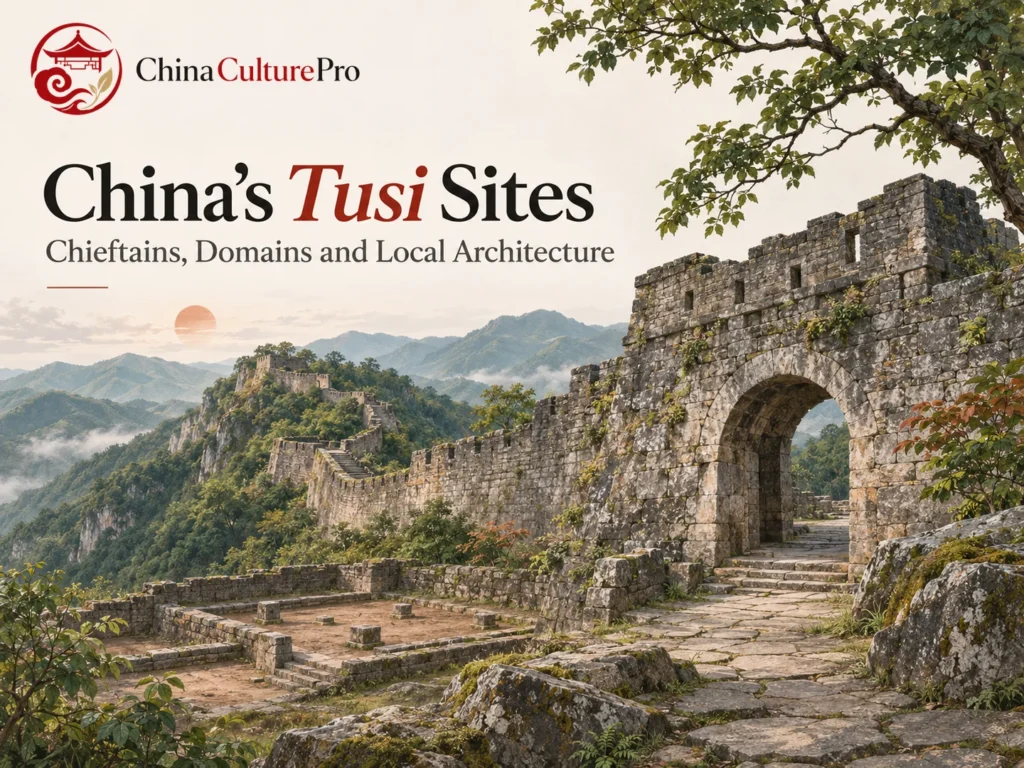

Quick Answer: What Are China’s Tusi Sites?
China’s Tusi Sites are three places that preserve the remains of domains governed by hereditary local chieftains known as tusi (土司, tǔsī). Central governments appointed these rulers. The institution linked local authority and customs with wider dynastic administration. UNESCO listed Laosicheng, Tangya and Hailongtun together in 2015. [1][2]
- Laosicheng, Hunan: Excavated remains and structures from the domain of a high-ranking tusi. [1][2]
- Tangya, Hubei: A memorial archway and remains of an administrative area, walls, drains and tombs from a lower-ranking domain. [2]
- Hailongtun, Guizhou: A mountain fortress that belonged to a high-ranking tusi domain. [1][2]
Three different kinds of evidence help show why the protected property includes several places.
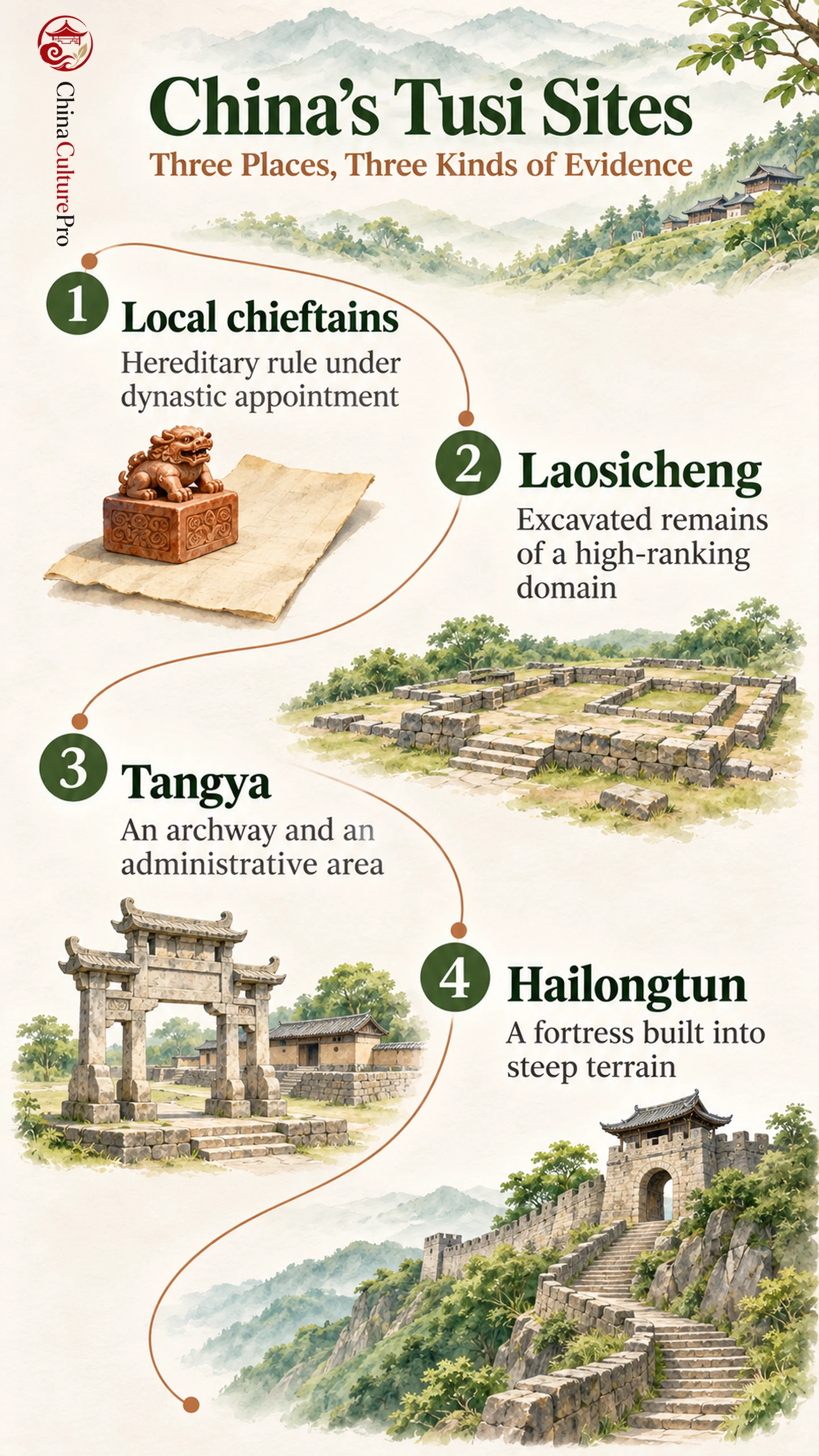
A stone archway can announce status. A wall on a steep slope can control access. A drain can reveal how a settlement laid out its ordinary functions. All three contribute to the record of how tusi ruled.
Laosicheng, Tangya and Hailongtun Compared
| Component | Kind of evidence | What it helps explain |
|---|---|---|
| Laosicheng | Extensive archaeological remains of a high-ranking domain. [2][3] | How a local seat of authority could accommodate administrative, settlement and family functions. [2][3] |
| Tangya | An archway and traces of administration, drainage, boundary walls and burials. [2] | What official status and a planned domain look like at a different level of rank. [2] |
| Hailongtun | A fortified hilltop site and standing remains. [2][3] | How steep terrain and controlled approaches supported defense. [3] |
UNESCO’s component maps show that the property comprises separate selected areas. The boundaries protect specific evidence within a much wider geography where tusi operated. [1][4]
What Hereditary Chieftaincy Meant in Practice
A tusi held local hereditary authority under appointment by a central dynasty. The arrangement linked local organization to a wider imperial administration. The arrangement recognized local leaders through titles and appointment, while families could continue to hold rights and duties across generations. UNESCO describes the form represented by these sites as rooted in Yuan and Ming periods. The wider institution lasted for centuries and should not be reduced to a single uniform local practice. [1][2][3]
The surviving structures belong to the history of regional communities and their relationships with dynastic authority. The Old Town of Lijiang offers a related reading of a southwestern settlement through a different set of evidence, particularly waterways, residential buildings and trade.
What the Buildings Reveal About Rank and Use
Compare Tangya’s arch with Hailongtun’s gates and walls. The arch preserves a public statement of status within a lower-ranking domain. A series of fortified approaches illustrates movement through a defensive landscape. Differences in form make sense when tied to use and setting, alongside evidence of rank. [2][3]
At Laosicheng, excavated foundations and spaces speak alongside standing remains. This makes archaeology important to reading Chinese architecture even when the original heights and roofs are missing. The three localities together make it possible to compare an ensemble, a lower-ranking domain and a fortress. [1][2][3]
FAQs About China’s Tusi Sites
Does tusi mean a single ethnic group?
It names a local office or title under an imperial institution. It does not identify one ethnicity. [1][2]
Are all three sites forts?
Hailongtun is the fortress component. Laosicheng and Tangya represent domains with surviving administrative, residential or burial evidence in addition to other remains. [1][2][3]
When did UNESCO list the sites?
The three components were inscribed together in 2015. The listing recognizes what they preserve about hereditary local government under dynastic appointment. [1][2]
Sources
[1] UNESCO World Heritage Centre. Tusi Sites
[2] World Heritage Committee. Inscription Decision for Tusi Sites
[3] ICOMOS. Tusi Sites Advisory Body Evaluation
[4] UNESCO World Heritage Centre. Tusi Sites Component Maps