
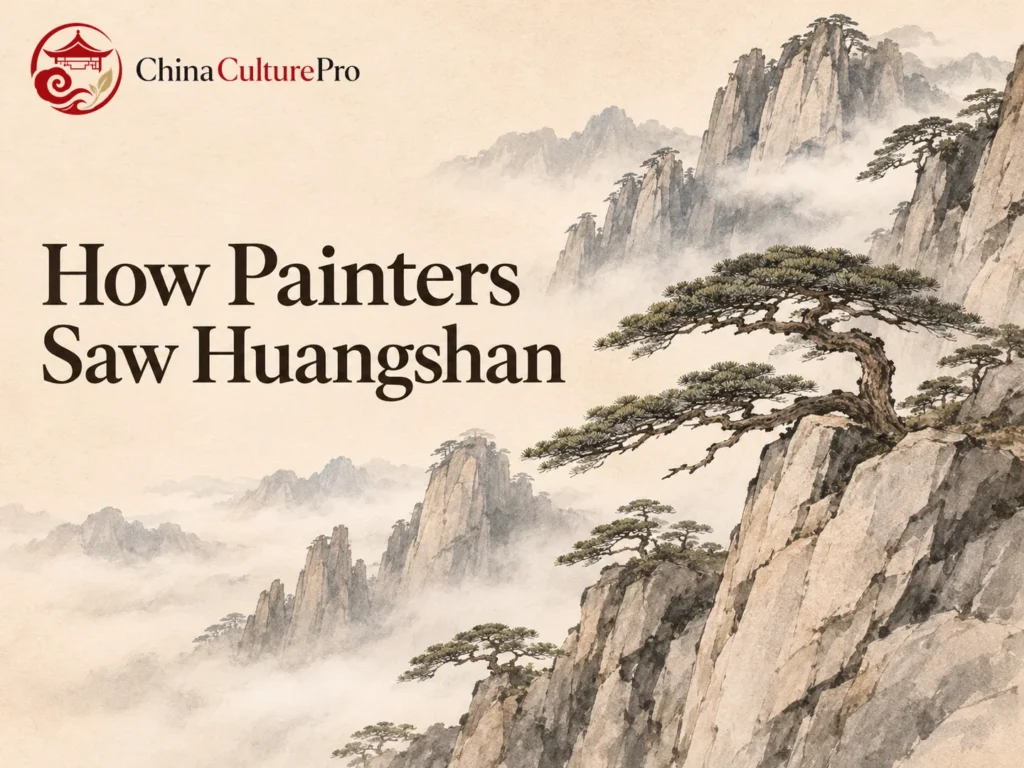

Quick Answer: What Is Huangshan in Chinese Landscape Painting?
Huangshan (黄山, Huángshān), or Mount Huang, became a subject for artists who saw its rock faces, peaks and pine trees as possibilities for ink painting. Hongren (弘仁, Hóngrén) organized named sights into album leaves. Shitao (石涛, Shítāo) also turned his memory of the range into a large hanging scroll.[1][2]
- Look for form: Angular rock outlines and concentrated ink can yield very different impressions of the same mountains.
- Read the format: An album breaks looking into separate views. A tall scroll composes one vertical experience.
- Check a title: A named site can orient a view even when the artist reshapes the scene.
A painting of Huangshan can preserve the identity of a place while transforming how the viewer sees it.
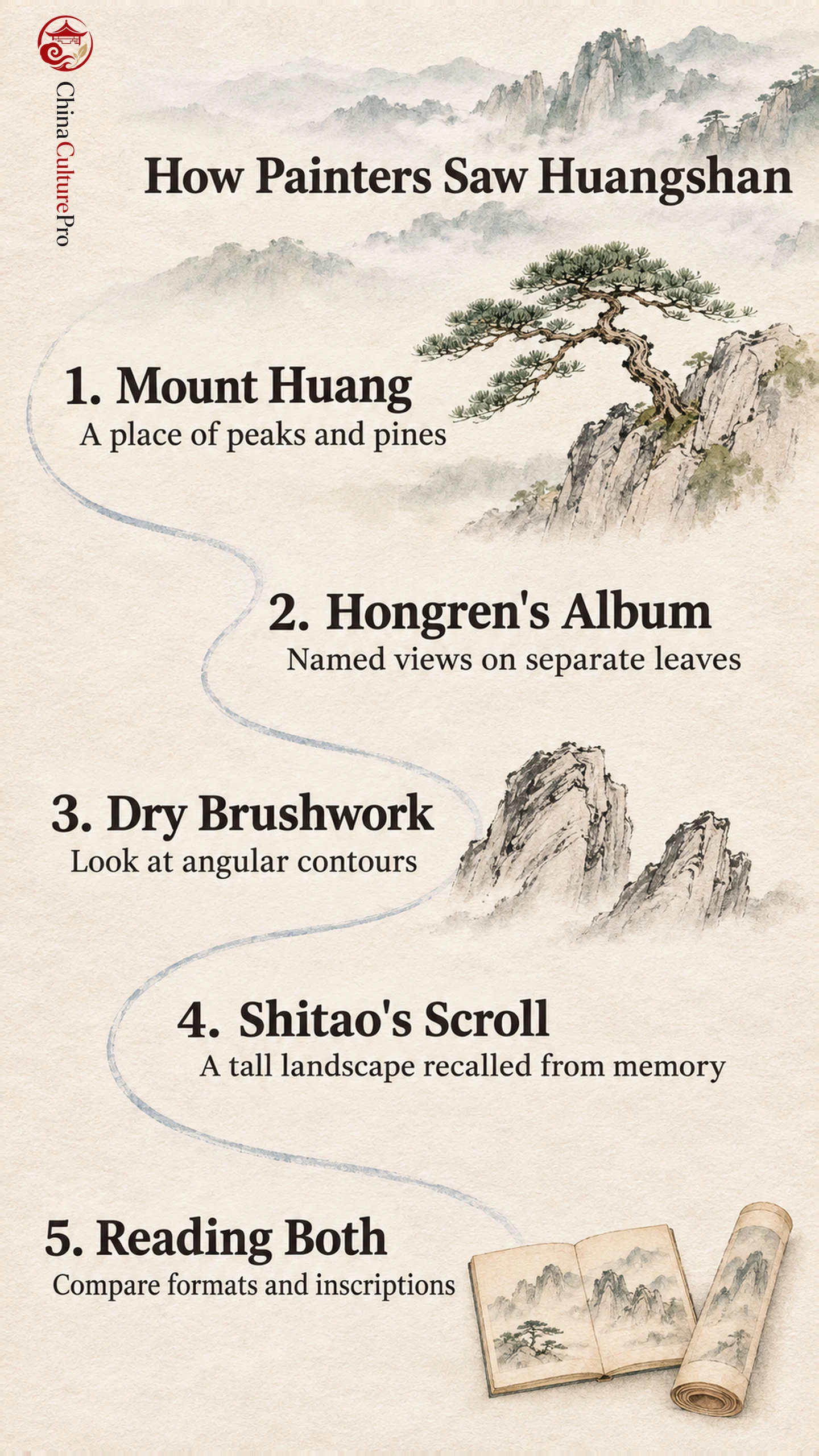
A pine gives scale to a cliff, while a stretch of bare paper lets a peak stand apart. The same landscape gives another painter the materials for a dense vertical sweep. Two objects make those choices visible.
Hongren and the Album of Named Sites
Hongren’s Mount Huang album in Beijing is catalogued in six groups of ten leaves. The views carry names such as Lotus Peak and Reclining Dragon Pine. The name invites you to identify the subject while the album isolates it from the rest of the range.[1]
The dry, angular handling that can be seen in Hongren’s The Sound of Spring in a Lonely Valley helps explain his place in Chinese painting. Look at the edges of a rock mass and at how much paper surrounds it. The relationship gives a cliff both weight and distance.[3]
Shitao and a Mountain Range Recollected
Shitao’s Thirty-six Peaks of Mount Huang Recollected, dated around 1705, is a hanging scroll in ink on paper. The artist used emphatic strokes and abundant ink dots to evoke the range from memory. As the eye moves upward, denser passages and lighter areas make the mountain seem to recede and rise again.[2]
An earlier work bears an inscription saying it was painted after his 1667 visit. Read alongside the later scroll, it shows how a visit and the act of recollecting it could inform different works.[2][4]
Place Names, Sacred Associations and Other Uses
The mountains drew painters and Buddhist monks, and both artists belonged to those worlds. Named peaks and sites in the catalogue give a way into the imagery, while brushwork and format tell you how a painter arranged that experience for the viewer.[1][3]
Huangshan also appears in the name of Huangshan Maofeng tea. The regional name connects the two subjects. A painting title directs you to an image and its artistic setting, while a tea name identifies a different product and tradition.
FAQs About Huangshan in Chinese Landscape Painting
Did Hongren and Shitao Paint Huangshan the Same Way?
Their individual works use different devices. Hongren’s album isolates named views, while Shitao’s later tall scroll brings the peaks together in a sustained composition.
Are All Works With Mount Huang in the Title the Same Object?
Check the artist, collection, format and date. An album with named views and a hanging scroll can both concern Mount Huang.
Sources
[1] Palace Museum. Hongren’s Mount Huang Album
[2] Metropolitan Museum of Art. Shitao, Thirty-six Peaks of Mount Huang Recollected
[3] Metropolitan Museum of Art. Hongren, The Sound of Spring in a Lonely Valley
[4] Palace Museum. Research on Shitao’s Landscapes of Mount Huang