

Quick Answer: What Are the Mogao Caves?
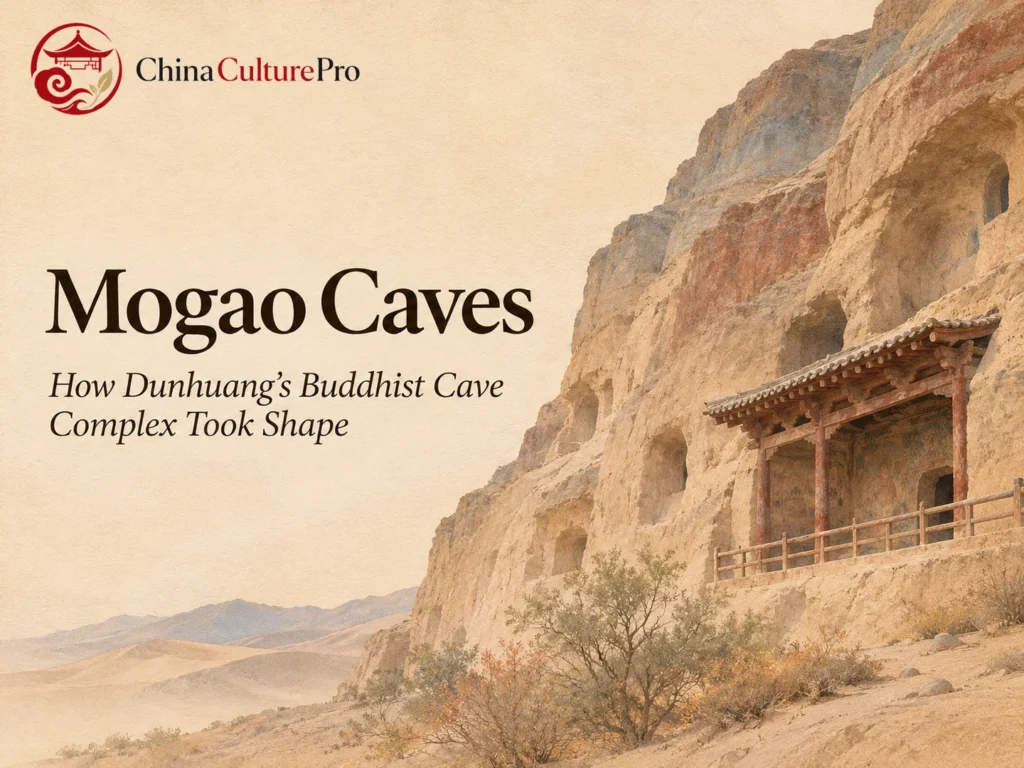
The Mogao Caves (莫高窟, Mògāo Kū) are Buddhist cave temples carved into cliffs southeast of Dunhuang in Gansu. The first excavation is traditionally dated to 366 CE. For centuries, patrons commissioned or renewed chambers with painted walls and sculpture. Cave 17 later became known for the manuscripts found inside it. [1][2][3]
- A long building history: Caves preserve different periods of carving, painting and use. [1][4][5]
- Patrons left evidence: Inscriptions and portraits help identify some commissions and later additions. [4][5][6]
- Two cave counts: The site has 735 surviving caves, 492 with murals and painted sculptures. [1][2]
UNESCO inscribed the Mogao Caves in 1987. [1]
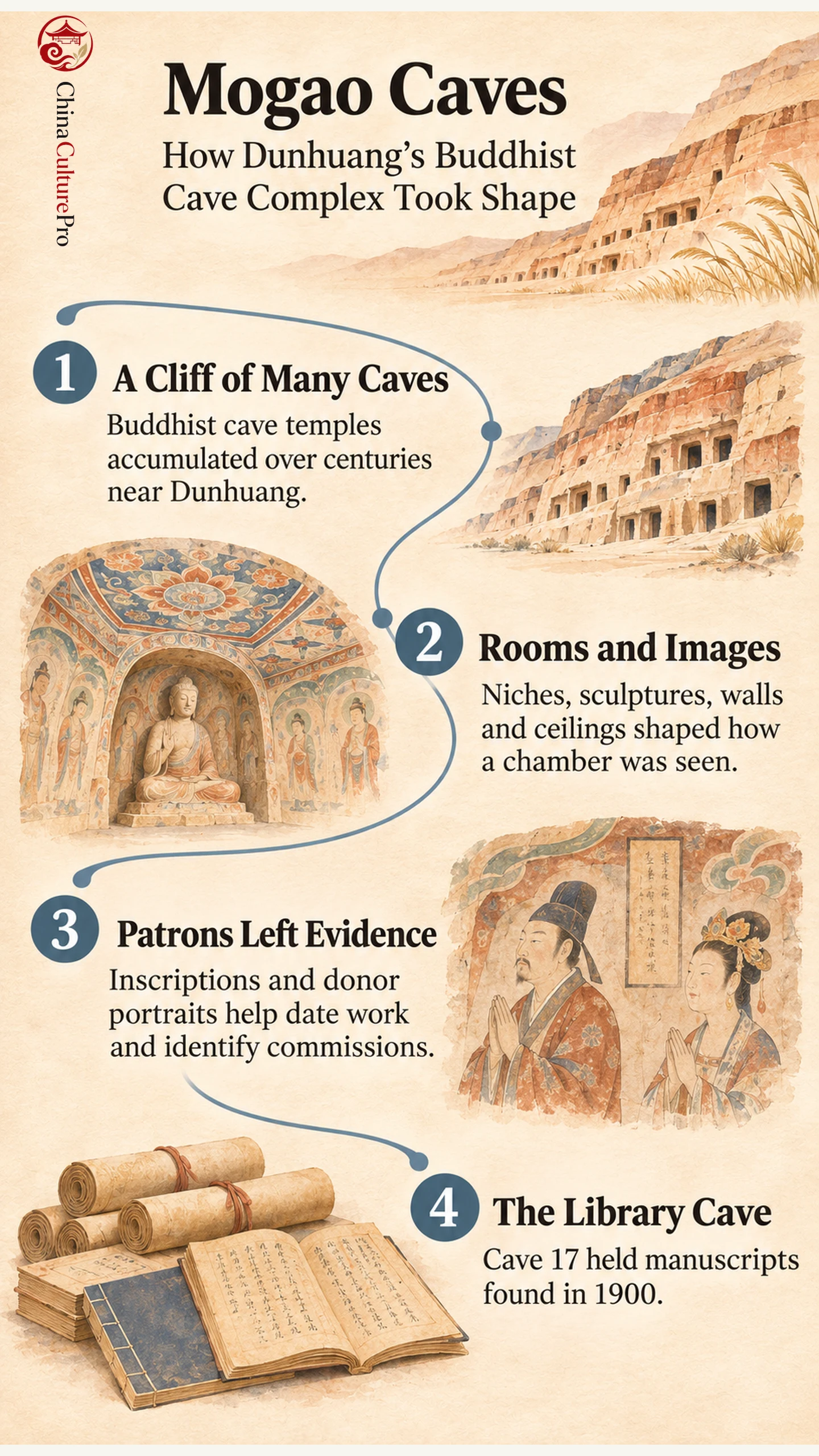
From the opposite bank of the river, the cliff openings can look like parts of a single building. Inside, every chamber has its own arrangement of walls, niches, ceiling and images. Dates, changes to rooms and donor inscriptions help researchers identify different building projects. [1][4][5][6]
How Buddhist Caves Accumulated in the Cliff
Dunhuang was an oasis where travel, trade and Buddhist practice met. The early date of 366 CE belongs to the site’s founding account. Later excavations created a long sequence of different caves. A person entering one chamber might turn from an approach passage toward a sculptural niche, with pictures spread across the surrounding walls and ceiling. The way those surfaces are arranged is part of the design. [1][4][5]
Cave 285 offers a precise example. Its north wall carries dated inscriptions from 538 and 539, in the Western Wei. The Dunhuang Academy records a central room with smaller spaces opening from the sides. The dated wall and the room arrangement let you place this particular cave in time. The structure of another cave can differ even when it uses similar Buddhist imagery. [4]
The rock and paint are different layers of the building. The Getty Conservation Institute describes the cliff as soft conglomerate. Artists worked on a prepared surface over earthen plaster rather than painting directly onto the rough rock. That construction choice helps explain both how a cave wall could carry a large picture and why the bond between the plaster and cliff matters to conservators. [8]
What Cave Details Tell Us About Patrons
Cave 220 preserves an inscription dated 642 on the east wall, above the doorway. The Dunhuang Academy also records later works and donor portraits in the passage associated with the Zhai family. Recognizing the date of a detail matters: the creation of a room and the addition or repainting of its approach could occur in different periods. [5]
Cave 61 represents a later stage of building and support. It preserves portraits and inscriptions of women from the Cao family. Its west wall has a painted view of the Mount Wutai pilgrimage landscape. A donor image, an inscription and a sacred landscape serve different functions in the same chamber. They can connect a cave to local families and to Buddhist places far beyond Dunhuang. [6]
Cave 85 shows several periods in one room sequence. The original late Tang complex included an approach and a large chamber with painted walls and sculptures. Later work added images in the passage, renewed the antechamber and altered the sculptural group. Conservators study these changes as part of the cave’s history. [8]
To read the decoration, note where a painting is placed before isolating a figure or motif. Paintings above a doorway, around a niche and across a large wall face a visitor in different ways. The guide to Dunhuang murals covers motifs and materials in greater detail. [4][5][6]
Why Cave 17 Matters in a Different Way
The Library Cave (藏经洞, Cángjīng Dòng), or Cave 17, is a small chamber off the passage of Cave 16. In 1900, Wang Yuanlu found the sealed space and its stored materials. The discovery brought thousands of manuscripts and other objects to scholarly attention. Researchers continue to debate why the chamber was sealed. [3]
The manuscripts give a kind of evidence beyond what is painted on the walls. The surviving texts include religious material and records that shed light on ordinary life. Many items were dispersed to institutions, and catalogues now allow work with records held in different places. Read Dunhuang manuscripts for the documents and the guide to Digital Dunhuang for ways to study the caves and their collections. [3][7]
FAQs About the Mogao Caves
Are the Mogao Caves in Dunhuang?
They are in cliffs southeast of the Dunhuang oasis in Gansu, China. [1]
Why are there two different cave counts?
The broader site count is 735 surviving caves. A narrower count of 492 describes caves with murals and painted sculptures. [1][2]
Do all caves date to 366 CE?
That date refers to the founding tradition. Inscriptions and other evidence date different caves and changes to them across later centuries. [1][4][5]
Sources
[1] UNESCO World Heritage Centre. Mogao Caves
[2] State Council Information Office English portal. Outsmarting climate change with high-tech at Mogao Grottoes
[3] International Dunhuang Programme, British Library. Cave 17: Discovering the Library Cave
[4] Dunhuang Academy. Digital Dunhuang: Mogao Cave 285
[5] Dunhuang Academy. Digital Dunhuang: Mogao Cave 220
[6] Dunhuang Academy. Digital Dunhuang: Mogao Cave 61
[7] International Dunhuang Programme, British Library. History of the International Dunhuang Programme
[8] Getty Conservation Institute. Conservation of wall paintings at the Mogao Grottoes