

Quick Answer
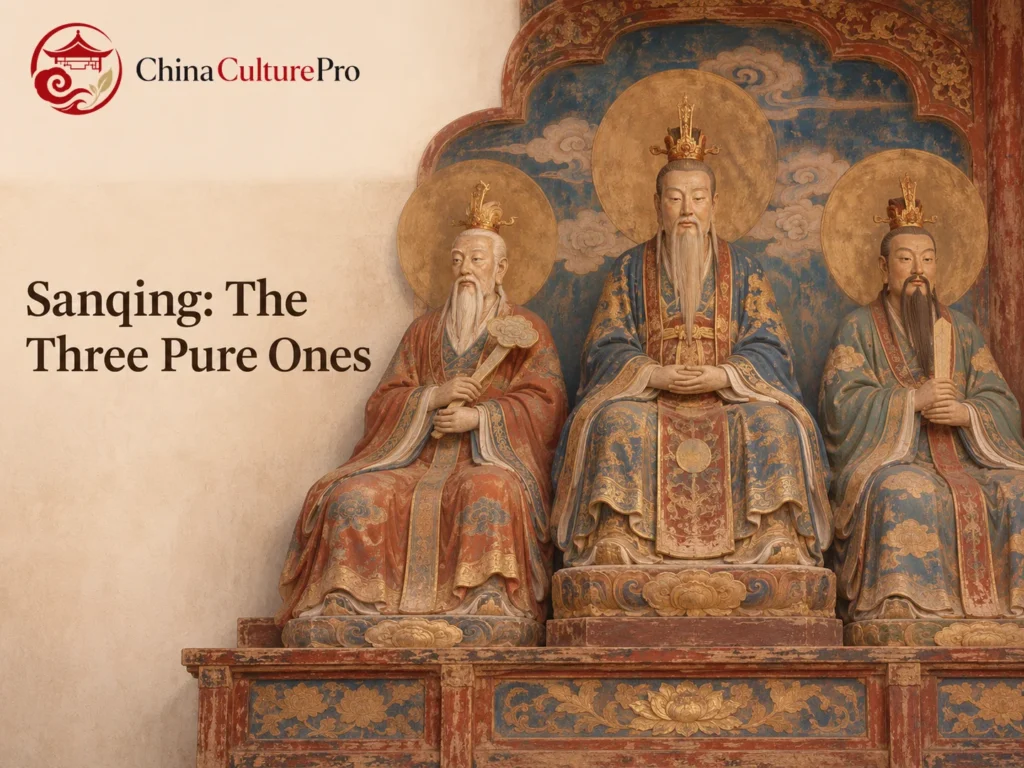
The Three Pure Ones (三清, Sānqīng) are the highest triad in an influential account of the Daoist pantheon. The group consists of Yuanshi Tianzun (元始天尊, Yuánshǐ Tiānzūn), Lingbao Tianzun (灵宝天尊, Língbǎo Tiānzūn) and Daode Tianzun (道德天尊, Dàodé Tiānzūn), the deified Laozi (老子, Lǎozǐ). The name Sanqing can also refer to the three heavens associated with them.[1][2]
- Yuanshi Tianzun: The Celestial Venerable of the Original Commencement is associated with Jade Purity (玉清, Yùqīng).[1][2]
- Lingbao Tianzun: The Celestial Venerable of the Numinous Treasure is associated with Highest Purity (上清, Shàngqīng).[1][2]
- Daode Tianzun: The Celestial Venerable of the Dao and Its Virtue is associated with Great Purity (太清, Tàiqīng).[1][2]
The same term can name a heavenly realm or, in another context, a body of texts. Read the surrounding title or object label before assuming that a name such as Highest Purity refers to an individual deity.[1][2]
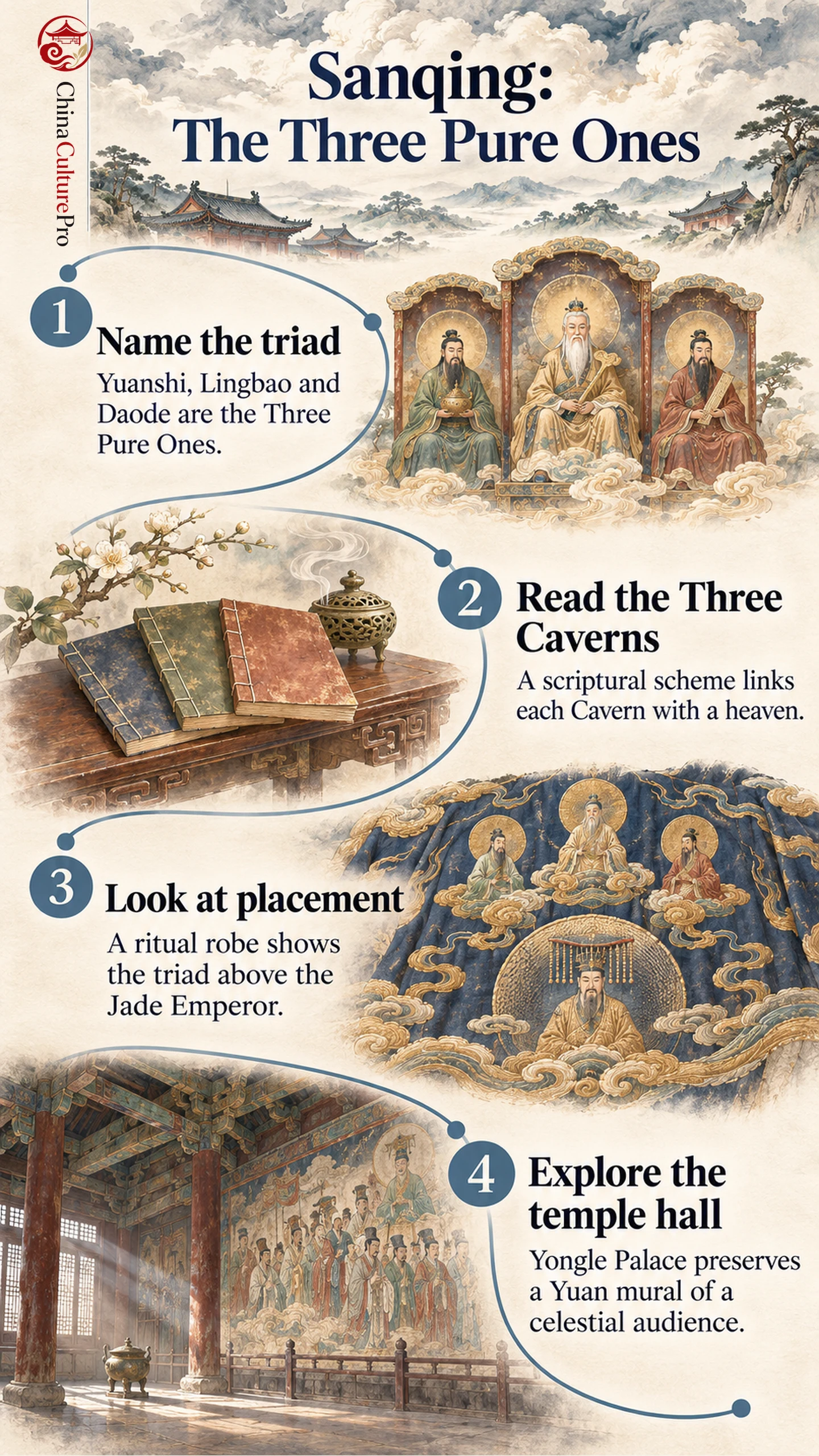
A tenth-century stele puts the Three Pure Ones beside scriptures. On a ritual robe, they appear above the Jade Emperor (玉皇大帝, Yùhuáng Dàdì). One object brings gods and texts together. The other shows where the triad sits in relation to a familiar ruler of heaven.[3][4]
Why Three Deities Are Linked to Three Heavens
The Chinese Taoist Association gives the conventional pairing of the three gods with Jade Purity, Highest Purity and Great Purity. It interprets the triad in relation to the Daoist idea that underlying unity can take several forms. The three figures are therefore linked to a cosmology even when they appear in recognizable human form on an altar or in a carving.[2]
The Three Caverns (三洞, Sāndòng) offer another way into the material. In this classification, three bodies of scripture were arranged in a hierarchy, with each Cavern corresponding to a heaven and a presiding deity. The scriptural classification also became a model for ranks of ordination. Pregadio names the three textual bodies as Shangqing, Lingbao (灵宝, Língbǎo) and the Three Sovereigns (三皇, Sānhuáng). The system pairs these textual bodies with heavens and deities without giving every part of the scheme the same name.[1]
Where the Three Pure Ones Appear in Daoist Art
A twentieth-century rubbing in the Smithsonian’s National Museum of Asian Art preserves an inscription dated 980. The original stele placed the Three Pure Ones with three Daoist scriptures. The museum notes that texts could be honored with incense as objects of devotion. On the stele, the carved figures and the words share a devotional setting.[3]
The Metropolitan Museum of Art identifies the Three Pure Ones at the top center of the back of a Ming or Qing ritual robe, flanked by the sun and moon. The Jade Emperor is a large figure lower down at the center. Size alone could draw a viewer’s attention to the emperor. To recognize the triad, look at placement and the relationship among the three figures, alongside the museum’s identification.[4]
What a Hall of the Three Pure Ones Shows
The Chinese Taoist Association describes the Hall of the Three Pure Ones (三清殿, Sānqīng Diàn) as a place where the three figures are commonly enshrined together. At Yongle Palace (永乐宫, Yǒnglè Gōng) in Ruicheng, Shanxi, the hall also contains a Yuan dynasty mural of a celestial audience. The provincial description identifies the host of deities on the walls as paying homage to Yuanshi Tianzun.[2][5]
The mural uses the scale of a court assembly, while the robe fits a celestial arrangement onto a garment worn in ritual. Both help explain why the triad is part of a larger pantheon and why spatial order matters in <a href=”https://www.chinaculturepro.com/religious-daoism/”>Daoist temples and worship</a>.[4][5]
FAQs About the Three Pure Ones
Which of the Three Pure Ones is Laozi?
Daode Tianzun is the deified Laozi. He is also known as Lord Lao (太上老君, Tàishàng Lǎojūn), a title commonly translated as the Most High Lord Lao.[1][2]
Is the Jade Emperor one of the Three Pure Ones?
The Jade Emperor is a separate deity. The Met’s ritual robe depicts him at center back and the Three Pure Ones in a group above him.[1][4]
Does Sanqing mean the Three Pure Ones or the Three Purities?
Both are used in English. Three Pure Ones points to the three deities, while Three Purities or Three Clarities can also refer to the heavens associated with them.[1][2]
Sources
[1] Fabrizio Pregadio. Religious Daoism, Stanford Encyclopedia of Philosophy
[2] Chinese Taoist Association. The Three Pure Ones
[3] Smithsonian National Museum of Asian Art. Stele with Daoist Triad and Three Daoist Scriptures
[4] Metropolitan Museum of Art. Daoist priest’s ritual robe with deities of the pantheon
[5] Shanxi Provincial Government. The murals of Yongle Palace