

Quick Answer
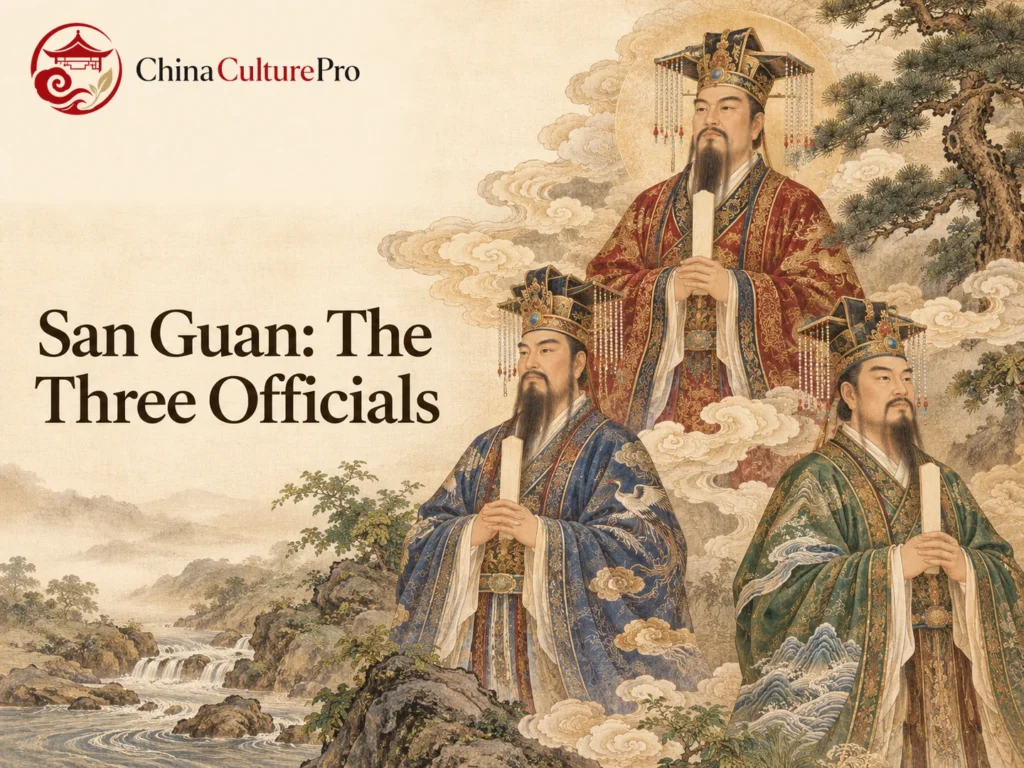
The Three Officials (三官, Sānguān) are Daoist deities responsible for Heaven, Earth and Water. Popular accounts describe the Official of Heaven (天官, Tiānguān) as granting blessings, the Official of Earth (地官, Dìguān) as pardoning faults, and the Official of Water (水官, Shuǐguān) as relieving misfortune. Early petitions, painted inspection tours and local temple calendars show how people understood those responsibilities.[1][2][3]
- The petitions: An early account describes written appeals sent to each official by a different route.[2]
- The images: In one silk painting, clouds, rocky land and waves indicate each official’s realm.[1]
- The dates: The Three Primes (三元, Sānyuán) link the officials with observances in the first, seventh and tenth lunar months.[3][4]
The standard lunar associations provide a way to read titles and calendars. Temples may hold different ceremonies, with their own dates and groups of organizers.[3][4]
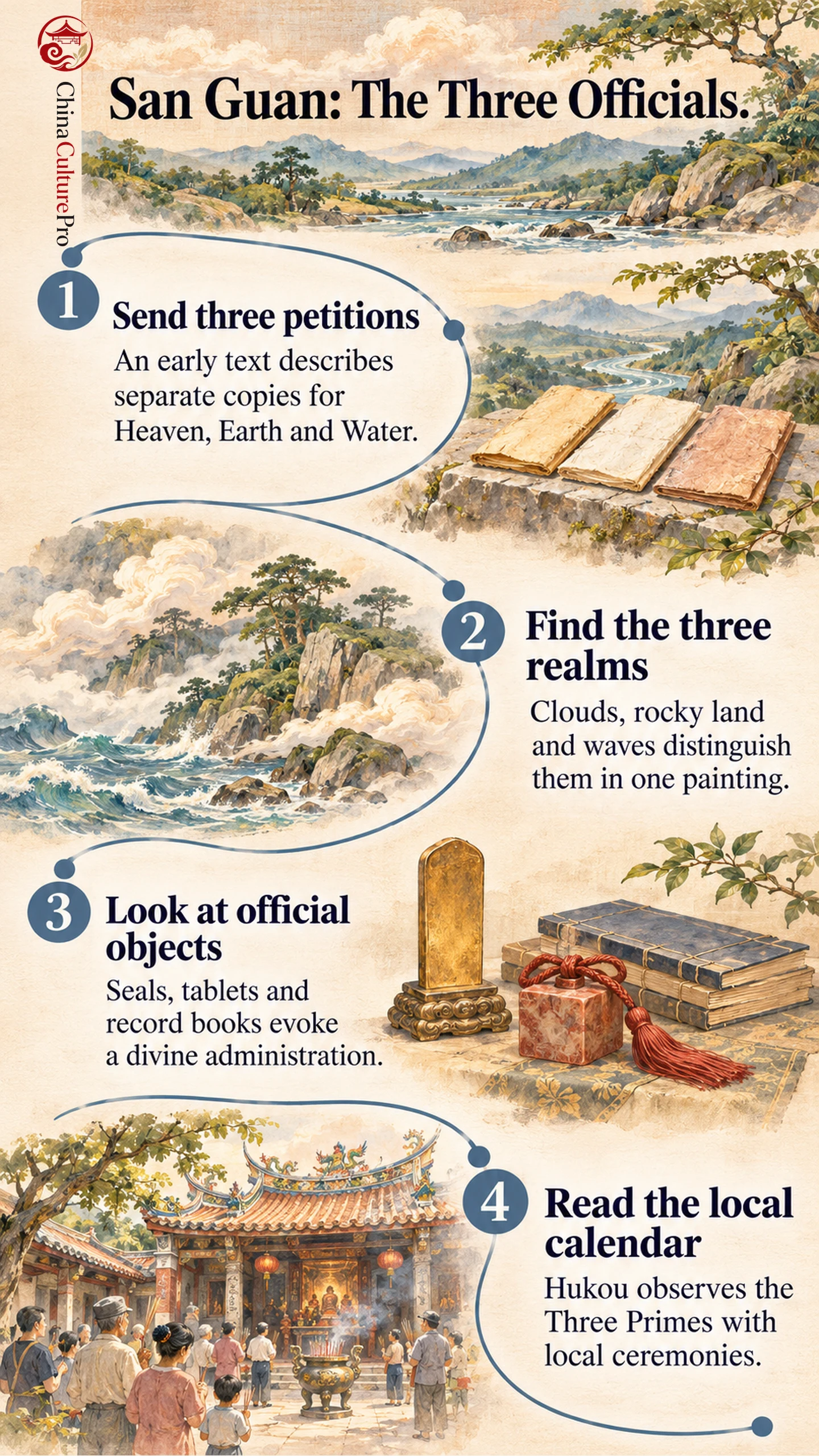
An old account sends a document into the water. A later painting gives the Water Official assistants carrying record books. Both make the idea of a divine administration concrete, though one describes a petition and the other shows the officials as they were imagined on an inspection tour.[1][2]
How People Addressed the Three Officials
One early account survives in a commentary to the Records of the Three Kingdoms (三国志, Sānguó Zhì), which quotes the lost historical text Dianlüe (典略, Diǎnlüè). It describes a written confession made in copies for three divine offices. One copy was placed on a mountain, another buried and the third put into water. The destinations corresponded to Heaven, Earth and Water.[2]
The route matched the recipient’s realm. Even before the petition was read, its destination identified the official being asked to act. Historian Ursula-Angelika Cedzich places those writings alongside other petitions from early Daoist sources. That context helps explain why a person struggling with misfortune might appeal to the officials through a written statement. The practice belongs to a history of ritual petitioning within <a href=”https://www.chinaculturepro.com/religious-daoism/”>religious Daoism</a>.[2]
How to Read a Painting of the Three Officials
The National Palace Museum’s Three Taoist Officials Making an Inspection Tour depicts the three within a single landscape. Clouds mark Heaven, trees and boulders mark Earth, and waves mark Water. The museum points out the Heaven Official’s carriage drawn by a mythical qilin (麒麟, qílín), the Earth Official’s lion and the Water Official’s dragon. Those mounts help distinguish processions within an unusually crowded composition.[1]
Look also at what the attendants carry. The museum identifies a wrapped seal and a court tablet (笏, hù) in the entourage of the Official of Heaven, and record books among the assistants of the Official of Water. The objects give the tour some of the equipment of earthly administration. A later woodblock print in Taiwan’s National Museum of History instead shows all three in robes and crowns, each holding a tablet. In that print, the central figure is the Official of Heaven. His position helps distinguish him from the other two when the robes and tablets look similar.[1][3]
How the Three Primes Shape Temple Calendars
The Taiwanese museum’s woodblock catalog associates the Official of Heaven with the Upper Prime (上元, Shàngyuán) on the fifteenth of the first lunar month, the Official of Earth with the Middle Prime (中元, Zhōngyuán) on the fifteenth of the seventh, and the Official of Water with the Lower Prime (下元, Xiàyuán) on the fifteenth of the tenth.[3]
At Sanyuan Temple in Hukou (湖口三元宫, Húkǒu Sānyuán Gōng), Hsinchu, the central niche belongs to the Official of Heaven, with Earth and Water in the side niches. Taiwan’s religious heritage record describes a blessing rite at the Upper Prime and a thanksgiving for well-being at the Lower Prime. It also records a local Middle Prime observance on the first day of the eighth lunar month at a related shrine, showing how a community’s arrangements can differ from the standard associations.[4]
FAQs About San Guan
Are the Three Officials the same as the Three Pure Ones?
They are distinct Daoist groupings. The Three Officials govern Heaven, Earth and Water. The Three Pure Ones (三清, Sānqīng) are a separate triad at the head of the Daoist pantheon.[1][5]
Why do the officials look like civil officials?
Their ceremonial robes, seals and tablets express authority. The inspection painting uses those objects to show the deities and their attendants carrying out official duties in their respective realms.[1]
Why do some temples use the name Sanyuan?
Sanyuan refers to the Three Primes, the observances associated with the three deities. At Hukou, Sanyuan names the temple that enshrines them.[3][4]
Sources
[1] National Palace Museum. The Three Taoist Officials Making an Inspection Tour
[2] Ursula-Angelika Cedzich. The Organon of the Twelve Hundred Officials and Its Gods
[3] National Museum of History. Woodblock print of the Three Officials
[4] Taiwan Ministry of the Interior. Hukou Sanyuan Temple
[5] Fabrizio Pregadio. Religious Daoism, Stanford Encyclopedia of Philosophy