

Quick Answer
Lingbao Tianzun (靈寶天尊, Língbǎo Tiānzūn), the Celestial Worthy of Numinous Treasure, is one of the Three Pure Ones (三清, Sānqīng). He is associated with Upper Purity (上清, Shàngqīng) and with revealing sacred teachings. A scepter, a lotus, and a court tablet appear in different images.[1][2][3][4]
- Place in the triad: The three deities are distinguished by titles and heavens.
- Role in texts: He is associated with the transmission of scriptures.
- Images: The object in his hands varies between prints, paintings, and sculpture.
The title belongs to a deity and shares the words “Numinous Treasure” with a scriptural tradition.[1][5]
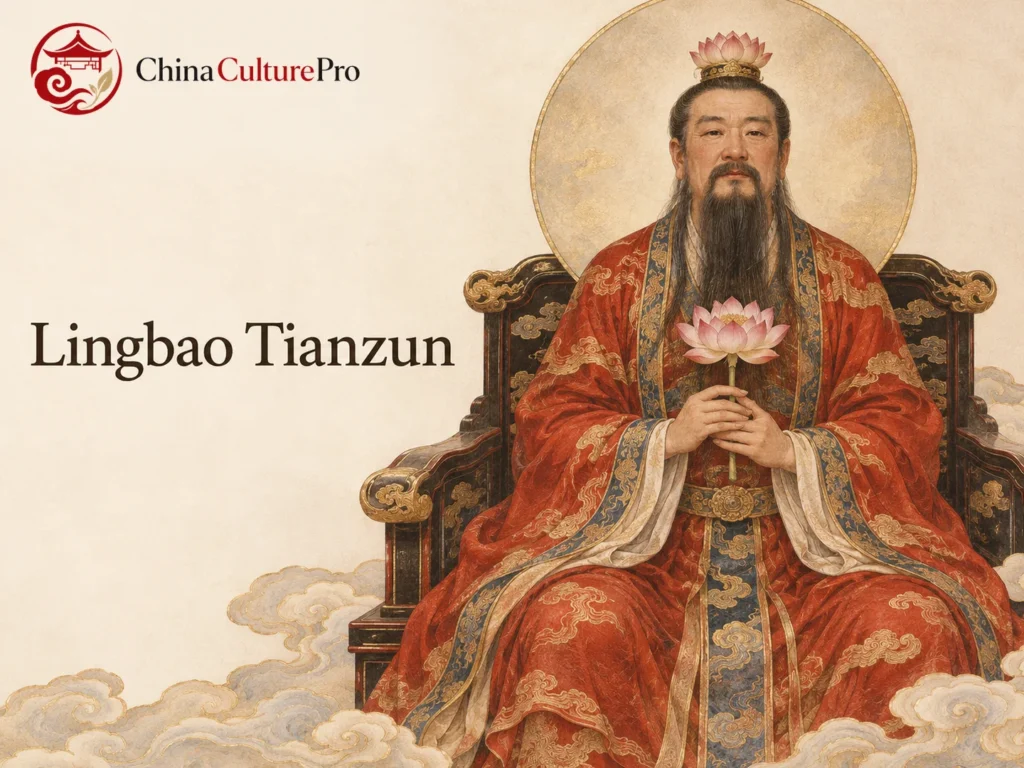
A Qing hanging scroll in Taiwan shows Lingbao Tianzun with a black beard and a red robe, seated on a throne. He holds a lotus. In another image, a woodblock print of the three deities, a scepter identifies him instead.[2][3]
Where Lingbao Tianzun Fits in the Triad
Early Tang Daoist encyclopedias describe a triad of celestial worthies and their heavens. Lingbao belongs to Upper Purity. Yuanshi Tianzun (元始天尊, Yuánshǐ Tiānzūn) belongs to Jade Purity, and Daode Tianzun (道德天尊, Dàodé Tiānzūn) to Great Purity. The heavens and titles help tell the three figures apart.[1]
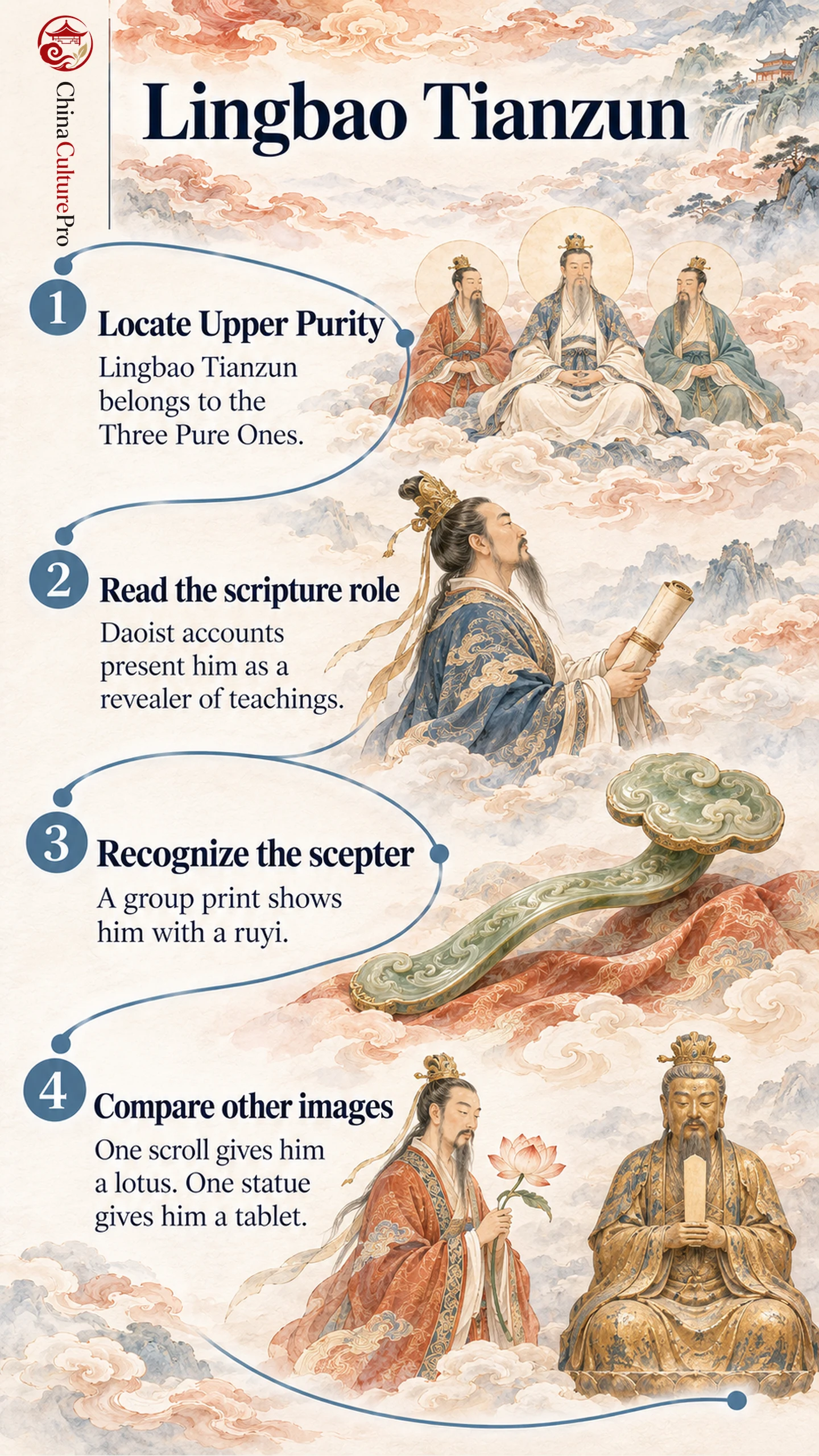
In a late Qing or early Republican devotional print, Yuanshi sits at the center. On the viewer’s right, Lingbao holds a ruyi scepter (如意, rúyì), while Daode holds a fan on the viewer’s left. The order here describes this print. The companions and objects together make the identification possible.[3]
Why the Deity Is Associated with Scriptures
In religious accounts, Lingbao Tianzun transmits teachings or makes scriptures available to others. One account describes him as receiving the task of revealing sacred teachings from Yuanshi. In that account, the distinction is between proclaiming the teaching and passing it on.[1][6]
The name also appears in the Lingbao body of writings, which circulated around 400 CE and became important to communal ritual and the organization of the Daoist canon. When the term appears in a catalogue of scriptures it can refer to the textual collection. The full divine title identifies the member of the triad. The overview of religious Daoism gives the wider context.[1][5]
How to Recognize Him When the Attribute Changes
The Qing scroll is 186.2 centimeters high. Its painter used mineral colors and shows Lingbao in a vermilion robe holding a lotus with both hands. A circular halo and clouds frame the seated figure. The floral attribute is clearly different from the print’s scepter.[2][3]
A gold-painted wooden image in Taiwan’s National Museum of History holds a court tablet with both hands and sits on a lotus base. The 2010 date in the record marks its transfer to the museum. The tablet identifies the action in the sculpture, while the object’s catalogue establishes which deity it shows.[4]
FAQs About Lingbao Tianzun
What does Lingbao Tianzun mean?
It means “Celestial Worthy of Numinous Treasure.” The title names one of the Three Pure Ones.[1]
Does Lingbao Tianzun always hold a ruyi?
The ruyi is a familiar clue. The examples here include a lotus in a hanging scroll and a tablet in a gold-painted image.[2][3][4]
Is Lingbao Tianzun the same as the deified Laozi?
Lingbao Tianzun and Daode Tianzun are different members of the triad. Daode Tianzun is the figure identified with the deified Laozi.[1]
Sources
[1] Religions. Daoist Cosmogony in the Kojiki Preface
[2] National Museum of Taiwan History. Lingbao Tianzun hanging scroll, 2003.001.1009
[3] National Museum of History, Taiwan. Print of the Three Pure Ones, 07395
[4] National Museum of History, Taiwan. Wooden Lingbao Tianzun figure, 99-00025
[5] Stephen Bokenkamp, The Encyclopedia of Taoism. Lingbao, Numinous Treasure
[6] Kenyon College. The Three Purities, Daoist painting notes