
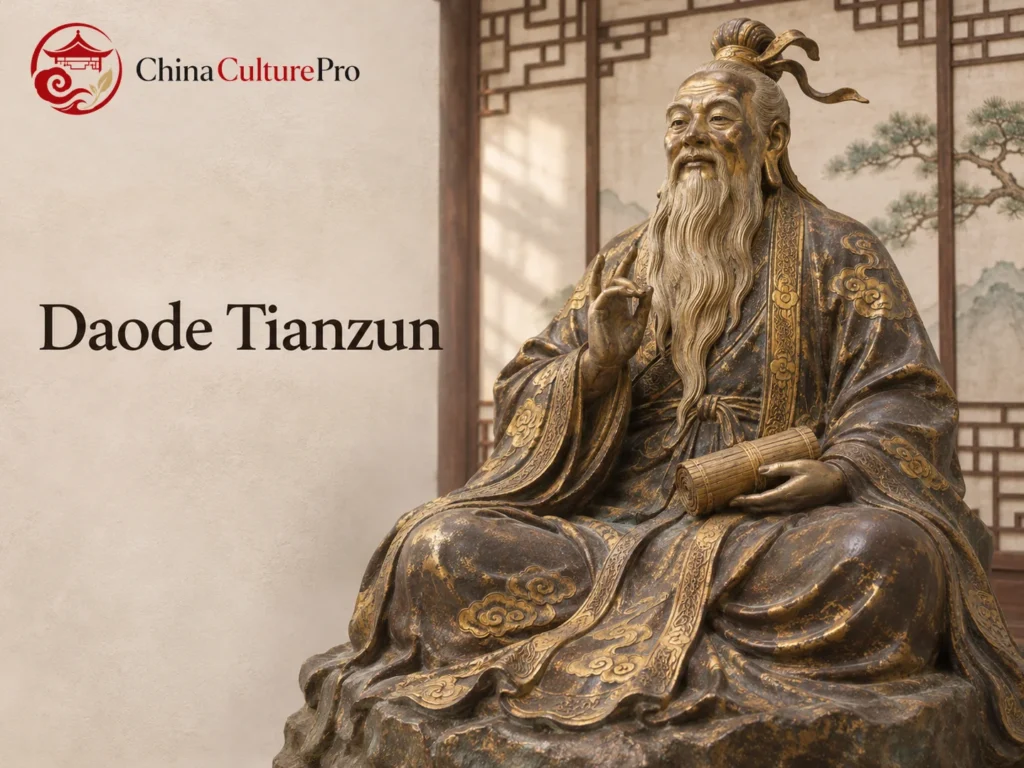

Quick Answer
Daode Tianzun (道德天尊, Dàodé Tiānzūn), the Heavenly Worthy of the Way and Its Power, is Laozi (老子, Lǎozǐ) understood as a Daoist deity. He is also known as Taishang Laojun (太上老君, Tàishàng Lǎojūn), the Most High Lord Lao, and belongs to the Three Pure Ones (三清, Sānqīng).[1][2]
- Divine title: Daode Tianzun identifies Lord Lao as a member of the Daoist triad.
- Revelation: Celestial Master tradition portrays Lord Lao transmitting a covenant to Zhang Daoling.
- Images: A ceramic figure and a Ming bronze show different ways of identifying him.
Texts establish what Daoists taught about Lord Lao. The objects show how particular artists and patrons represented him.[1][2][3]

A gilded sculpture dated 1438 has an inscription on the underside of its robe. It records a commission for an official’s mother. The sculpture presents a bearded Laozi, while the hidden inscription connects the image to a particular family.[3]
How Lord Lao Fits Among the Three Pure Ones
The triad places Daode Tianzun in Great Purity (太清, Tàiqīng), one of three heavens named in accounts of the triad. Yuanshi Tianzun (元始天尊, Yuánshǐ Tiānzūn) is associated with Jade Purity, and Lingbao Tianzun (靈寶天尊, Língbǎo Tiānzūn) with Upper Purity. In this setting, the three titles distinguish the figures and their places in the religious cosmos.[1][4]
A Six Dynasties scripture gives Lord Lao a role at the opening of heaven and later portrays him manifesting in human form to transmit teachings. This account helps explain why a deity of the Daoist heavens can also be depicted as a human sage. The story places the act of teaching within an account of creation.[1]
Why Lord Lao Appears as a Revealer
The Daodejing (道德經, Dàodéjīng) is traditionally attributed to Laozi, whose historical identity is uncertain. In the story of his westward journey, a guard asks the departing sage to put his teachings in writing. The ox and the frontier pass are useful clues to that story in art. The guide to Dao and de explains the two terms in the title.[5]
In the founding account of the Celestial Masters, Lord Lao appears to Zhang Daoling in 142 CE, the traditional date. He grants a covenant and gives Zhang the title Celestial Master. In this founding account, the covenant authorizes Zhang to establish a community that follows Daoist principles. For that setting, see religious Daoism.[2]
How Images Identify Daode Tianzun
A ceramic figure held by the Asian Civilisations Museum is identified as Daode Tianzun by a fan with a fly-whisk. An image in a group also offers another clue: the companions can establish that the figure belongs to the Three Pure Ones. An object’s attributes and its place in a set are stronger evidence together.[4]
The 1438 image by Chen Yanqing is catalogued as Laozi and shows a full beard. The robe inscription records that an official in a northwestern frontier city ordered it for his mother in Nanjing. This tells us who commissioned the image and for whom, details that its pose and costume alone could never supply.[3]
FAQs About Daode Tianzun
Is Daode Tianzun another name for Taishang Laojun?
Yes. Both titles refer to the deified Laozi in the accounts discussed here. Daode Tianzun is especially useful for identifying his place among the Three Pure Ones.[1][4]
Where does Daode Tianzun reside in the Daoist triad?
His heaven is Great Purity. The other two figures in the triad are associated with Jade Purity and Upper Purity.[1]
What does an image of Laozi on an ox show?
The ox commonly accompanies the story of the sage traveling west. The story gives the ox a narrative role, alongside details such as a pass, a guard, or a written text.[4][5]
Sources
[1] Religions. Daoist Cosmogony in the Kojiki Preface
[2] Fabrizio Pregadio, Stanford Encyclopedia of Philosophy. Religious Daoism
[3] Metropolitan Museum of Art. Chen Yanqing, Daoist immortal Laozi, 1438
[4] Asian Civilisations Museum. Figure of Daode Tianzun
[5] Metropolitan Museum of Art. Daoism and Daoist Art