


Quick Answer: How Does Tang Yin Turn a Snow Scene into a Journey?
Clearing after Snow at the Han Pass (函关雪霁图, Hán Guān Xuě Jì Tú), by Tang Yin (唐寅, Táng Yín), places freight animals and travelers beneath towering, snow-covered cliffs. The small procession gives the landscape a practical human scale.
- Collection: National Palace Museum, Taipei; identifier 故畫000470.
- Medium and size: Ink and light color on silk, 69.9 × 37.3 cm.
- Look first: Compare pale snow surfaces with darker rock edges and trees.
- Then look low: Find the animals moving along the foreground route.
Compare a small freight animal with the towering cliff above it.
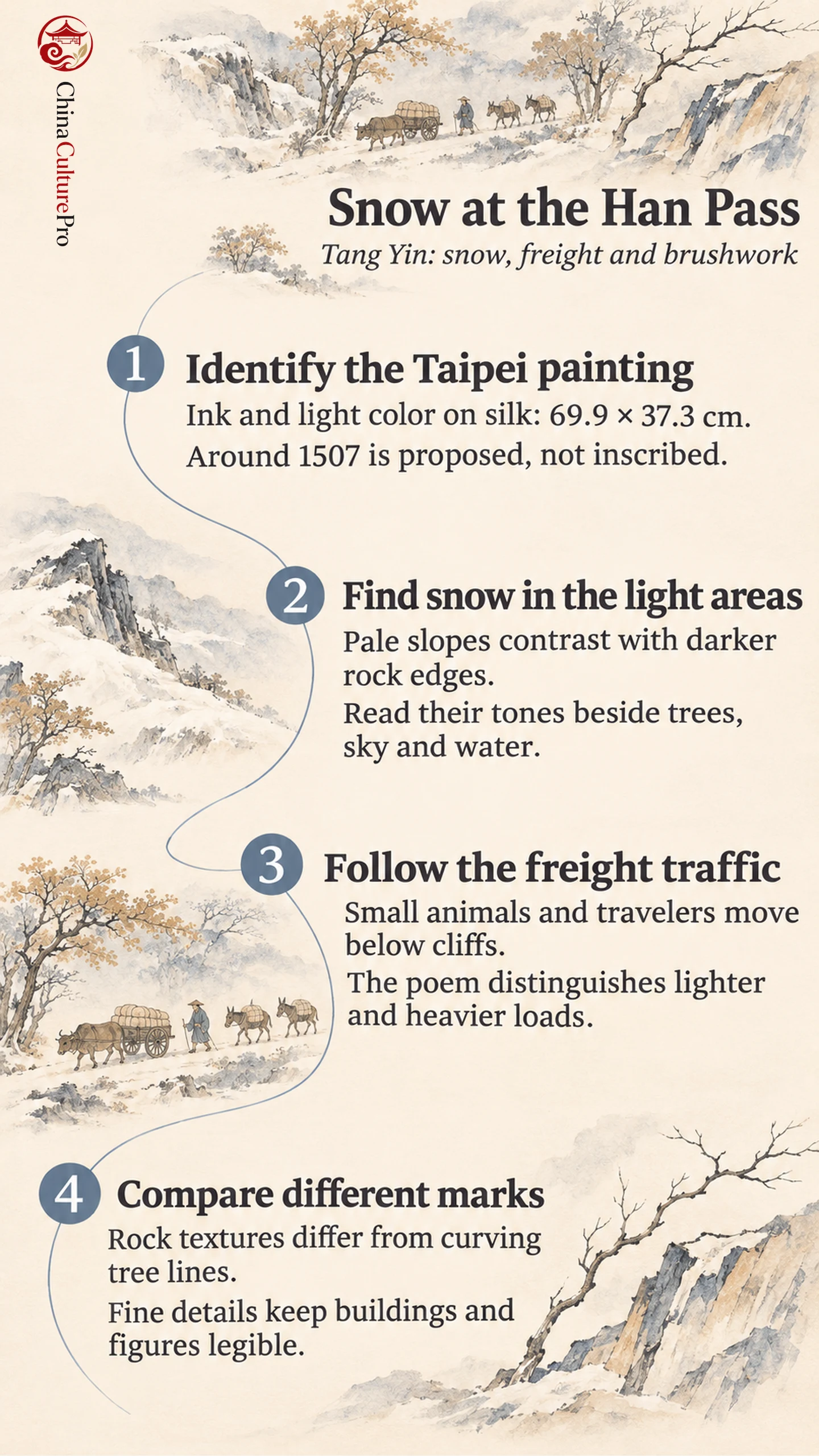
A large cliff rises near the left side, while paler slopes occupy much of the right. Bare branches spread through the foreground. Below them, the small transport group is easy to miss on a first glance at the whole painting.
Compare the abruptly rising terrain with the much smaller scale of the animals and people moving below it.
Identify the Taipei Silk Painting
The museum’s digital title is Mountain Pass After Snow. The record identifies a silk hanging scroll measuring 69.9 × 37.3 cm, signed by Tang Yin but without a year inscription. Its collection number is 故畫000470. [1]
A 2014 museum study discusses a proposed date around 1507, based on comparisons of rock brushwork and calligraphy with another painting. This is scholarly dating by comparison, not a year written beside the signature. [2]
The Ming dynasty guide provides the period setting. Keep that context alongside the museum identifier when comparing translated titles or reproductions.
Begin with the whole field. The prominent cliff, open right-hand slopes and much smaller foreground activity are easier to relate at this scale than in a detached detail of a cart or tree.
Find Snow in the Light Areas
Look along a mountain crest or the upper side of a sloping bank. A light area becomes recognizable as snow partly because it sits next to darker marks that establish a rock edge, scrub or vegetation.
Compare a broad pale slope at the right with the more heavily marked vegetation beside it. The contrast makes the slope feel covered without requiring each patch to be outlined as a separate white object.
Now move toward the sky. Its subdued tone is different from the lightest mountain surfaces, although both belong to the same aged silk support. Read those values in relation to their neighbors rather than expecting photographic white snow.
A sharp boundary may make one snowy edge clear; elsewhere, a softer transition makes the terrain harder to separate. Notice how the handling changes between the large cliff face and the smaller irregular banks below.
The landscape-painting guide explains how light and densely marked areas organize a view. Here, compare a pale slope with a nearby dark tree group before deciding which portion first attracts attention.
At the bottom right, water and a small cascade introduce another kind of light passage. Their relation to banks and broken rocks distinguishes flowing water from a still covering of snow.
Follow the Traffic through the Pass
Find the transport animals near the lower-left area. Their dark forms remain small beside the foreground trees, and much smaller than the cliff above. Compare their scale with a nearby branch or rock, then with the full mountain.
The recorded poem describes a busy pass after snow, assigning lighter loads to donkeys and mules and heavier ones to oxen. The inscription makes the animals’ work part of the picture’s theme, not merely incidental decoration. [1]
The museum study relates the title to Hangu Pass (函谷关, Hán Gǔ Guān), historically associated with Lingbao in Henan. It also emphasizes the labor of transporting goods through snowy mountain terrain. [2]
Follow the visible route through the lower scenery. Where trees or rocks interrupt it, compare the forms on either side before imagining a continuous road farther into the distance.
The buildings provide a second scale reference. Their small roofs and walls suggest occupation within this difficult terrain, but they do not identify a particular inn or establish an individual traveler’s destination.
The inscriptions-and-seals guide explains how written evidence can clarify a painted subject. Here, the poem helps connect the title’s snowy pass with the specific activity of carrying loads.
Compare Rock, Tree and Building Brushwork
The archived museum account contrasts axe-cut texture strokes (斧劈皴, Fǔ Pī Cūn) in the mountains with rounded, fluid tree lines, comparing the latter to strokes used in seal-script writing. It also draws attention to careful details in figures and houses. [3]
Compare a dark, angular rock accent with a curving bare branch. The rock mark can suggest a broken plane; the branch line needs to turn and extend while remaining a connected structure.
The 2014 study describes a mixture of wet and dry handling, small axe-cut marks and pale washes, rather than one uniform treatment across every surface. Its discussion places the composition in dialogue with Northern Song and Southern Song painting traditions. [2]
The painting-techniques guide supplies a broader introduction to texture strokes and washes. Test those categories against neighboring passages: a rock edge, an interior rock surface and a branch can require different marks.
The architecture guide helps with roofs and structural outlines. Compare those controlled small lines with the larger, less regular mountain masses around them.
Return finally to the procession. The fine detail that keeps a small traveler or animal legible works within a much broader arrangement of cliffs and pale slopes. Compare their relative size once more before leaving the whole image.
FAQs About Clearing after Snow at the Han Pass
Is 1507 written on the painting?
The painting has no year inscription. Around 1507 is a proposed date based on stylistic and calligraphic comparison.
Is this a reliable picture of a particular mountain pass?
The archived museum text cautions that it may not depict an actual site, while recognizing a northern atmosphere. Treat the pass association as a subject, not a verified topographic map.
Does the title make it a Han dynasty painting?
Tang Yin was a Ming dynasty painter. The English title’s pass name does not change the work’s historical period.
Sources
[1] National Palace Museum. Mountain Pass After Snow: digital collection record
[2] Lin Lina, National Palace Museum. Painting Brush and Poetry Brush: Tang Yin’s Poetic Landscapes, Palace Museum Monthly 377 (2014), pp. 12–14
[3] National Palace Museum, archived presentation. Clearing after Snow in a Mountain Pass