

Quick Answer: What Is a Chinese Ying Stone?
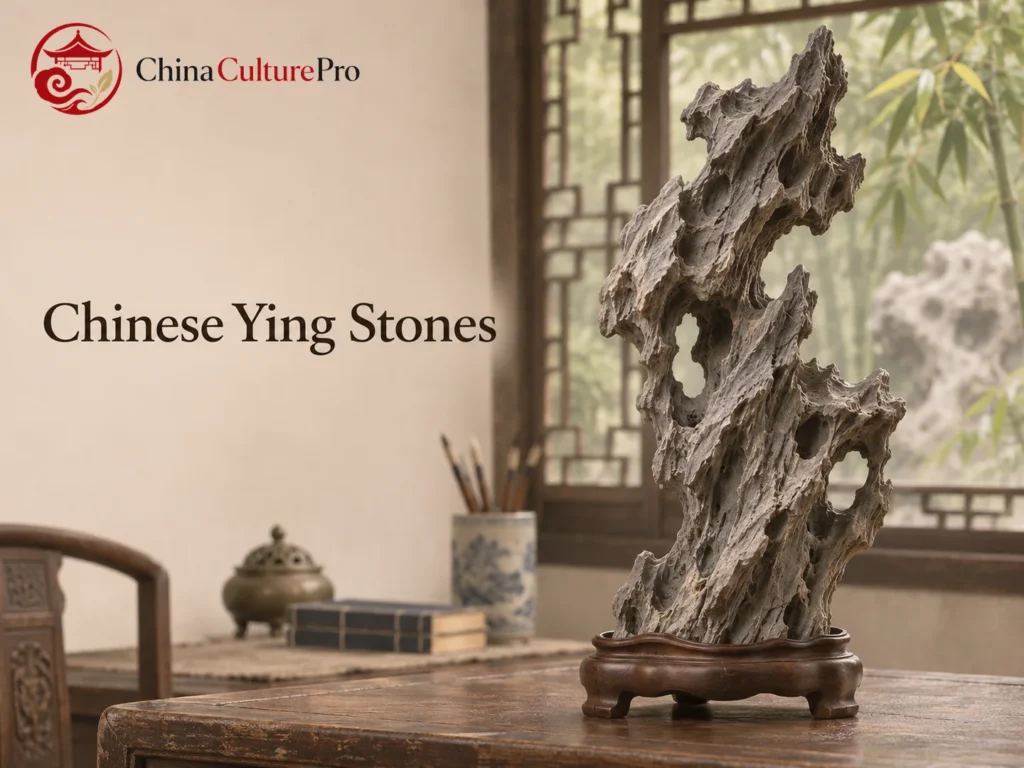
Ying stone (英石, yīngshí) is a form of ornamental limestone associated with Yingde in Guangdong, southern China. Weathering leaves ridges, folds and hollows that can suggest a mountain landscape. A small stone may stand on a wooden base. Larger pieces can form a rockery.[1][2][3]
- Origin: The name refers to the Yingde stone tradition, with a documented source near Ying Mountain.[1][2]
- Form: Look for lean outlines, textured folds and openings that let light through.[1][2]
- Scale: The material can be a display object or part of an arranged landscape.[1][2][3]
To identify a specific piece, start with its collection record or another documented account of its origin. Similar contours occur in other kinds of limestone.[3][5][6]
A stone can look different as you move around it. View the silhouette from one side, then move to see which shadows are shallow grooves and which are spaces behind the rock.[1][2]
What the Stone’s Surface Reveals
The Qingyuan geographic-indication description identifies Ying stone as limestone shaped by long weathering. Its description emphasizes four visual qualities: a lean outline, folds or wrinkles, recesses and openings. These are qualities to look for, with considerable variation among individual stones.[1]
A deep fold can cast a dark line like a cleft in a cliff. A space that opens through the piece draws the eye toward the background. These features also occur in other Chinese scholars’ rocks. Princeton’s Taihu example is perforated, and a Lingbi example at the Met has fine linear textures and indentations. Origin gives a stronger basis for identifying a stone than the presence of a hole.[1][5][6]
How a Wooden Stand Changes the View
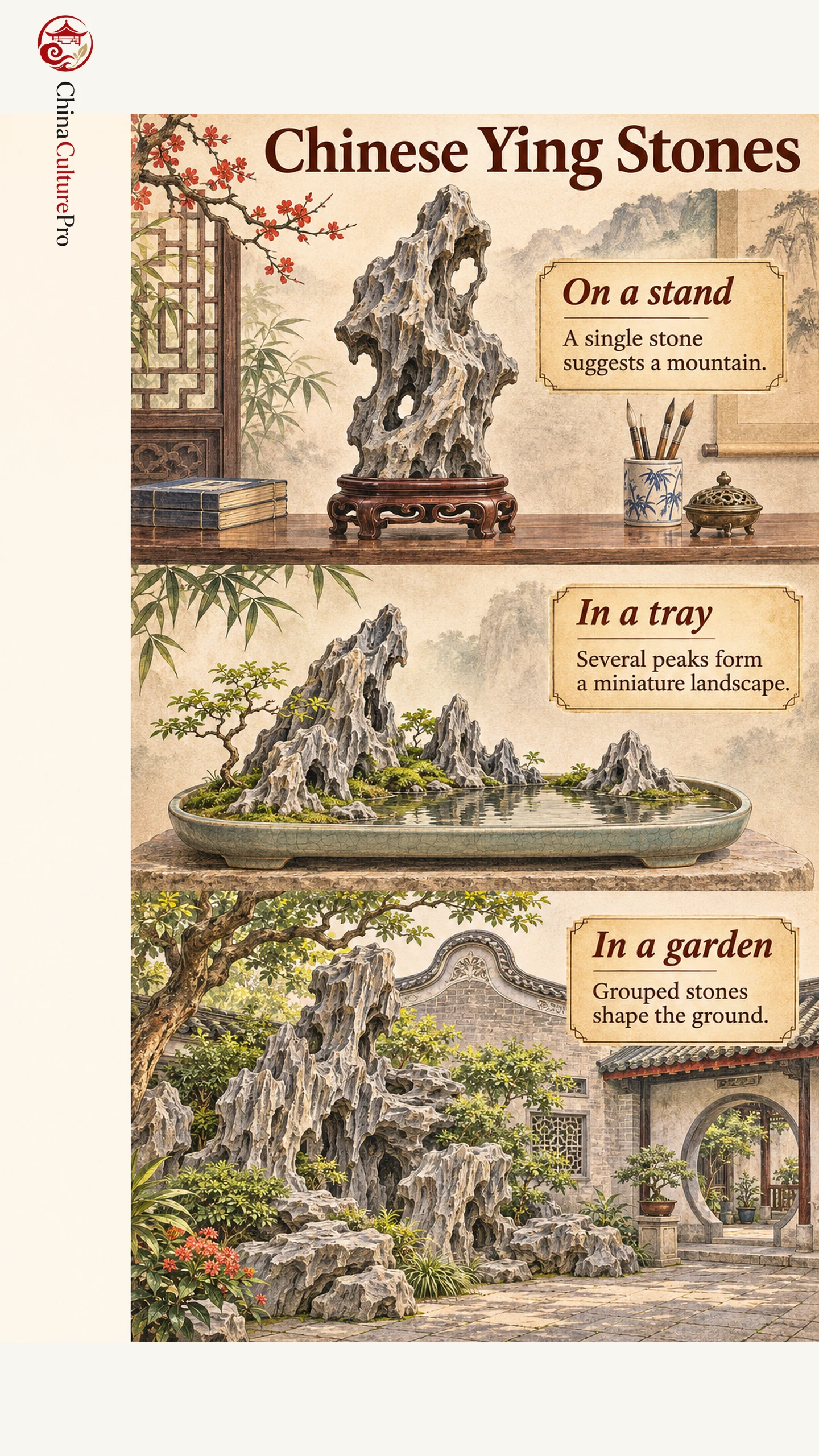
An 18th- or 19th-century Ying limestone in the Metropolitan Museum of Art rises to 54.6 cm including its wooden stand, with a cataloged width of 17.5 cm. Seen upright, its narrow outline has room to register above the horizontal base. Look for the contact points where the base follows the bottom of the stone. The mount controls which edge becomes the skyline and which face the viewer sees first.[3]
The National Gallery of Victoria also records a Yingde limestone with a wooden base. The catalog dates the base to the seventeenth century. Keep that distinction when reading a label: a date assigned to the base can help place the history of the display without giving the limestone itself a date.[4]
How Ying Stones Become a Landscape
In a landscape form of penjing (盆景, pénjǐng), the rock may serve as one peak among several arranged in a tray. The national heritage register describes Yingde compositions that combine rock with water or trees, as well as dry mountain scenes. Gaps between the pieces can suggest valleys and give the small composition a sense of depth.[2]
At garden scale, a group of Ying stones can rise from the ground to make a rockery. The national register names Liang Garden in Foshan and Yuyin Shanfang in Panyu among the historic Lingnan gardens associated with Ying-stone rockeries and arrangements. Chinese penjing and garden rockery use similar choices about peaks and gaps at different scales.[1][2]
FAQs About Chinese Ying Stones
Is any perforated limestone a Ying stone?
Openings occur in several ornamental limestones. A documented Yingde origin gives a better clue than shape alone.[1][3][5][6]
Can a Ying stone stand on its own?
Yes. Museum examples mounted on wooden bases show how an individual stone can be displayed indoors.[3][4]
What did China list as intangible heritage in 2008?
The national list added the Yingde craft of creating rockery penjing with Ying stones.[2]
Sources
[1] Qingyuan Intellectual Property Public Service Platform. Ying Stone Geographic Indication
[2] China Intangible Cultural Heritage Digital Museum. Ying Stone Rockery Penjing Craft
[3] Metropolitan Museum of Art. Scholar’s Rock in Ying Limestone
[4] National Gallery of Victoria. Scholar’s Rock from Yingde
[5] Princeton University Art Museum. Taihu Rock
[6] Metropolitan Museum of Art. Scholar’s Rock with Lingbi Characteristics