


Quick Answer: What Are Chinese Roof Ridge Tiles?
A ridge tile (脊瓦, jǐ wǎ) is a ceramic piece used to cover a roof ridge where sloping surfaces meet. On traditional Chinese roofs, the finished crest can include shaped pieces along its length and separate fittings at its ends. The term can also appear in museum catalogues for ornamental ceramics from the ridge.[1][2][3]
- At the crest: Ridge pieces cover the junction of adjoining slopes.[1][2]
- Down the slope: Rows of field tiles lead toward the eaves.[2][4]
- At the end: A modeled terminal can close or decorate the ridge junction.[3][4]
When you see a ceramic piece in isolation, look for its original position in the catalogue. Similar colors occur on tiles serving different parts of a roof.[2][3][4]
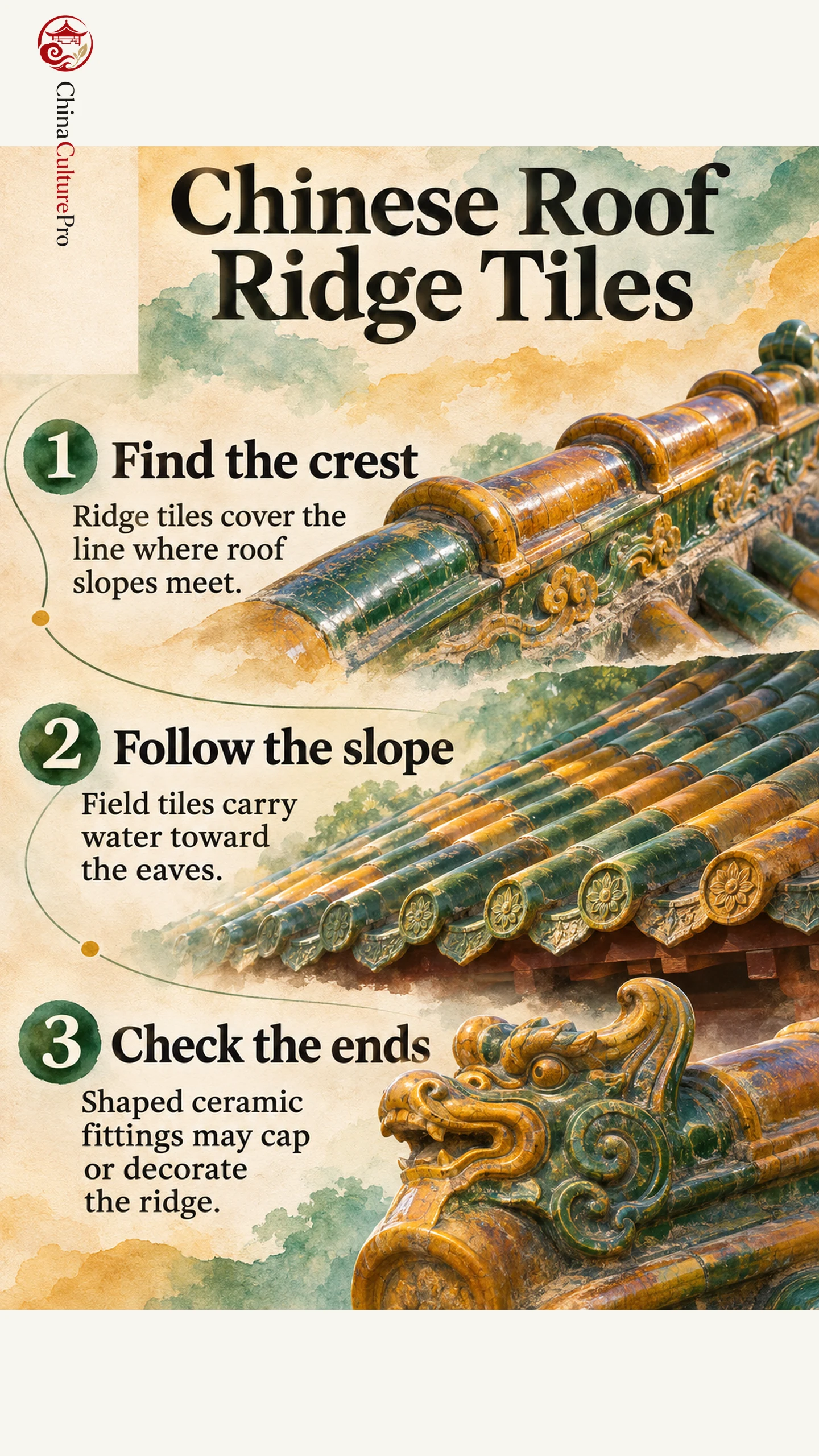
In a roof photograph, the crest and tile rows often share a glaze color. Their positions tell you how to begin identifying them.[2][4]
Where the Ridge Tile Sits
The main ridge (正脊, zhèngjǐ) is the top crest on a roof with a horizontal ridge line. A hipped roof can also have sloping ridges running toward the corners. On a hip roof, the sloping ridges connect the horizontal crest to the four roof corners.[2][4][5]
| Roof zone | Where to look | What the ceramics do |
|---|---|---|
| Crest and sloping ridges | Along the lines where roof faces meet | Cover or finish a junction |
| Main roof slopes | In repeating rows down the face | Carry rainwater toward the lower edge |
| Eaves | At the bottom of the tile rows | Finish the row and help direct water past the edge |
On the tiled slopes, lower tiles form channels and cover tiles sit over the joints between rows. At a ridge, the covering pieces close the junction where the courses end.[2][4]
What Is Hidden Inside a Palace Roof Ridge?
Palace Museum conservation researcher Wang Wentao documents a fish-shell tile (鱼壳瓦, yúkéwǎ) concealed inside ridges in the Forbidden City. It is an unglazed ceramic piece that fits over adjacent tiles at the roof junction. Its position helps hold the neighboring pieces together and limits rainwater entry at their seam.[2]
The study describes distinct forms for main-ridge and corner-ridge use. That difference is easy to miss in photographs of Chinese architecture because the visible crest covers the insert. The conservation record documents a fitted part that the finished roof surface hides.[2]
How Decoration Fits Into the Ridge
A ridge can end in a modeled ceramic terminal. During conservation of the Hall of Supreme Harmony, the Palace Museum reported work on both the main ridge and the diagonal ridges. It treated installation of the large main-ridge terminals as a distinct part of that work.[4]
A museum can also use “ridge tile” as the object name for an ornamental piece removed from a roof. The Museum Angewandte Kunst in Frankfurt catalogues a Chinese dragon-shaped example with honey, green and beige glaze. The catalogue discusses possible settings for a piece of that kind. Its original building remains uncertain.[3]
FAQs About Chinese Roof Ridge Tiles
Were all Chinese ridge tiles glazed?
Glaze appears on visible palace roof pieces and on ornamental objects. The Palace Museum also documents unglazed ceramics concealed within glazed roof ridges.[2][3][4]
Is an eave-end disc a ridge tile?
The eave end closes a tile row at the lower edge of the slope. A ridge tile belongs to the crest or to a line where roof faces meet.[1][2]
Can you identify the hidden ridge tiles from a courtyard photo?
The photograph can show the crest, terminals and visible courses. Conservation photographs, measured drawings or a documented opening of the roof can reveal pieces enclosed beneath the finished surface.[2][4]
Sources
[1] Getty Research Institute. Art & Architecture Thesaurus: Ridge Tile
[2] Wang Wentao, Palace Museum. Concealed Components of Glazed Roofs in the Forbidden City
[3] Museum Angewandte Kunst. Ridge Tile in the Shape of a Dragon
[4] Palace Museum. Conservation Record: Installation of the Hall of Supreme Harmony Ridge Terminals
[5] Getty Research Institute. Art & Architecture Thesaurus: Chinese Hip Roof