

Quick Answer: What Is a Chinese Pontoon Bridge?
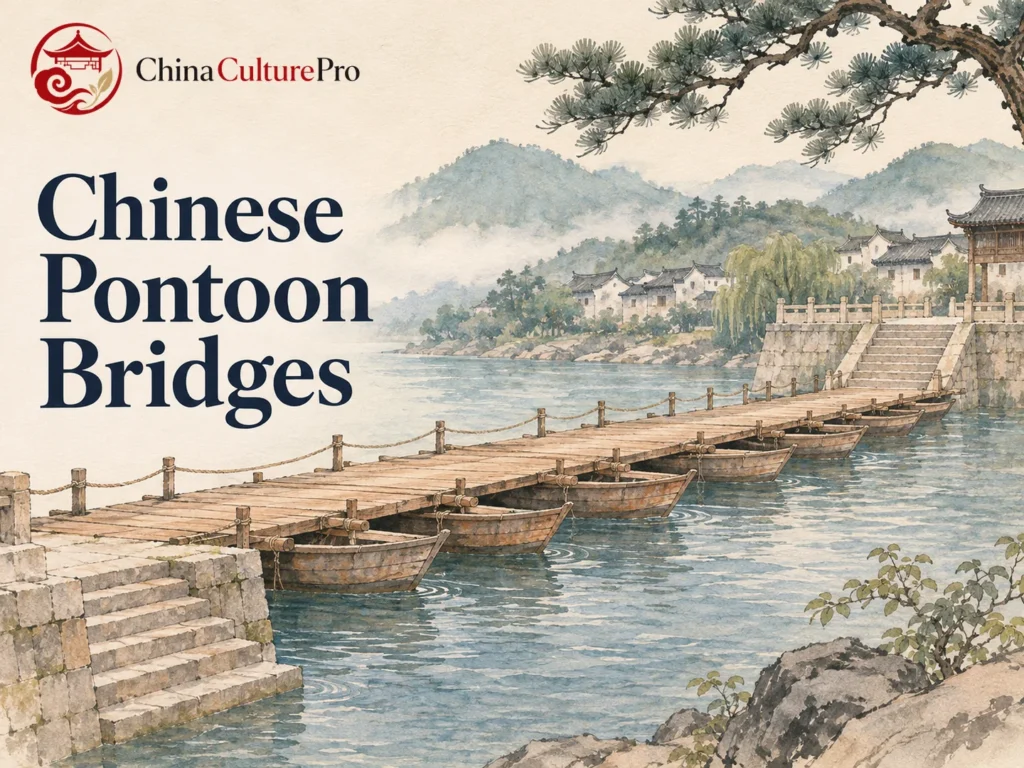
A pontoon bridge (浮桥, fúqiáo) carries its walkway on floating supports. On historic examples in China, rows of boats support planks that form a crossing. Guangji Bridge (广济桥, Guǎngjì Qiáo) in Chaozhou uses this system in its middle section.[1][2][3]
- Support: The boats float under the walking deck.[1][3]
- Chaozhou: A movable center links fixed approaches at Guangji Bridge.[1][2]
- Ganzhou: Boats support most of the crossing on the historic East River bridge.[3][4]
Look below the deck to see where it rests on boats and where it rests on fixed supports.[1][3]
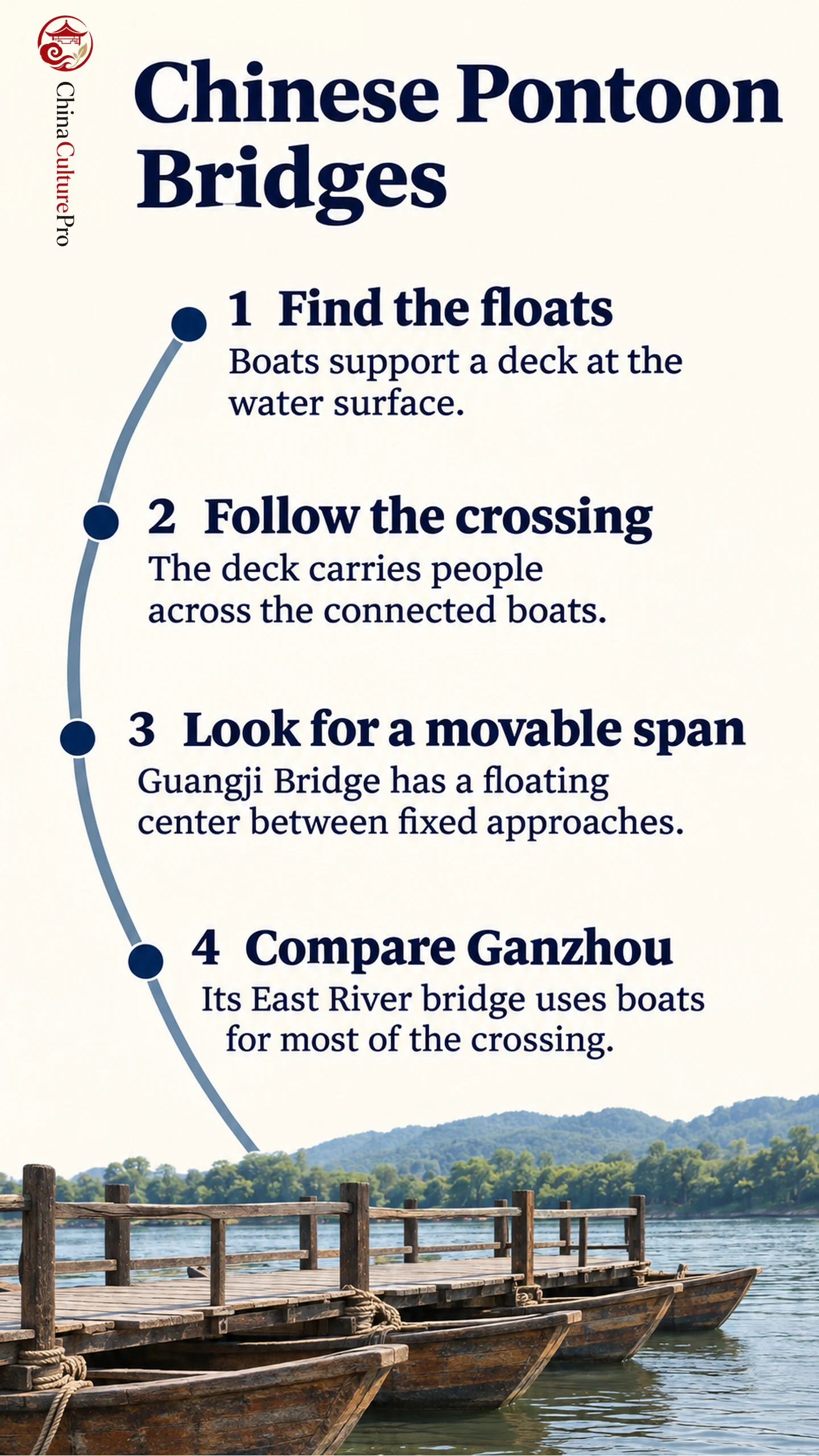
From the riverbank, the hulls just below the planks give away how the bridge works. A low deck alone can look similar to a fixed crossing.[1][3]
How Boats Support the Crossing
On a boat-supported span, the hulls displace water and carry the weight of the deck and the people using it. The walking surface extends over successive hulls. Connecting and securing the boats keeps them aligned across the river. The floating parts move with changes in river level, while the points where they meet fixed approaches have to accommodate that movement.[1][2][3]
The bridge can be described by following the weight from the walkway to its support. In historic Chinese architecture, a fixed bridge bay may bear on masonry piers, while a nearby floating section depends on hulls in the water. This distinction is visible in the contrast between the approaches and the center of Guangji Bridge.[1][2]
Guangji Bridge: A Floating Center Between Fixed Spans
Guangji Bridge crosses the Han River at Chaozhou. The Guangdong historical account dates the first bridge here to 1171, when a boat crossing was established during the Southern Song. Fixed masonry sections were added and altered over the following centuries. The layout familiar today combines a floating middle with solid bridgework on both sides.[1][2][5]
The Guangdong Foreign Affairs Office identifies 18 shuttle boats in the bridge’s distinctive layout. When the middle section is connected, pedestrians can continue between the two fixed sides. Moving the boats aside opens the central passage to river traffic. The same river space could serve foot traffic and river traffic at different times.[1][2][5][6]
The fixed sections also provided space for activities beyond crossing. Research on the bridge documents a historical market, where pavilions served as shops and places to eat. The bridge was both a transport link between Fujian and Guangdong and a place where goods changed hands.[5]
Ganzhou’s East River Bridge: Boats Beneath the Walkway
Ganzhou’s East River crossing in Jiangxi is also called Huimin Bridge or Dongjin Bridge (东津桥, Dōngjīn Qiáo). Ganzhou’s city archives distinguish it from the historic floating crossings on the other sides of the old city. The East River crossing served the route into the city from the east.[3][4]
The city describes a deck of timber planks laid over more than a hundred small boats, with a length of about 400 metres. The sequence of hulls is a feature of most of the crossing here. In Chaozhou the floating section sits between two substantial fixed approaches, giving the viewer a different relationship between the movable and fixed parts.[1][3]
FAQs About Chinese Pontoon Bridges
Do both bridges float from bank to bank?
Guangji Bridge has fixed sections and a floating middle. Ganzhou’s East River crossing is predominantly supported by boats.[1][3]
Why could Guangji Bridge open in the middle?
The boat-supported section could be moved aside to leave a passage for vessels through the center of the crossing.[1][6]
Does a Song origin mean the present boats are Song originals?
The founding date describes the origin of the crossing. At Guangji Bridge, the structure changed over centuries and a major restoration was completed in 2007.[2][5]
Sources
[1] Foreign Affairs Office of Guangdong Province. Chaozhou Ancient City Cultural and Tourism Zone
[2] Overseas Chinese Affairs Office of Guangdong Province. Guangji Bridge: Historical Timeline and Role in Chaozhou
[3] Ganzhou Municipal Government. Eight Scenes of the Southern Song City in Zhanggong District
[4] Ganzhou Municipal Archives. Remembering Ganzhou: Floating Bridges
[5] Built Heritage. Research on Heritage Interpretation at Guangji Bridge
[6] Beijing Cadre Education Network. The Structure of Chaozhou’s Guangji Bridge