

Quick Answer: How Did Chinese Imperial Palaces Differ?
Chinese imperial palaces housed different kinds of court life. Beijing’s main palace held audiences and the imperial household. Shenyang preserves the earlier Qing court and served visiting rulers after the capital moved. At Beijing’s imperial garden and the Chengde retreat, court buildings sit in landscapes built for seasonal residence and ceremony.[1][2][3][4]
- Principal court: Compare the large formal courts and residential quarters in central Beijing.[1]
- Founding court: At Shenyang, architecture preserves the early Qing court’s Manchu traditions.[1][2]
- Seasonal residences: Gardens and retreats could also accommodate government and ritual.[3][4]
The best clues are where the complex stood and what its halls were designed to do.[1][3][4]
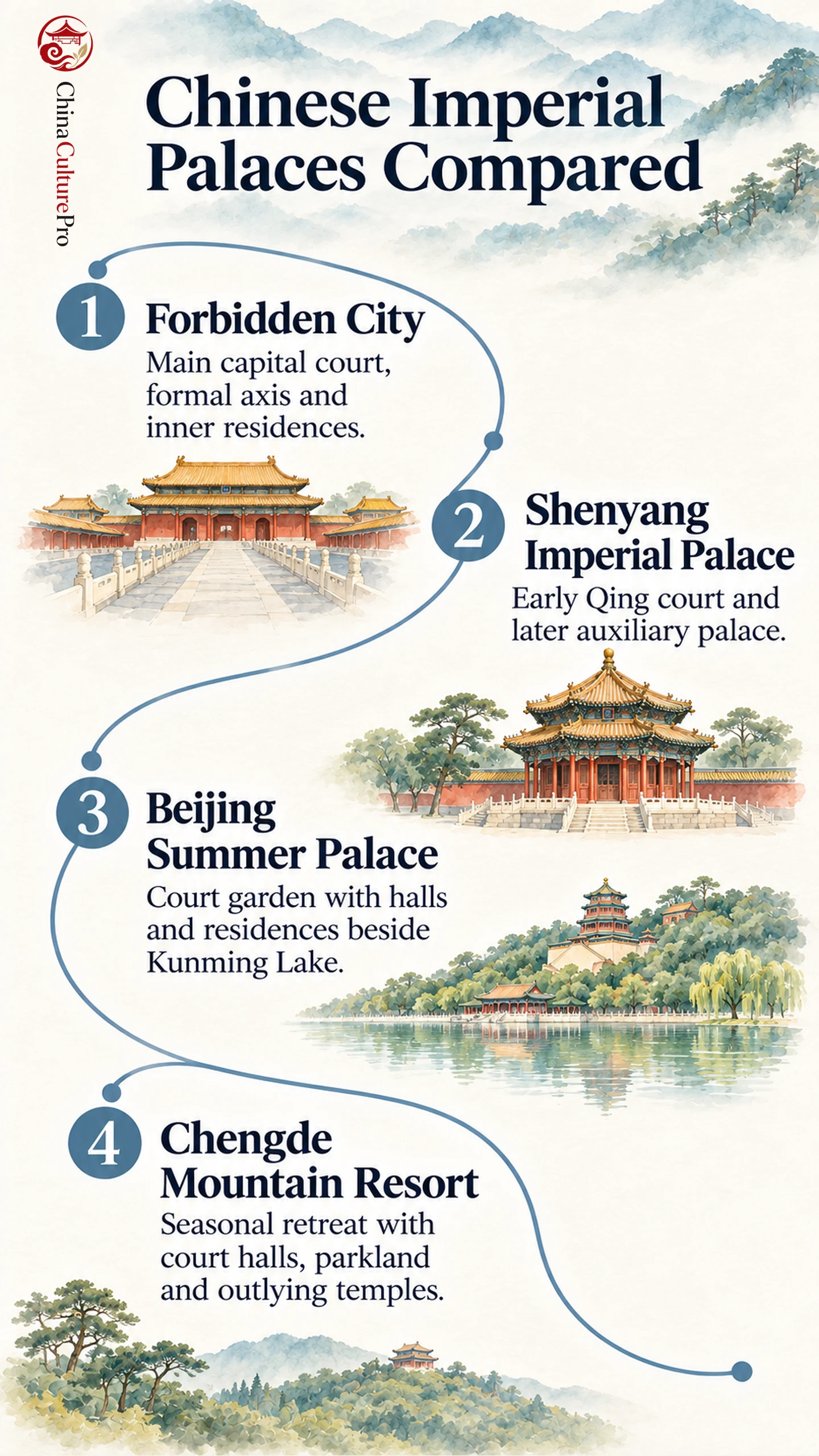
The court moved between settings, and rulers sometimes used inherited palaces for new purposes. A straight axis in Beijing, a Banner court in Shenyang and a lakeside garden show how place shaped court life.[1][2][3]
Beijing’s Forbidden City and the Main Capital
Completed in 1420 under the Ming Yongle emperor, the Forbidden City (紫禁城, Zǐjìnchéng) later served the Qing court. Its central axis orders the approach through outer courts toward inner quarters. This separation helps explain the scale of formal gathering spaces at the front and the concentration of residential buildings deeper in the complex.[1]
Architecture shows one side of government. The Qing Grand Council provides a complementary view of how officials carried work to the emperor and sent decisions out. A throne hall and the paperwork of government answer different questions about the court.[1]
Shenyang and the Qing Founding Court
Work began on the palace at Shenyang in the 1620s. Known as Shengjing Palace (盛京宮殿, Shèngjīng Gōngdiàn) and often as the Mukden Palace in English, it served the rulers who founded the Qing before their capital shifted to Beijing in 1644. It remained an auxiliary palace and was enlarged in later reigns.[1][2]
The octagonal Dazheng Hall and ten Banner pavilions make its political culture visible. Their arrangement connects a ceremonial court to the Banner organization. The residential Qingning Palace also preserves evidence of Manchu sacrificial practices.[1][2]
Summer Palaces and Seasonal Residence
Beijing’s Summer Palace (頤和園, Yíhéyuán) groups residences, religious spaces and gardens around Longevity Hill and Kunming Lake. Its Hall of Benevolence and Longevity belongs to an administrative zone near the east gate. The lake and hillside shape the views, while covered corridors link residences with other parts of the garden.[3]
| Complex | What its layout helps you understand |
|---|---|
| Forbidden City | A principal capital palace with layered approaches, formal spaces and inner quarters.[1] |
| Shenyang Imperial Palace | An early Qing court and later auxiliary palace, with a Banner ceremonial court.[1][2] |
| Beijing Summer Palace | A court garden combining administration, residence, ritual and recreation around a lake.[3] |
| Chengde Mountain Resort | A Qing seasonal retreat in Hebei with administrative and ceremonial halls, parkland and outlying temples.[4] |
The two seasonal settings put different demands on the landscape. Kunming Lake organizes Beijing’s garden, while at Chengde the palace and garden are set amid lakes, woodland and open ground, with temples forming a wider ensemble.[3][4]
FAQs About Chinese Imperial Palaces
Were the Forbidden City and Shenyang Imperial Palace in use at the same time?
Yes. When Beijing became the principal Qing capital in 1644, Shenyang remained an auxiliary court and hosted later imperial visits.[1][2]
Is the Summer Palace the same as the Chengde Mountain Resort?
They are separate places. The Summer Palace centers on Kunming Lake in Beijing. The Mountain Resort in Chengde is a larger Qing retreat and temple landscape in Hebei.[3][4]
Did imperial gardens also contain government buildings?
Yes. The Summer Palace had its own administration area, and the Mountain Resort also includes halls for administration and ceremonies.[3][4]
Sources
[1] UNESCO World Heritage Centre. Imperial Palaces of the Ming and Qing Dynasties in Beijing and Shenyang
[2] ICOMOS. Shenyang Imperial Palace evaluation and building plan
[3] UNESCO World Heritage Centre. Summer Palace, an Imperial Garden in Beijing
[4] UNESCO World Heritage Centre. Mountain Resort and its Outlying Temples, Chengde