


Quick Answer: How Can You Tell a Motif From a Religious Symbol?
A motif is an image or design that appears in an object. It can carry an auspicious, religious or decorative meaning, depending on what it accompanies and how the object was used. The same form can appear on a robe, a furnishing or an object made for devotion.[1][2][3][4]
- Start with the object: Identify its function, material and recorded setting.[1][2][3]
- Read the group: A motif’s neighbours can make a conventional message clearer.[1][4][5]
- Check the label: Provenance and an identified ritual context support a stronger claim.[2][3][4]
A religious origin can be part of a motif’s history even when the individual object served another purpose.[2][4]
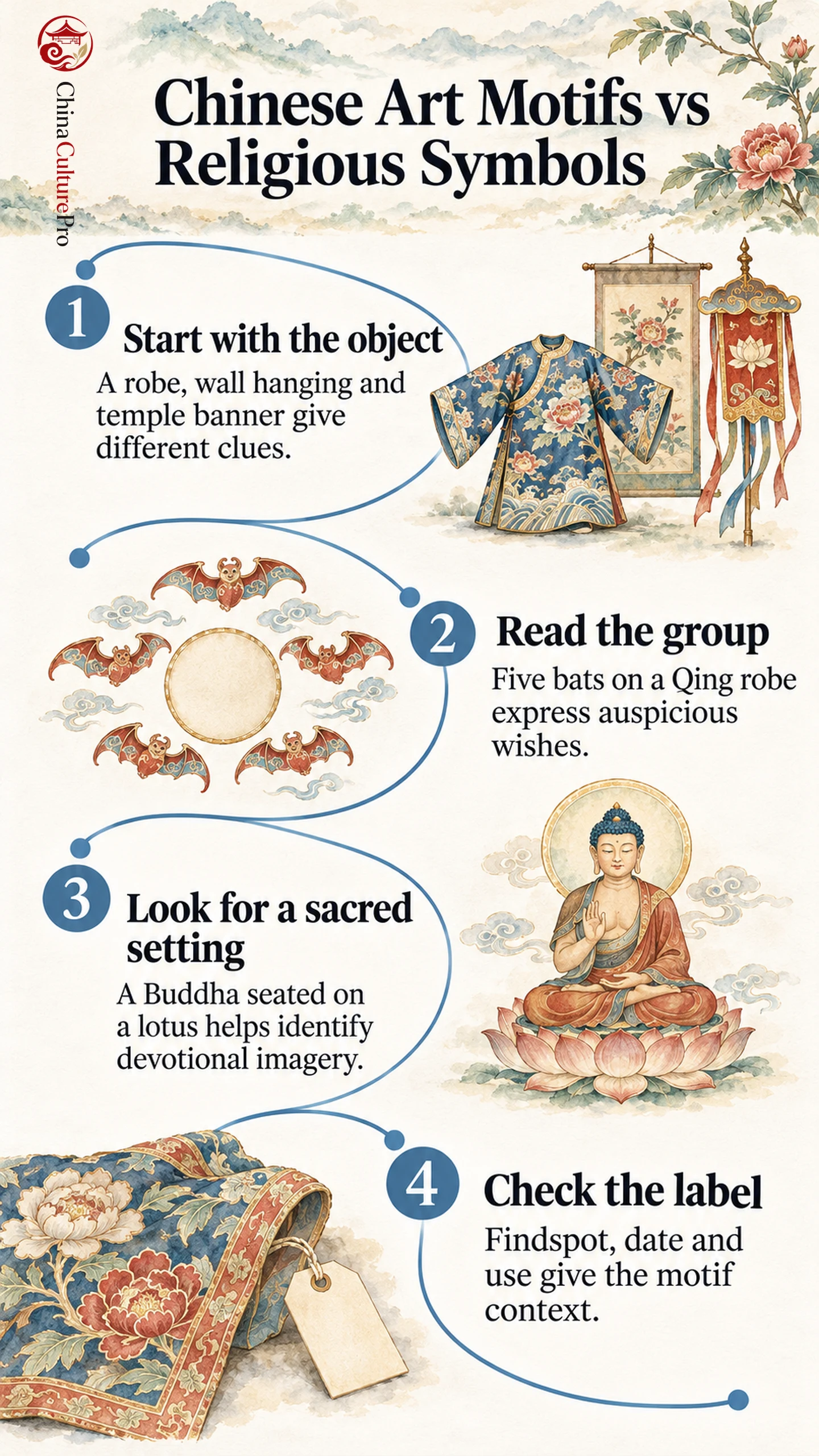
Suppose you see a lotus on a strip of silk. A lotus under a seated Buddha in a Buddhist cave banner gives a different reading from a flower on a wall hanging. The flower is a clue. A catalogue entry can explain where the object came from and which details support the attribution.[2][3]
Start With the Object and Its Setting
Read the object title and description before isolating its pattern. Ask whether the object is clothing, a furnishing, a ritual implement or part of a larger display. Note which details the record gives, such as a dated inscription, excavation context or temple findspot. An object may have a documented religious setting even when some of its decorative elements also appear elsewhere.[1][3][4]
A cloisonné stupa in the Smithsonian collection illustrates the overlap. It has a bat (蝠, fú) above an opening and a lotus-scroll pattern interspersed with the Eight Auspicious Symbols of Buddhism. The whole object helps interpret the emblems. The bat’s presence on a religious object also shows why decorative and devotional vocabularies can coexist.[4]
Read the Motif With Its Neighbours
The word for bat sounds like the word for blessing (福, fú). On a Qing ceremonial robe in the Metropolitan Museum’s collection, five interlocking bats surround a longevity character. Their number and arrangement support an auspicious reading connected to the Five Blessings.[1][5]
That reading rests on several clues together. When a bat motif appears on a fragment or by itself, the full design may be missing. Describe the shape and remaining neighbours before assigning it the message of a complete five-bat arrangement.[1][5]
Compare Two Uses of the Lotus
On a Buddhist banner from the Dunhuang area, a painted Buddha sits on a lotus. The figure, the floral support and the cave-temple context support a Buddhist reading. Here the lotus belongs to an identified devotional image.[3]
The same museum describes a Qing lotus wall hanging as an example of the plant’s broad use in Chinese art. It traces the image’s association with Buddhist purity while showing how lotus forms circulated more widely. When considering lotus symbolism, read the motif’s background separately from the use of the particular object in front of you.[2][3]
FAQs About Chinese Art Motifs and Religious Symbols
Is a lotus always a Buddhist symbol?
A lotus in a documented Buddhist scene can help support that interpretation. It also appears on decorative objects. The setting and surrounding images give the more precise reading.[2][3]
Do bats carry the same meaning on every Chinese object?
The sound of the word for bat supports a familiar auspicious association. The number of bats, surrounding characters and object type can change how specific a reading is.[1][4][5]
What if a museum label gives no original use?
Describe what the object and its design show. Then state any interpretation as provisional and give the basis for it, such as a comparison with a related object that has a documented setting.[2][3][5]
Sources
[1] The Metropolitan Museum of Art. Woman’s Ceremonial Robe
[2] The Metropolitan Museum of Art. Wall Hanging With Lotus
[3] The Metropolitan Museum of Art. Banner With Bodhisattva, Possibly Mahamayuri
[4] Smithsonian Institution. Cloisonné Stupa With Gilt Ornaments
[5] Asian Art Museum. Hidden Meanings in Chinese Decorative Motifs