
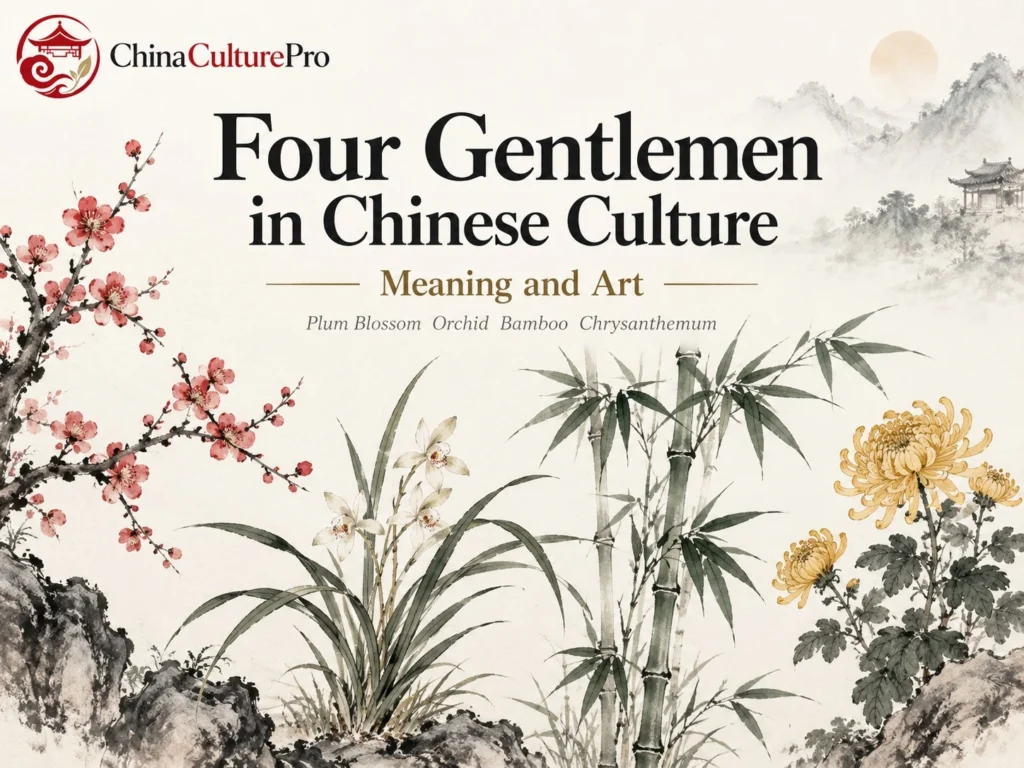

Quick Answer: What Are the Four Gentlemen in Chinese Culture?
The Four Gentlemen (四君子, sì jūnzǐ) are plum blossom, orchid, bamboo and chrysanthemum. In Chinese literati culture, artists compared the plants’ visible qualities with ideals of cultivated character. The group became a major subject of poetry, ink painting and brush practice.
- Plum blossom: Flowering in winter cold, it suggests endurance, moral courage and resolve under pressure.
- Orchid: Associated with quiet fragrance in secluded places, it evokes refinement, integrity and worth that does not depend on public attention.
- Bamboo: Its upright form, hollow center, joints and flexibility support readings of humility, principle and resilience.
- Chrysanthemum: Blooming late in the year and closely associated with reclusion, it represents independence, self-possession and freedom from worldly ambition.
These are cultural and artistic interpretations, not supernatural powers. One isolated flower does not automatically form a Four Gentlemen subject, and the familiar four-season mapping is a later organizing framework rather than the sole reason the group was created.
Few Chinese plant motifs unite ethics and brushwork as closely as the Four Gentlemen. Their importance lies less in promising good fortune than in giving visible form to questions of character: how to remain principled in hardship, preserve refinement away from public praise, combine strength with humility and choose integrity over status.
That shared theme does not erase the plants’ individual histories. Plum, orchid, bamboo and chrysanthemum had long appeared separately in literature and art before they were organized under one late-Ming name. Reading them well therefore requires attention to the object, inscription, period and format—not a fixed list of meanings applied to every image.
What Does “Gentleman” Mean in the Four Gentlemen?
The word “gentleman” translates junzi (君子, jūnzǐ), an ethical ideal rather than a reference to four men. In classical Chinese thought, a junzi is a cultivated person whose conduct shows learning, self-discipline, integrity and steadiness. Although the concept is deeply connected with Confucian ethics, artists used it broadly as a model of literati character rather than as a checklist from one philosophical text.
The governing artistic method is analogy. A plum flowering in cold weather can stand for resolve; a secluded orchid can suggest unadvertised worth; a jointed bamboo can evoke moral principle; and a late chrysanthemum can recall a scholar who refuses fashionable ambition. The plants do not possess moral qualities. Their forms, habitats and literary associations gave poets and painters a language for expressing those qualities.
This is why the Four Gentlemen belong primarily to the history of literati self-cultivation and art. They can appear in decorative or festive settings, but calling them four generic “lucky plants” misses the system’s central purpose: using nature to examine human conduct.
The Four Plants and What They Represent
Each member has its own symbolic mechanism. The table gives the group-level reading; the linked plant guides explore the wider meanings and exceptions attached to each subject.
| Plant | Observed quality | Literati reading | Key cultural association | Common seasonal place |
|---|---|---|---|---|
| Plum blossom | Flowers in winter cold, often before other blossoms | Endurance, courage and an unyielding moral stance | Poems and paintings use wintry plum to voice integrity during hardship | Winter |
| Orchid | Delicate leaves and a fragrance conventionally imagined in a secluded valley | Refinement, integrity and worth without display | Classical literary traditions connect fragrant plants and orchids with cultivated virtue | Spring |
| Bamboo | Upright culms, hollow center, visible joints and flexible growth | Humility, moral principle and resilience without rigidity | Ink bamboo became a major vehicle for expressive, calligraphic brushwork | Summer |
| Chrysanthemum | Blooms in autumn and withstands cooling weather | Independence, self-possession and resistance to social pressure | Tao Yuanming’s poetry helped establish the flower’s enduring connection with reclusion | Autumn |
The sequence orchid–spring, bamboo–summer, chrysanthemum–autumn and plum–winter is now a familiar way to present the set. It helps explain four-panel and four-season displays, but it should not be mistaken for the group’s only meaning or original design rule. Moral analogy and established literary associations remain more important to many works.
“Orchid” also needs care. The orchid of Chinese literati art is a culturally shaped lan image, not an automatic reference to every modern ornamental orchid sold under that English name. Botanical identification alone cannot supply an artwork’s meaning.
How the Four Gentlemen Became a Recognized Group
Older Traditions of Plum, Orchid, Bamboo and Chrysanthemum
The four plants did not acquire their literary and moral associations at the same moment. Orchid imagery appears in early classical literature; Tao Yuanming’s verse made chrysanthemums central to the language of reclusion; and plum and bamboo developed rich poetic and pictorial traditions over many centuries. By the Song and Yuan periods, artists could use individual plants or smaller combinations as personal statements.
An important earlier grouping was the Three Friends of Winter (岁寒三友, suìhán sānyǒu): pine, bamboo and plum. All were admired for remaining green or flowering through the cold season. Yuan painter Wu Zhen later added orchid to these three in a work described as the Four Friends (四友, sì yǒu), creating a meaningful precursor—but not yet the standard plum-orchid-bamboo-chrysanthemum set.[2] This distinction corrects a common compressed history: early plant symbolism and prototype combinations are not evidence that the named Four Gentlemen system was already fixed.
The Late-Ming Formation of the Four Gentlemen
The decisive grouping is associated with the Wanli reign of the Ming dynasty. Publisher Huang Fengchi compiled the Four Manuals of Plum, Bamboo, Orchid and Chrysanthemum (梅竹兰菊四谱, Méi Zhú Lán Jú Sì Pǔ), bringing the four subjects together in a painting-manual format. Chen Jiru used the expression “Four Gentlemen” in connection with a manual devoted to these plants, and later usage settled on the familiar name.[1][2]
This late-Ming milestone should be described as consolidation, not invention from nothing. Huang and Chen organized four already mature traditions into a memorable artistic category. The Palace Museum likewise connects Huang’s Wanli-period compilation with the Four Gentlemen name and notes that adding pine, narcissus or ornamental rock could produce later groups called the Five Pure Ones or Five Friends.[3]
The distinction matters because “the four plants were admired earlier” and “the Four Gentlemen were a recognized set” are different historical claims. English summaries that simply date the entire system to the Song dynasty collapse those layers and obscure what changed in the late Ming: a stable membership, collective label and reproducible manual tradition.
Qing Painting Manuals and Wider Circulation
The Qing dynasty helped turn that learned category into a widely teachable visual system. The first installment of the Mustard Seed Garden Manual of Painting (芥子园画传, Jièzǐyuán Huàzhuàn) appeared in 1679 and focused on landscape. Its later second installment presented separate manuals for plum, orchid, bamboo and chrysanthemum, while another installment treated flowers, birds, grasses and insects.[4]
Woodblock reproduction let students study established brush conventions beyond an individual master’s studio. As editions and later copies circulated, the Four Gentlemen became familiar not only as subjects of cultivated self-expression but also as a practical foundation for learning ink painting. Their imagery spread through painting, calligraphy, poetry, embroidery, bamboo carving, screens, ceramics and paper cutting.[2]
Wider circulation also multiplied contexts. On one object, the four plants might express literati character; on another, they might organize the seasons or offer a cultured decorative program. Later festive uses exist, but they do not replace the older artistic and ethical center of the motif.
Why the Four Gentlemen Matter in Chinese Ink Painting
The Four Gentlemen are especially useful for ink painting because each plant asks the brush to solve a different visual problem. Chinese painting had long drawn on methods developed through calligraphy: changes in pressure, speed, angle, moisture and ink load make a line feel firm, supple, dry, heavy or light.[6] The subjects therefore train control while leaving room for personal rhythm.
- Plum: Angular, turning branches develop structural control, while blossoms test spacing, repetition and the balance between ink and untouched paper.
- Orchid: Long, tapering leaves reward continuous strokes, changes of pressure and disciplined curves rather than repeated correction.
- Bamboo: Culms, joints and clustered leaves teach decisive strokes, proportion, rhythm and the relation between solid structure and empty space.
- Chrysanthemum: Layered petals and varied leaves require close control of repeated forms, ink tones and the relationship between detail and overall coherence.
These are broad artistic functions, not one universal sequence of beginner exercises. Different manuals, teachers and lineages prescribe different stroke orders. Nor does technical proficiency prove moral superiority. “Painting the person” is an aesthetic ideal: brushwork, inscription and subject can make an artist’s temperament or aspiration visible, but they cannot objectively measure virtue.
Museum collections show how widely that expressive language could vary—from windblown bamboo and wintry plum to orchid-and-bamboo handscrolls and printed painting manuals.[5] The Four Gentlemen endure because they connect a compact vocabulary of forms with both artistic discipline and cultural memory.
How the Four Gentlemen Appear in Chinese Art
A complete Four Gentlemen subject may appear as four hanging scrolls, a four-panel screen, an album sequence or four coordinated sections of a handscroll. Separating the plants lets each retain a distinct brush language while the set creates a larger statement about cultivated character or the yearly cycle.
- Four-scroll or four-panel sets: The clearest complete format, with one plant assigned to each unit.
- Albums and handscrolls: Intimate formats that combine painting with poems, colophons or inscriptions and reward viewing in sequence.
- Ceramics, embroidery and carved objects: The plants may provide a cultured decorative program, a seasonal scheme or a general blessing, depending on the object and accompanying motifs.
- Single-plant paintings: An ink plum, orchid, bamboo or chrysanthemum can carry its own literary or personal meaning without representing the complete group.
An inscription can decisively change the reading. A lone plum branch painted after political upheaval may serve as personal testimony, while a similar branch on porcelain may be seasonal decoration. Artist, date, medium, title, inscription and companion motifs are therefore stronger evidence than plant identity alone. For a wider method, see our guide to Chinese flower and plant symbolism.
Four Gentlemen vs Three Friends of Winter
The two groups overlap, but they are not interchangeable. Plum and bamboo belong to both; orchid and chrysanthemum complete the Four Gentlemen, while pine completes the Three Friends of Winter.
| Point of comparison | Four Gentlemen | Three Friends of Winter |
|---|---|---|
| Members | Plum, orchid, bamboo and chrysanthemum | Pine, bamboo and plum |
| Organizing principle | A set of plant analogies for cultivated literati character, later also arranged by season | Plants admired together for remaining green or flowering through winter cold |
| Historical profile | Older individual traditions; stable collective naming in the late Ming | An earlier established grouping, prominent by the Song period |
| Common artistic emphasis | Ink-painting practice, self-cultivation and personal expression | Integrity and endurance in adversity, with poetic and decorative uses |
The Three Friends can also express the lofty moral character of a scholar, so the difference is not “ethical” versus “seasonal.” It lies in membership, historical organization and emphasis. A museum object may even combine these meanings with other motifs; for example, pine and crane can introduce a longevity reading that does not come from the Three Friends alone.[7]
How to Interpret the Four Gentlemen Correctly
- Identify what is actually present. Check whether the work shows one plant, a partial pairing or all four members. A single bamboo painting is not automatically a Four Gentlemen composition.
- Read the written evidence. Translate the title, poem, colophon, inscription and seals where possible. They may reveal whether the artist intended self-portraiture, commemoration, seasonality or simple brush practice.
- Check period, maker and medium. A literati handscroll, a teaching manual and a mass-produced decorative plate do not perform the same cultural job.
- Test the possible interpretive frame. Decide whether moral analogy, a four-season arrangement, festive blessing or ordinary decoration best fits the complete object.
- Separate tradition from modern use. A contemporary tattoo or design may use the set for personal ideas of resilience and integrity, but that choice should not be presented as an ancient fixed rule.
This context-first method also applies across Chinese flower symbols: an object’s full composition and use usually matter more than an isolated motif dictionary.
Common Misreadings of the Four Gentlemen
- They are not four historical men. “Gentlemen” personifies plants through the junzi ideal.
- They are not universal luck charms. Their central tradition concerns cultivated character and artistic expression, not guaranteed wealth, protection or changed fortune.
- One member is not the whole set. A lone orchid or chrysanthemum should first be read through its own context.
- The group was not fully fixed in the Song dynasty. The individual traditions and earlier combinations are older, but the stable named set belongs to the late-Ming history of painting manuals.
- The four seasons are not the only key. Seasonal mapping is useful, especially in coordinated displays, but cannot override inscriptions or artistic context.
- The Four Gentlemen are not the Three Friends of Winter. Only plum and bamboo belong to both groups.
FAQs About the Four Gentlemen in Chinese Culture
What are the Four Gentlemen in Chinese culture?
They are plum blossom, orchid, bamboo and chrysanthemum. Chinese poets and painters used their natural forms and inherited literary associations to express ideals such as resilience, refinement, integrity, humility and independence.
Why are plum, orchid, bamboo and chrysanthemum called gentlemen?
They are compared with the junzi, the cultivated person of classical Chinese ethical thought. The name turns observed plant qualities into metaphors for human conduct; it does not mean the plants possess moral or supernatural powers.
Which season does each of the Four Gentlemen represent?
The common mapping is orchid for spring, bamboo for summer, chrysanthemum for autumn and plum blossom for winter. This later organizing scheme is widely used, but not every Four Gentlemen artwork is principally about the seasons.
Are the Four Gentlemen the same as the Three Friends of Winter?
No. The Four Gentlemen are plum, orchid, bamboo and chrysanthemum; the Three Friends of Winter are pine, bamboo and plum. The groups share two plants and some ethical themes, but have different membership and historical development.
Do the Four Gentlemen bring good luck?
Not in any guaranteed or supernatural sense. Later decorative and festive uses can convey good wishes, but the group’s central historical meanings concern literati character, self-cultivation and the art of brush painting.
Sources
[1] Hong Kong Special Administrative Region Government. Museum of Art Exhibition “The Four Gentlemen” Opens
[2] National Museum of History, Taiwan. The Spirit of the Gentleman—Plum, Orchid, Bamboo and Chrysanthemum Exhibition
[3] Palace Museum. Five Pure Ones
[4] Central Academy of Fine Arts. Mustard Seed Garden Manual of Painting
[5] The Metropolitan Museum of Art. Noble Virtues: Nature as Symbol in Chinese Art
[6] Asian Art Museum. The Development of Landscape Painting in China Through the Tang Dynasty
[7] Smithsonian National Museum of Asian Art. Crane and Pine