

Quick Answer
Qingshui Zushi (清水祖师, Qīngshuǐ Zǔshī), or Patriarch of Clear Water, is the title of a Northern Song Buddhist monk whose religious name was Puzu (普足, Pǔzú). His worship centers on Qingshuiyan (清水岩, Qīngshuǐyán) in Anxi (安溪, Ānxī), Fujian. Migrants helped carry the tradition to Taiwan, where temples in Sanxia (三峡, Sānxiá) and Tamsui (淡水, Dànshuǐ) developed distinct celebrations.[1][2][3][4]
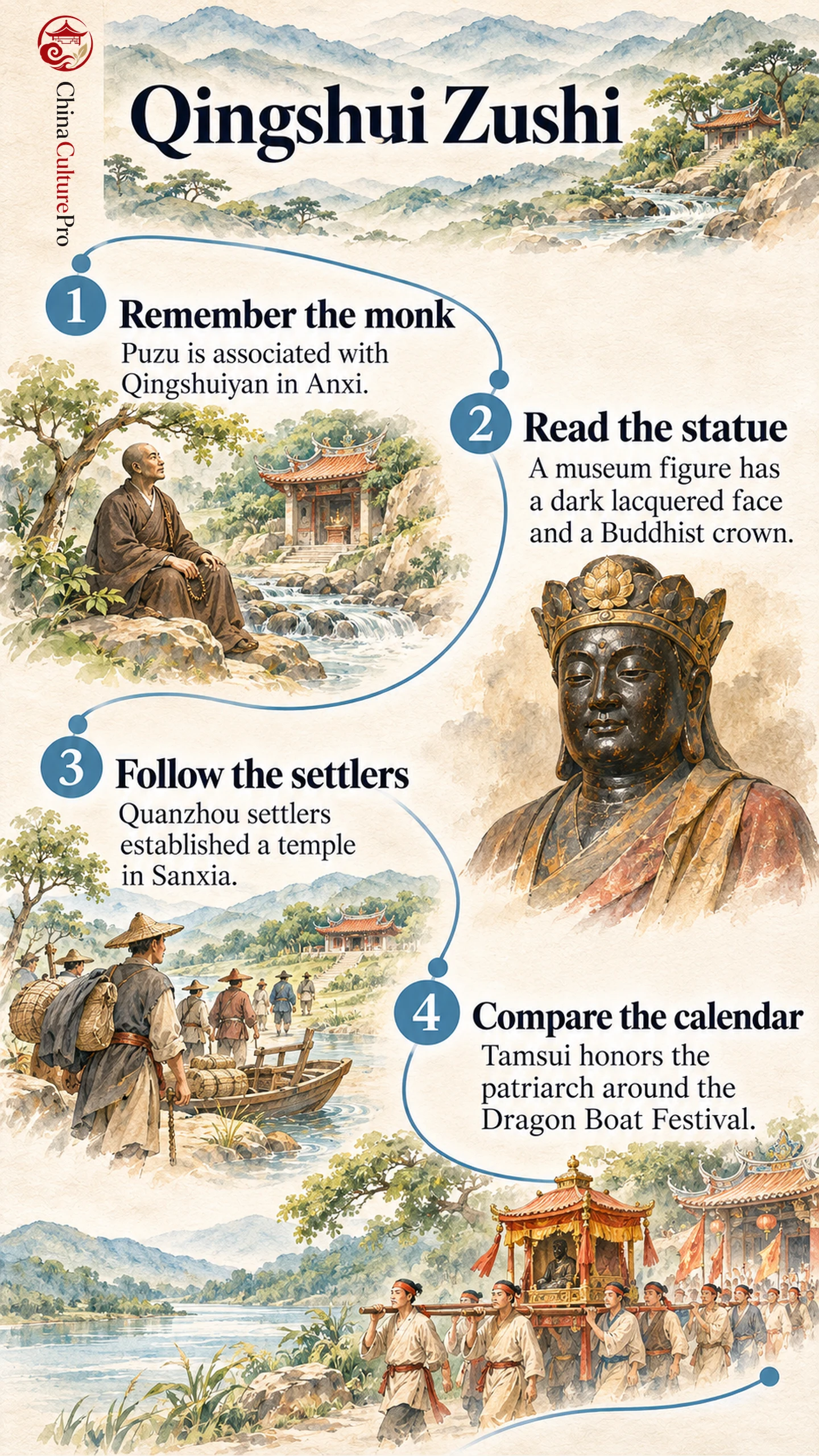
- The monk: Accounts remember Puzu at Qingshuiyan and credit him with helping local people in times of hardship.[1][2]
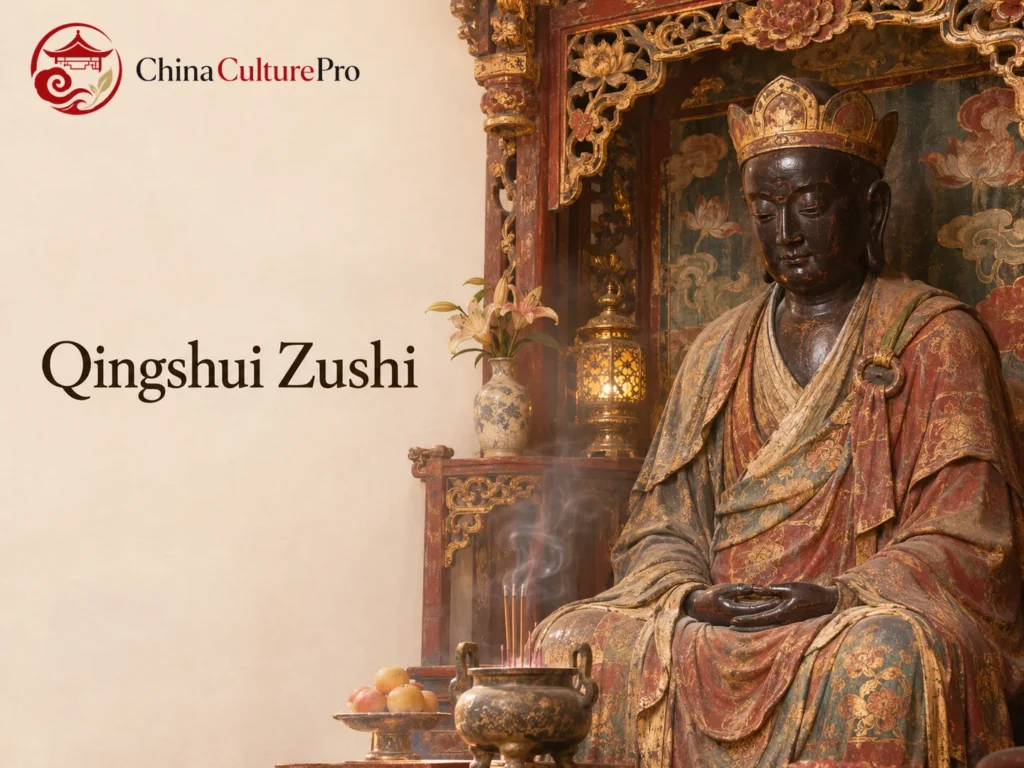
- The image: Wooden statues often show an older monk with a dark lacquered face and a Buddhist crown.[2]
- The calendar: Anxi’s spring procession and Tamsui’s Dragon Boat Festival observances honor the same figure on different dates.[1][4][5]
Sources disagree on the monk’s birth year and give variants of his personal name. Accounts of rain and other miracles record what people came to believe about the patriarch.[1][2]
The title follows a place name even when it appears far from the original site. Anxi’s spring procession brings the patriarch down from the mountain, while Tamsui’s procession grew into a town-wide observance around the early summer festival.[1][4]
How Puzu Became the Patriarch of Clear Water
The national intangible heritage entry locates the beginning of the tradition at Qingshuiyan in Anxi. It cites a Qing gazetteer that remembers the Song monk establishing a place for religious practice there. The same account tells of rice emerging from a rock crevice during construction and people later praying to the monk for rain. As told by the gazetteer, the rock that fed the builders and the rain sought by residents both tied the monk’s reputation to people’s livelihood in Anxi.[1]
The Anxi heritage entry records flower and tea offerings during a three-day spring procession. A report from Quanzhou documents the practice on the eleventh through thirteenth days of the first lunar month. In the local observance, offerings welcome the patriarch down from Qingshuiyan as the new year begins. The procession links the mountain shrine to the surrounding community.[1][5]
Why Some Statues Have a Dark Face
The National Museum of Taiwan History identifies one standing wooden figure from the remains of dark lacquer on its face and its Buddhist crown. It has downcast eyes and wears a belted monk’s robe. The catalog sets that material evidence alongside a story in which smoke from a mountain spirit darkened the patriarch’s face.[2]
The catalog also describes statues with separately carved noses. Tamsui’s heritage account connects one local image to a different story in which the falling nose could warn of trouble. These stories can accompany similar-looking figures without sharing the same plot. The temple dedication and the object’s catalog are useful when a blackened face is the first thing a viewer notices.[2][4]
How the Tradition Took Root in Taiwan
In Sanxia, the heritage account says settlers from the Quanzhou area proposed a temple in 1767 and completed it in 1769. The temple is called Changfuyan (长福岩, Chángfúyán), and local tradition traces its incense to Anxi. Seven groups, organized partly by surname, took turns overseeing worship. New neighborhood groups later helped sustain the birthday festival and its performances. The record shows how people shaped this form of <a href=”https://www.chinaculturepro.com/chinese-folk-religion/”>Chinese folk religion</a> around the communities that had settled there.[3]
At Tamsui’s Qingshuiyan temple, heritage records describe a tradition in which residents sought the patriarch’s protection during an epidemic under Japanese rule. The procession developed around the evening of the Dragon Boat Festival and the following day. Its timing and history differ from the New Year observance in Anxi, although the title Qingshui Zushi continues to recall the Fujian shrine.[1][4]
FAQs About Qingshui Zushi
Was Qingshui Zushi a Buddhist monk or a folk deity?
The name honors a Song Buddhist monk, Puzu, who became the focus of local protector worship. The honorific at the temple remembers his monastic practice at Qingshuiyan.[1][2]
Are all Qingshui Zushi statues missing a nose?
Some images have a separately carved nose, which the Taiwan museum relates to stories of the patriarch. The details vary between sculptures and local accounts.[2][4]
When is Qingshui Zushi celebrated?
Local calendars differ. Sanxia holds its principal birthday celebrations early in the first lunar month. Anxi records a spring procession on the eleventh through thirteenth days of that month, while Tamsui’s procession belongs to the Dragon Boat Festival season.[3][4][5]
Sources
[1] China Intangible Cultural Heritage Digital Museum. Qingshui Zushi devotional customs
[2] National Museum of Taiwan History. Carved wooden figure of Qingshui Zushi
[3] Taiwan Ministry of the Interior. Birthday celebration at the Sanxia Qingshui Zushi Temple
[4] Taiwan Ministry of the Interior. Tamsui Qingshui Zushi procession
[5] Quanzhou Public Security Bureau. Anxi’s spring Qingshui Zushi procession