

Quick Answer
Mount Longhu (龙虎山, Lónghǔ Shān), or Dragon and Tiger Mountain, is a Daoist center in Jiangxi associated with the Celestial Masters (天师, Tiānshī) of the Zhang family. It became an important place for ordination in Zhengyi (正一, Zhèngyī), usually translated as Orthodox Unity. Accounts of travel to the Heavenly Master’s Mansion (天师府, Tiānshī Fǔ) to receive registers help explain the mountain’s influence far beyond Jiangxi.[1][2][3]
- The office: The hereditary Zhang line claimed descent from Zhang Daoling (张道陵, Zhāng Dàolíng), the first Celestial Master in Daoist tradition.[1][2]
- The register: Receiving an ordination register (箓, lù) gave the recipient standing and responsibilities within a religious hierarchy.[2]
- The sites: The mansion and the archaeological remains of the Great Shangqing Palace (大上清宫, Dà Shàngqīng Gōng) document different parts of Mount Longhu’s history.[3][4][5]
The early story of the Celestial Masters and the later history of their Jiangxi headquarters belong to different periods. Mount Longhu’s role in ordination becomes clearer in medieval and later records.[1][2]
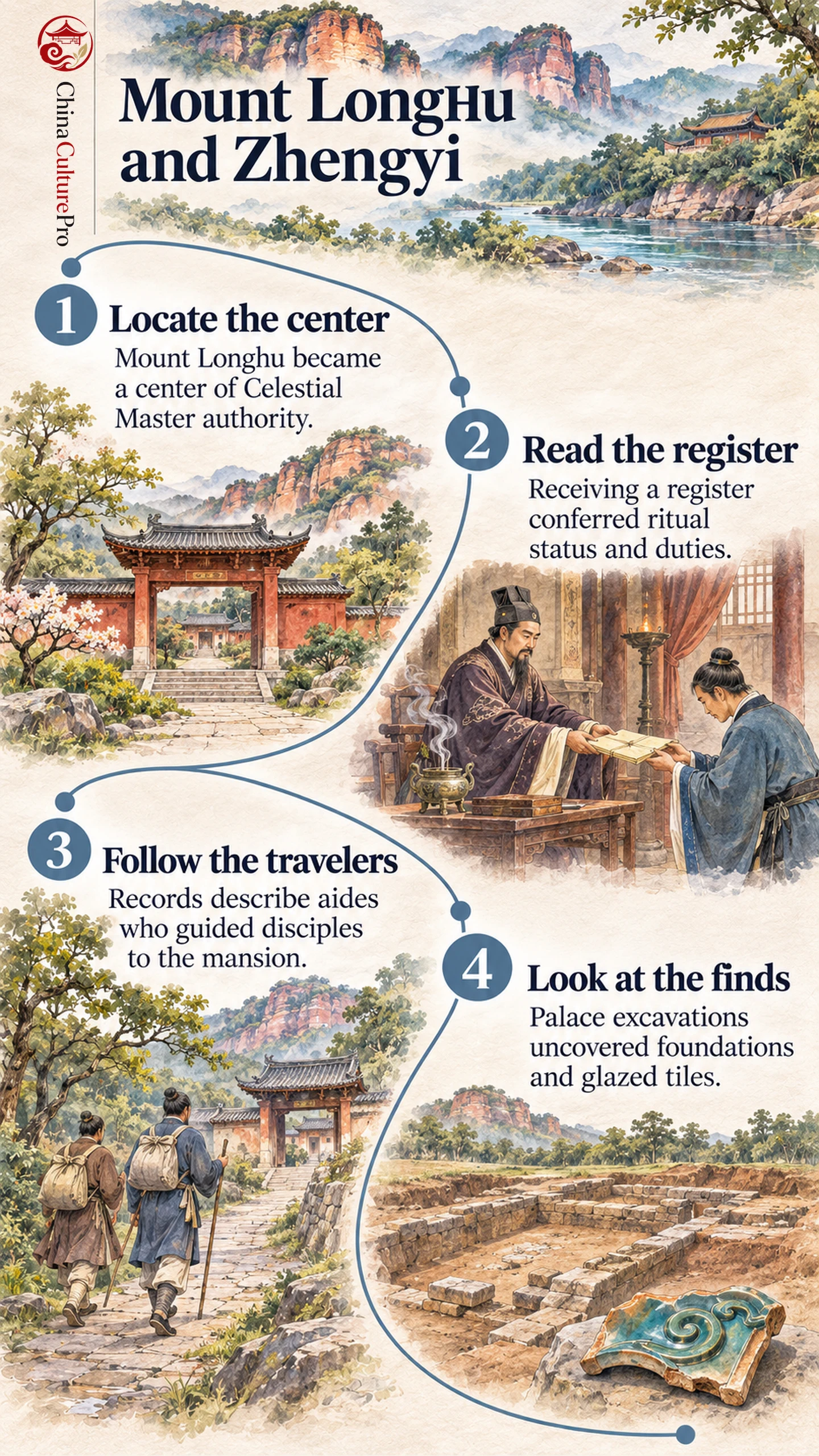
To see why a mountain could have such influence, look beyond its temples to the people who traveled there. Ming and Qing manuscripts preserve details of a network that linked local ritual specialists to the mansion. Records of a ceremony held there in the 1990s also show how the same site could serve a different institution.[3][6]
How Mount Longhu Became a Zhengyi Center
Tradition associates the early movement with Zhang Daoling, who is said to have received a revelation in 142 CE. Later accounts credit a descendant with establishing the family at Mount Longhu. Historian Vincent Goossaert treats those founding accounts as part of the history of the Heavenly Master institution. A separate strand of evidence traces how the mountain itself became prominent over time, including an early mention in a Daoist list of sacred places.[1][2]
By the Song dynasty, the Celestial Masters were based at Mount Longhu and had official authority to ordain priests. Its influence joined the Jiangxi center to a larger network of <a href=”https://www.chinaculturepro.com/religious-daoism/”>Daoist temples, lineages and ritual communities</a>. People could practice far from the mountain while looking to it for ordination and recognition.[1][3]
What It Meant to Receive a Register
Receiving a register (受箓, shòulù) is a form of ordination. Goossaert reads it as receiving a rank and status in the divine hierarchy, with powers attributed to the spirits named in the register and duties toward them. In this context a register represents a religious relationship with named spirits and authorities, in addition to being a document that can be transmitted.[2]
Hsieh Tsung-hui’s study of Ming and Qing manuscripts describes intermediaries known as huashi (化士, huàshì). Some disciples followed such specialists to the mansion for registers or sought their help in finding their way there. The manuscripts preserve names of officiants and the scriptures and registers associated with the mansion. They make ordination visible as something people arranged and traveled for.[3]
What the Mansion and Palace Ruins Tell Us
At the mansion in December 1995, the National Daoist Association organized a three-day Zhengyi ordination. Scholar Lai Chi-tim distinguishes the association’s event from the hereditary family institution and notes a separate ordination for visiting clerics in 1991. The association used an established place of ordination to confer registers under its own authority.[6]
The ruins of the Great Shangqing Palace in Shangqing town (上清镇, Shàngqīng Zhèn) preserve another side of this history. Excavations reported in 2017 uncovered foundations of halls and gates, as well as glazed roof tiles with dragon patterns. Archaeologists compared the foundations with Qing drawings of the palace. Together, the drawings and buried remains help locate a large religious complex whose buildings were destroyed in a fire in 1930.[4][5]
FAQs About Mount Longhu and Zhengyi
Are Mount Longhu and Longhushan the same place?
Yes. Longhushan is the pinyin place name, while Mount Longhu uses the English word “Mount” for shan. It lies in the Yingtan area of Jiangxi.[4][5]
Did the Celestial Masters begin at Mount Longhu?
The tradition traces its beginnings to Zhang Daoling. Later accounts link his family to Mount Longhu, and the site’s documented institutional role developed over time, especially by the Song dynasty.[1][2]
Is Mount Longhu a UNESCO World Heritage Site?
The Longhushan section is part of the China Danxia natural World Heritage property. The listing concerns the red sandstone landscape and its geology. The UNESCO Global Geopark profile also describes the region’s Daoist cultural sites.[5][7]
Sources
[1] Fabrizio Pregadio. Religious Daoism, Stanford Encyclopedia of Philosophy
[2] Vincent Goossaert. Heavenly Masters: Two Thousand Years of the Daoist State, chapters 1–3
[3] Hsieh Tsung-hui. Daoist Huashi in Ming–Qing Ordination Rituals
[4] Xinhua. Archaeological findings at the Great Shangqing Palace
[5] UNESCO. Longhushan UNESCO Global Geopark
[6] Lai Chi-tim. Daoism in China Today, The China Quarterly
[7] UNESCO World Heritage Centre. China Danxia