

Quick Answer
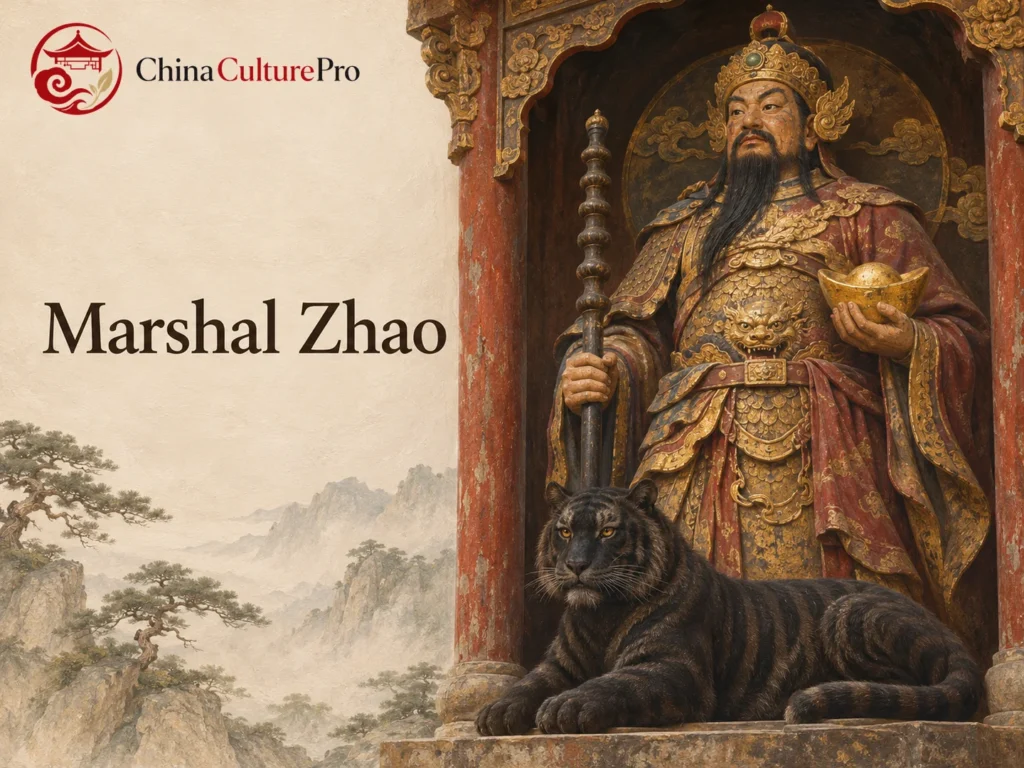
Marshal Zhao (赵元帅, Zhào Yuánshuài) is the Daoist guardian also known as Zhao Gongming (赵公明, Zhào Gōngmíng). He protects the ritual arena in Daoist sources and is honored as a martial God of Wealth (武财神, Wǔ Cáishén) in popular worship. His black tiger is a familiar clue in temple sculptures and New Year prints, especially when paired with a staff and an ingot.[1][2][3]
- The title: Marshal Zhao of the Dark Altar (玄坛赵元帅, Xuántán Zhào Yuánshuài) names him in his religious role as a celestial marshal.[1]
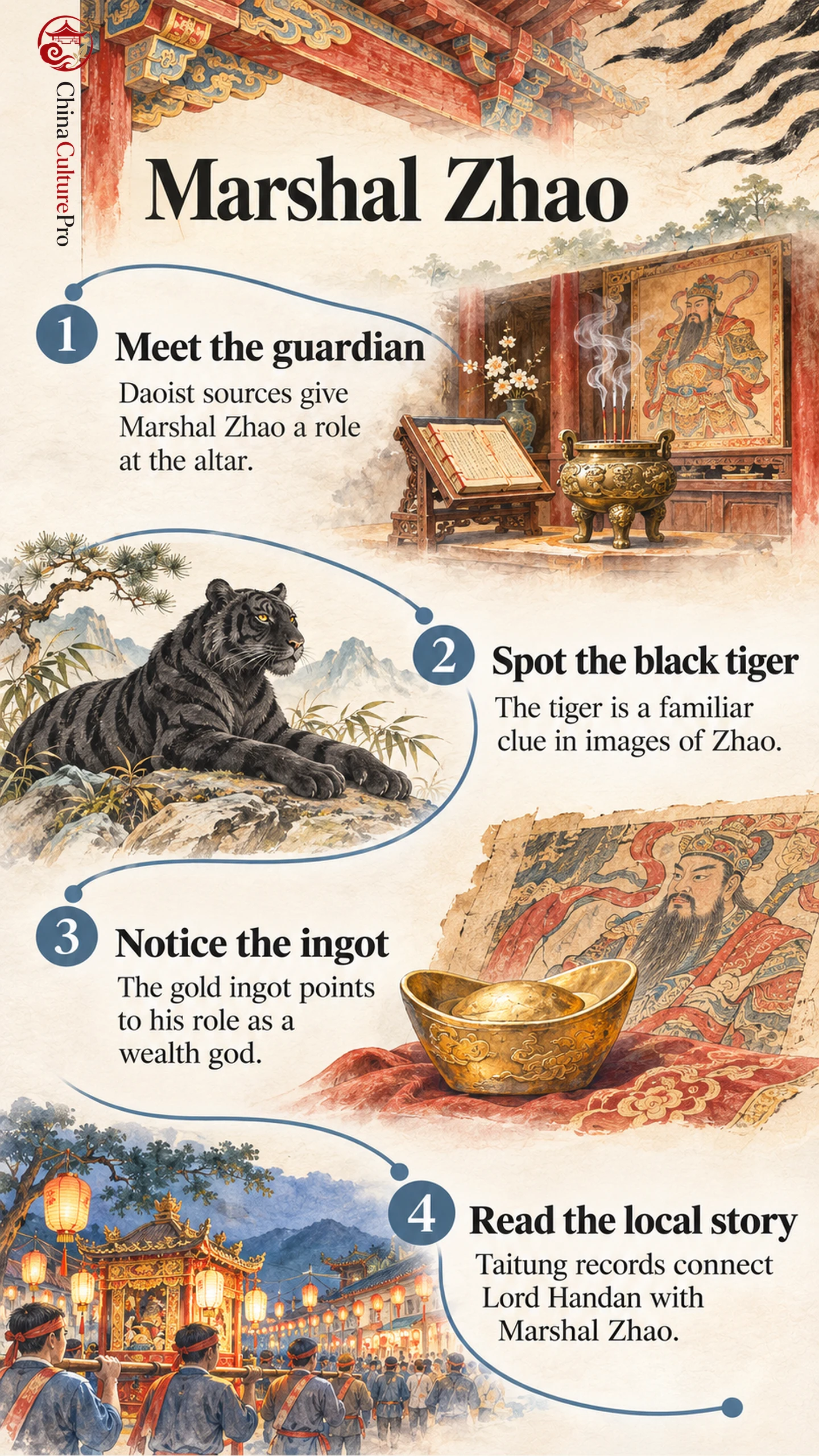
- The image: The tiger, commanding pose and iron whip (铁鞭, tiěbiān) mark his martial authority. An ingot emphasizes wealth.[2][3]
- The worship: His name appears in Daoist liturgies, in New Year imagery and in Taiwanese accounts of Lord Handan (寒单爷, Hándān Yé).[3][4][5]
Caishen (财神, Cáishén) is a title that can apply to several wealth gods. Identifying a specific figure involves looking at the image, its dedication and the setting in which people use it.[3][6]
At the end of a 1527 edition of a Daoist scripture, Marshal Zhao appears as the guardian of the text. In an early twentieth-century New Year print, he rides his tiger with gold in his hand. The two objects put the same figure to different uses.[2][3]
What Zhao Gongming Guards in Daoist Ritual
Sources from the Six Dynasties period associate Zhao Gongming with plague deities. In studies of Song and later Daoist ritual, he appears as a commanding general in liturgies linked to the Orthodox Unity tradition (正一, Zhèngyī). In that setting the marshal belongs to a hierarchy of divine officers who can be addressed in ritual. His protective role concerns the altar and the work performed there.[1][4]
One image of that guardian survives in a 1527 edition of the Scripture of the Jade Pivot (玉枢经, Yùshū Jīng), held in Japan’s Tenri Central Library. The University of Hawaiʻi’s Daoist Iconography Project identifies the black tiger, beard and iron whip in the guardian’s image. This particular image helps explain why a figure classified today as a wealth god can also appear in a book of religious rites.[2]
How to Recognize the Martial God of Wealth
In the Metropolitan Museum of Art’s early twentieth-century New Year print, Zhao holds an ingot in his left hand and a gnarled implement in his right as he rides a tiger. The ingot makes the prosperity theme explicit. A wooden figure at the National Museum of Taiwan History shows him standing with one foot on the black tiger and holding three stacked ingots. The object catalog notes that the figure’s whip has been removed and treats its date as uncertain.[3][7]
A tiger by itself leaves room for another identification. École française d’Extrême-Orient research on woodblock imagery compares Zhao with Zhang Daoling (张道陵, Zhāng Dàolíng), who can also ride a tiger. The ingot, armor and inscription are stronger clues when several appear together. The site’s guide to <a href=”https://www.chinaculturepro.com/caishen/”>Caishen and the other Chinese wealth gods</a> offers comparisons if the image is less clear.[2][3][8]
Where the Marshal Appears in Taiwan
Taiwan’s official folklore dictionary identifies Zhao as a martial wealth god associated with hopes for protection and success in trade. It names four subordinates whose titles and objects are linked to welcoming treasure or profit. A wealth-god image with several attendants can depict those distinct responsibilities, including attracting treasure and welcoming commercial gain.[6]
The Taiwan Historica describes Taitung’s Lantern Festival practice honoring Lord Handan as a local form of worship associated with Marshal Zhao. Its account records a story in which the god dislikes the cold and devotees use firecrackers to warm him. Taitung’s cultural heritage office describes the wider Lantern Festival procession in which temples bring their gods out together. The local name and story help explain why the Lantern Festival custom looks different from the New Year print.[5][9]
FAQs About Marshal Zhao
Is Marshal Zhao the same as Zhao Gongming?
Yes. Zhao Gongming is the name used for the deity whom Daoist sources also call Marshal Zhao of the Dark Altar. The name identifies him in wealth-god images as well.[1][3]
Does every God of Wealth ride a tiger?
The tiger is a familiar part of Zhao’s martial image. The Taiwanese folklore dictionary distinguishes him from civil wealth gods such as Bi Gan (比干, Bǐ Gān) and Fan Li (范蠡, Fàn Lǐ).[6]
What does the gold ingot mean in a Zhao Gongming print?
It points to the prosperity role of the deity. The early twentieth-century Met print pairs the ingot with his tiger and martial implement.[3]
Sources
[1] University of Washington Press. The Story of Han Xiangzi, notes on Marshal Zhao
[2] University of Hawaiʻi at Mānoa. Daoist Iconography Project: Marshal Zhao
[3] Metropolitan Museum of Art. New Year’s picture: God of Wealth riding on a tiger
[4] Religions. Generals in Song–Ming Daoist Liturgies
[5] Taiwan Historica. Taitung’s Lord Handan customs
[6] Taiwan Historica. Dictionary of Taiwanese Folk Artifacts: Civil and Martial Gods of Wealth
[7] National Museum of Taiwan History. Wooden sculpture of Zhao Gongming
[8] École française d’Extrême-Orient. The Tiger and its Association with Protection and Prosperity in Late Imperial China
[9] Taitung County Cultural Affairs Department. Lantern Festival procession of deities