


Quick Answer
Feng Bo (風伯, Fēngbó), the Earl of Winds, personifies wind in Chinese myth and ritual. An early commentary identifies him with Feilian (飛廉, Fēilián). In paintings and prints he may appear as a figure with a wind bag or a fan, sometimes next to a rain deity.[1][2][3]
- Name: The title refers to a wind deity.
- Stories: A classical account pairs wind and rain on a battlefield.
- Images: A bag and a fan are two different clues to the same role.
Check the title on a print and the other figures in a painting when identifying him.[2][3]
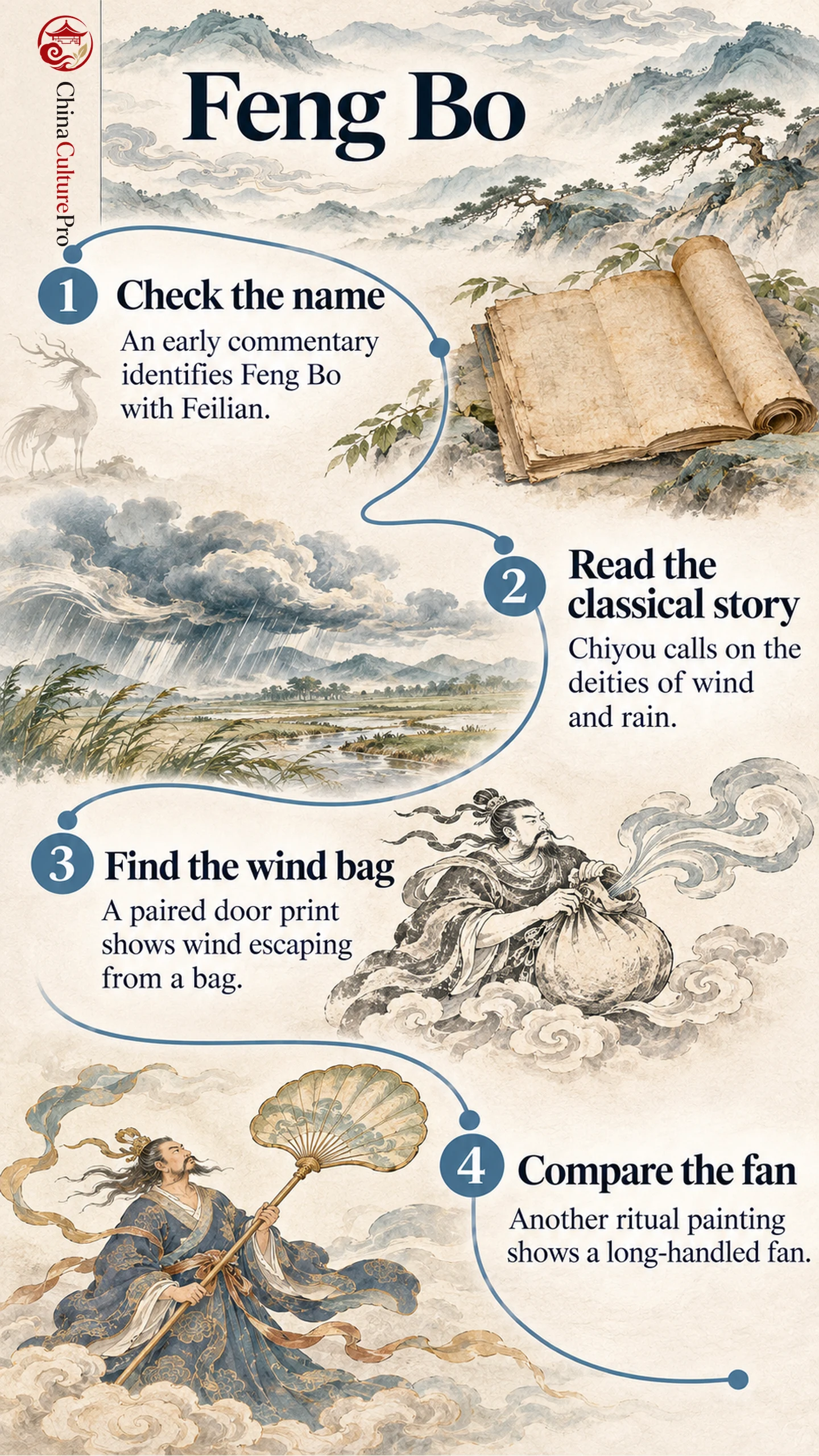
In a woodblock door print collected in Taiwan, Feng Bo faces left and holds a swollen cloth bag. Wind pours from its opening. The print names him at the side and was made to pair with a print of the rain deity.[2]
How Feng Bo and Feilian Are Connected
The Fengsu Tongyi (風俗通義, Fēngsú Tōngyì) cites the poem Li Sao and identifies the figure called Feilian there as Feng Bo. The same entry discusses the Master of Winds as a recipient of ritual offerings. It connects wind and rain with the conditions that nourish living things and gives gratitude as a reason for offerings.[1]
In Search of the Supernatural cites a description of Feilian as a divine bird with a deerlike body, a birdlike head, horns, and a snakelike tail. The animal description and the later human figure each give wind a visible form.[2][4]
Why the Earl of Winds Appears Beside the Rain Master
In the Classic of Mountains and Seas (山海經, Shānhǎijīng), Chiyou enlists Feng Bo and the Rain Master (雨師, Yǔshī) in his conflict with the Yellow Emperor. Wind and rain arrive together. The Yellow Emperor sends a heavenly woman who stops the rain. The episode uses weather to shift the course of a legendary conflict.[5]
A painted ritual hanging from a Taiwanese collection also puts the two near each other, but in a celestial assembly. The Rain Master tips a vessel, and Feng Bo holds a long-handled fan. Their tools let a viewer distinguish the two duties in an image where several figures share the same sky.[3]
How to Identify a Wind Bag or Fan
The National Museum of History in Taiwan catalogues the woodblock image and its rain-deity companion as a pair of door pictures. The museum acquired the print in 1996. That date records its arrival in the collection. The bag gives the print its visual action, as the wind escapes through the opening. The printed title and the documented pairing make the identification firmer than the bag by itself.[2]
In For Timely Rain, a hanging scroll traditionally attributed to Li Gonglin, a wind bag again helps identify Feng Bo. The Taiwanese ritual hanging uses a fan instead. Comparing those objects shows why the name, neighbors, and gesture can matter more than a checklist of attributes. For a related genre, see Chinese door gods.[2][3][6]
FAQs About Feng Bo
Is Feng Bo the same as Feilian?
The Fengsu Tongyi identifies Feilian in the Li Sao with Feng Bo. The name can carry different descriptions in other texts, so the source matters.[1][4]
Does Feng Bo always carry a wind bag?
A wind bag appears in the paired door print and For Timely Rain. A Taiwanese ritual hanging shows him with a fan.[2][3][6]
What is the difference between Feng Bo and the Rain Master?
Feng Bo personifies wind, and the Rain Master is associated with rain. They often work together in stories and can be distinguished by what they carry in an image.[3][5]
Sources
[1] Fengsu Tongyi. Feng Bo entry
[2] National Museum of History, Taiwan. Feng Bo door print, 85-00440
[3] Taiwan National Center for Traditional Arts. Painted ritual hanging, 11201002121
[4] In Search of the Supernatural. Book One, Feng Bo entry
[5] Classic of Mountains and Seas. Classic of the Great Wilderness, North, Chiyou passage
[6] National Palace Museum. The ritual meaning of For Timely Rain