


Quick Answer
Daoist ritual robes are garments worn by priests in ceremonies. The cut helps distinguish types of robe, while embroidery can represent deities, stars, directions, or sacred mountains. A complete set of vestments may also include a headdress and shoes suited to a particular role.[1][2][3]
- Cut: A sleeveless outer garment and a sleeved robe have different shapes when laid flat.
- Embroidery: The front and back can carry different groups of figures.
- Role: In a Hong Kong example, the high priest’s attire changes with the rite.
Compare the whole garment with its ritual setting before inferring rank or identifying a figure.[1][2][3]
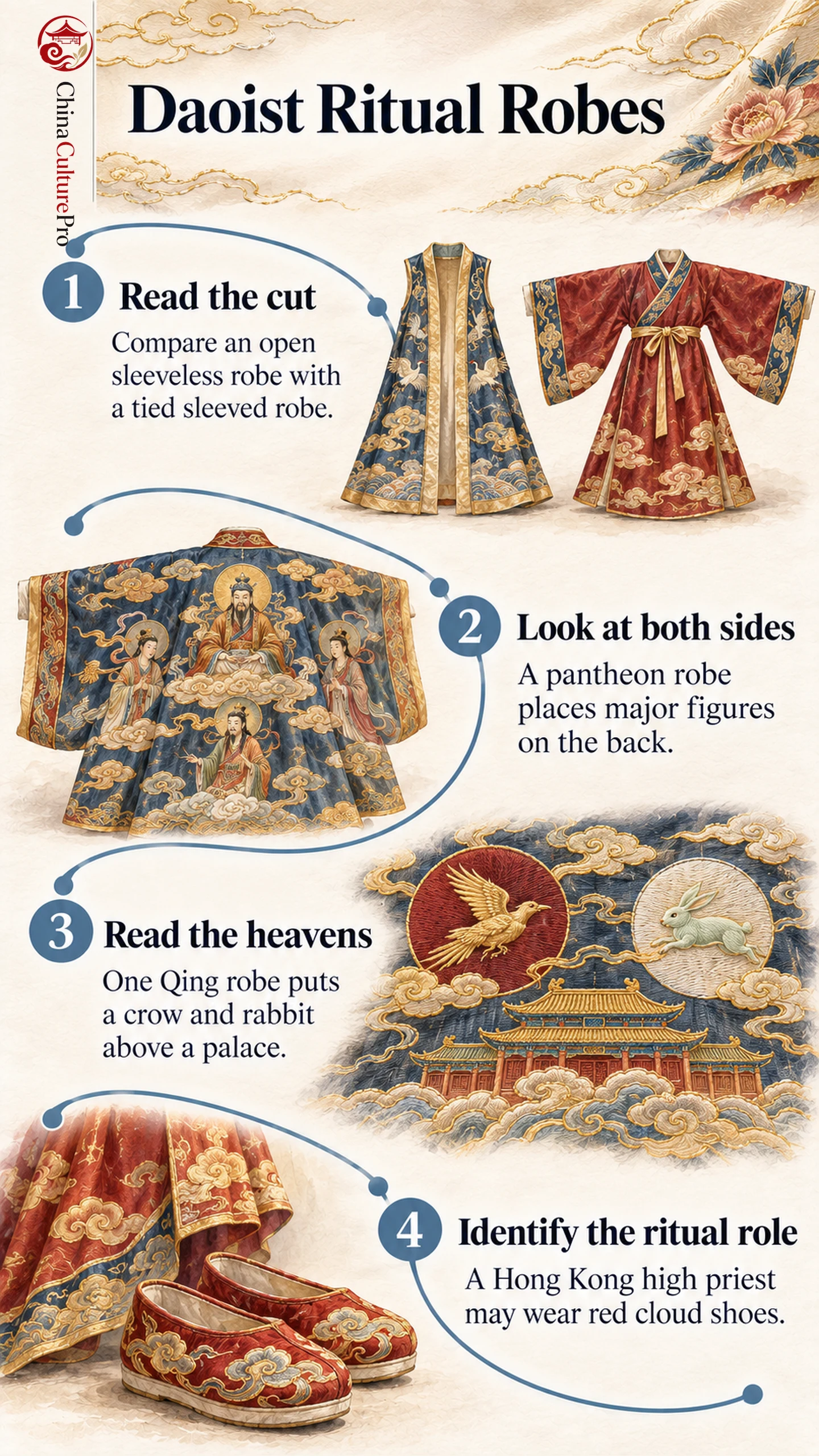
On one silk robe from the late Ming or early Qing period, embroidered deities gather on clouds. Its back centers on the Jade Emperor, with three other major figures above him. The front gives different figures a place beside the opening.[2]
How to Tell a Jiangyi from a Daopao
A jiangyi (降衣, jiàngyī), or robe of descent, can have a square, full-length body, an opening down the front, and no sleeves. A daopao (道袍, dàopáo) is also full-length in the comparison of Qing garments, but has sleeves and can fasten at the front with ties. Look for sleeves and closures first. Both forms can have elaborate embroidery.[1][4]
A robe laid flat in a museum lets you trace how the garment opens and where the motifs fall. Photographs of both sides are especially helpful, since a richly embroidered back can carry a composition different from the one seen across the front opening.[1][2]
Why the Front and Back Carry Different Images
On the late Ming or early Qing garment, the Three Pure Ones appear at the center top on the back above the Jade Emperor, flanked by the sun and moon. The front includes the Lord of the White Tiger Star with a tiger. One interpretation compares this arrangement to a temple: major figures occupy the back, while a dragon and tiger stand on either side of the opening.[2]
A late eighteenth-century silk robe arranges the heavens differently. Above its embroidered palace, a gold crow appears inside the red sun and a jade rabbit inside the white moon. Cranes are scattered across the silk. On this object, the placement of the animals around the palace helps identify the design as a view of celestial space.[5]
What the Rest of the Vestments Can Tell You
In Hong Kong Quanzhen (全真, Quánzhēn) practice, a documented high priest’s vermilion silk robe carries crane roundels and emblems of the Eight Immortals. The outfit also includes red shoes embroidered with clouds. In the Hong Kong project’s account, crane roundels cover the front and back, while the eight emblems sit along the collar, cuffs, and hem.[3]
For a rite to feed and deliver the dead, the high priest can wear a Cihang cap (慈航帽, Cíháng mào). When speaking on behalf of the gods during this rite, the high priest attaches a separate five-petaled crown to the front. Each petal bears the image of an emperor associated with a direction. The guide to religious Daoism provides context for the altar and the officiants who serve there.[3]
FAQs About Daoist Ritual Robes
Is every Daoist ritual robe sleeveless?
No. The Qing forms compared here include a sleeveless jiangyi and a sleeved daopao. Both can be ceremonial.[1]
What do the sun and moon mean on a Daoist robe?
They can help place the composition in the heavens. On one Qing example, a crow and rabbit distinguish the two discs above an embroidered palace.[5]
Can you identify a priest’s rank by robe color?
Color can be one clue within a documented tradition. Check the cut, emblems, headgear, and the priest’s role in the ceremony together.[1][3]
Sources
[1] Minneapolis Institute of Art. Embroidering an Ordered Cosmos
[2] Metropolitan Museum of Art. Daoist priest’s ritual robe with deities of the pantheon
[3] Hong Kong Quanzhen Temples Taoist Ritual Music project. Clothing
[4] The George Washington University Museum and The Textile Museum. Unraveling Identity, Celestial and Mountain Symbols in Chinese Textiles
[5] Metropolitan Museum of Art. Daoist priest’s ritual robe with celestial palace