


Quick Answer: What Was Shaw Brothers Film Culture?
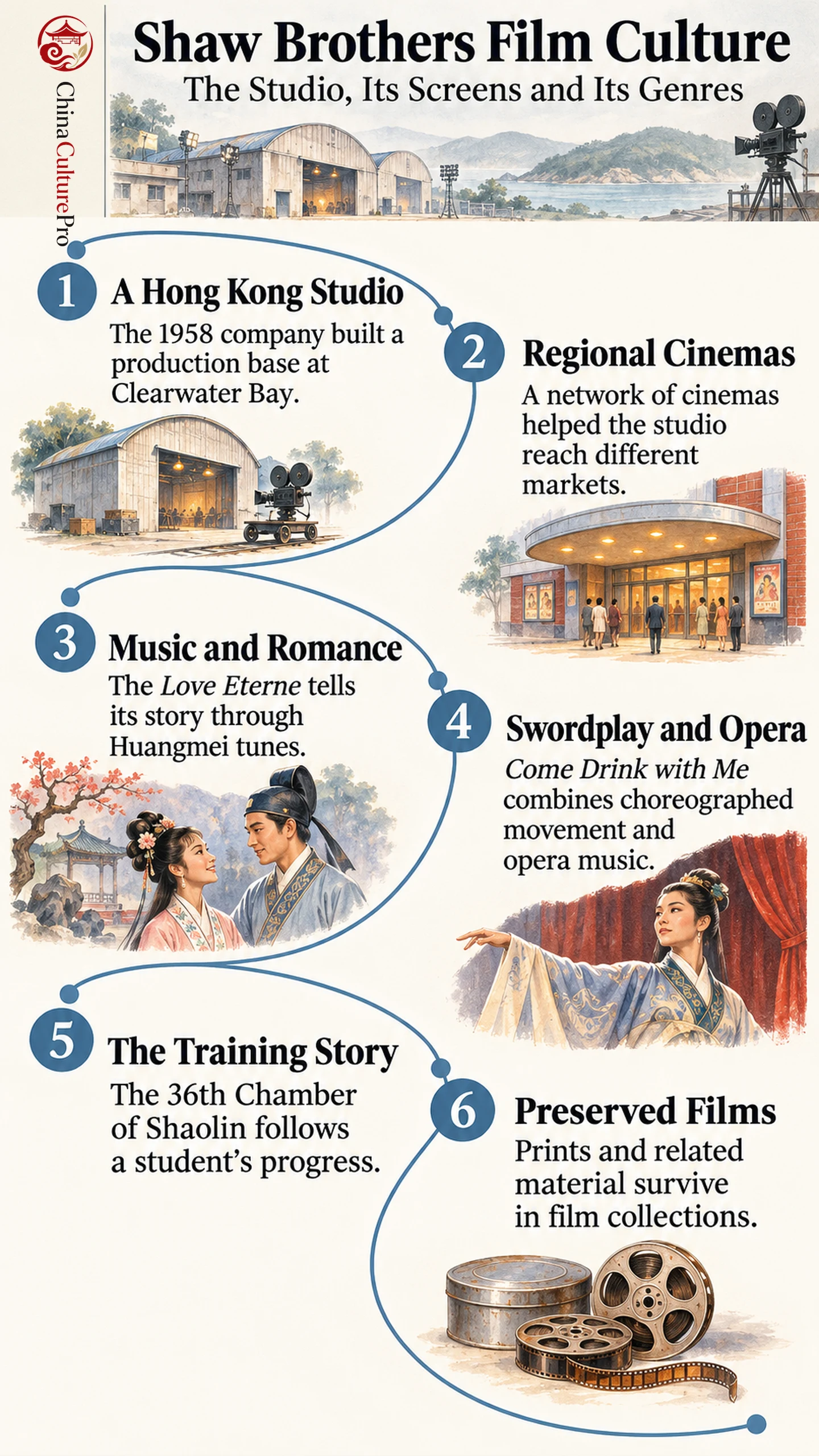
Shaw Brothers (邵氏兄弟, Shàoshì Xiōngdì) was a Hong Kong studio and production company with cinema and distribution connections across Hong Kong and Southeast Asia. The Hong Kong company was founded in 1958 and developed a large studio at Clearwater Bay. It produced musicals, dramas and comedies alongside the martial-arts films for which it is widely known.[1][2]
- The Love Eterne (1963) tells a love story through music.[4]
- Come Drink with Me (1966) draws on stage performance in its action and music.[5]
- The 36th Chamber of Shaolin (1978) makes training the focus of much of the story.[7]
The same production system could make films that asked viewers to listen, watch and anticipate in different ways.
A sung exchange in a romance and a short burst of movement in a swordplay film can both belong to the Shaw catalogue. The variety makes more sense once the company’s studios, performers and cinemas are seen together.
How the Studio Reached a Regional Audience
The 1958 company was part of a longer business history. The Shaw enterprises already had interests in cinema exhibition and distribution. With Shaw Movie Town at Clearwater Bay, the Hong Kong operation had a base for producing a steady supply of films for those screens.[1][2] During the 1960s the studio expanded its production facilities and introduced colour and widescreen filmmaking on a larger scale.[3]
A studio could reuse sets and develop new performers. Cheng Pei-pei studied in its acting training class and went on to play Golden Swallow in Come Drink with Me. Much of the film used existing sets, although the inn was newly made.[5][6] These details explain how a film linked to a distinctive director also depended on shared facilities and a system for developing talent.
Three Films That Show the Studio’s Range
The Love Eterne and the Sung Story
In Li Han-hsiang’s adaptation of the Butterfly Lovers story, the Huangmei tune (黄梅调, huángméidiào) shapes the way the film tells a romance. Sung choruses and returning melodies carry much of the narrative.[4] Listen for how a familiar tune brings an earlier feeling or situation into a new scene.
Come Drink with Me and Operatic Movement
Wuxia (武侠, wǔxiá) stories foreground martial heroes and their choices. In King Hu’s Come Drink with Me, Cheng Pei-pei plays a swordswoman searching for her kidnapped brother. Opera music and choreographed movement help shape the pace.[5] This pairing makes a useful example when distinguishing wuxia from historical drama.
The 36th Chamber of Shaolin and Training
Lau Kar-leung’s film follows San Te, played by Gordon Liu, through a series of training chambers. The changes in setting mark how far San Te has progressed as a student.[7] The film tells a fictional story using the setting and associations of Shaolin martial arts.
What Film Archives Preserve
Celestial Pictures transferred Shaw film prints and associated materials to the Hong Kong Film Archive in 2009. UCLA’s Film & Television Archive also identifies hundreds of Shaw titles in its DVD collection.[4][8] These collections let programmes and researchers consider work across genres. The Hong Kong New Wave provides a later point of comparison for how filmmakers reworked some of the forms Shaw had popularized.
FAQs About Shaw Brothers Film Culture
When was the Hong Kong company founded?
Shaw Brothers (Hong Kong) Ltd was founded in 1958.[1]
Did Shaw Brothers make films besides martial arts?
Yes. The company made musicals, dramas, fantasy, horror and comedies, among other genres.[2]
Which Shaw film tells the Butterfly Lovers story?
Li Han-hsiang’s The Love Eterne, released in 1963, adapts that story in the Huangmei tune style.[4]
Sources
[1] Hong Kong Film Archive. The Shaw chronology
[2] Hong Kong Memory. Shaw Brothers’ Movies: Film Genres
[3] Hong Kong Memory. Shaw Studio Production
[4] Hong Kong Film Archive. The Love Eterne
[5] Hong Kong Film Archive. Come Drink with Me
[6] Hong Kong Film Archive. Chivalry and Grace: Cheng Pei-pei
[7] The Museum of Modern Art. The 36th Chamber of Shaolin
[8] UCLA Film & Television Archive. Shaw Brothers DVD Collection