

Quick Answer: How Are Wuxia and Historical Drama Different?
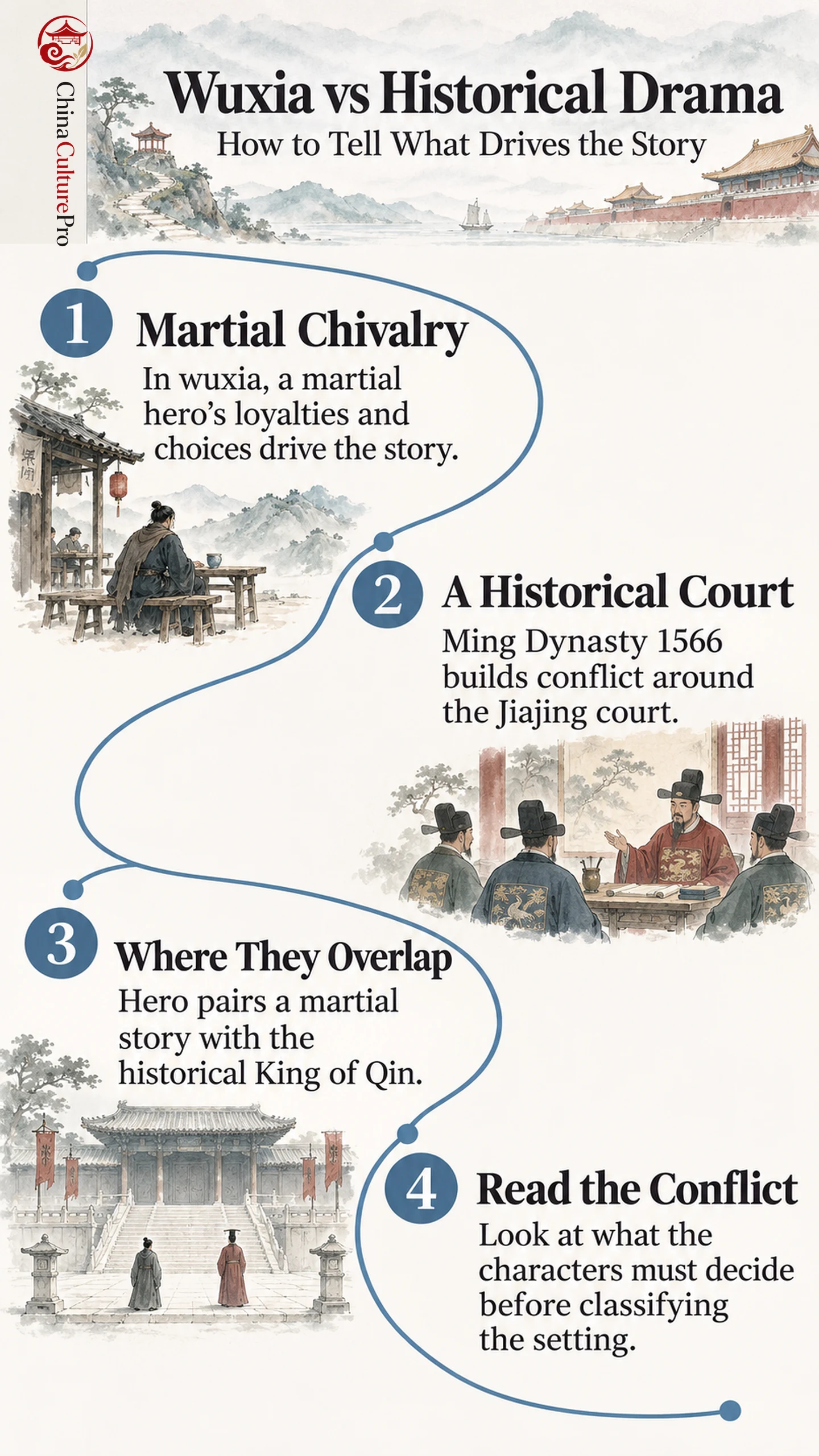
Wuxia (武侠, wǔxiá) centres on martial heroes whose skills, loyalties and ideas of justice drive the story. A historical drama (历史剧, lìshǐjù) draws its main action from a recognizable past, often involving historical figures or institutions. A work can do both.[1][2][6]
- In wuxia, a promise, rivalry or act of chivalry can give a story its shape.[1][7]
- In historical drama, a reign, a court or a political dispute can shape what the characters can do.[2][4]
- Period clothing can appear in either kind of story.
Identify the central conflict before using the costumes or setting to classify it.
Two productions may show people in similar robes. One may hinge on whether a hero keeps a promise, while the other follows an official trying to challenge a powerful minister.
What Drives a Wuxia Story
Wuxia developed around the figure of the knight-errant, who uses martial skill within an ethical code. The term jianghu (江湖, jiānghú) often describes the social world in which such figures make alliances and answer to loyalties of their own.[1][7]
In King Hu’s Come Drink with Me (1966), Golden Swallow tries to rescue her brother. Choreography draws on Chinese opera, and the protagonist’s actions determine the story’s path.[3] That film belongs to the history of Shaw Brothers. Later directors in the Hong Kong New Wave used familiar swordplay conventions for different kinds of stories.
What Drives a Historical Drama
The 2007 television series Ming Dynasty 1566 follows disputes involving the Jiajing emperor and officials including Hai Rui and Yan Song. It dramatizes power at the court and uses named people from the Ming dynasty.[4] The court setting matters because officials’ access to the emperor shapes their choices.
The director described a fictional story told through a historically grounded approach.[5] A script can invent conversations or combine events. The history drama label identifies the frame of reference, while historical records help establish what individual Chinese emperors and officials did.
When Both Labels Fit
Zhang Yimou’s Hero (2002) is set in the Warring States period and features the King of Qin. Its story turns on the martial figure Nameless and on competing accounts of the events he relates.[6] A historical ruler supplies the setting for a wuxia plot. Both features matter to how the film works.
If the story instead gives immortality or cultivation a central role, another useful distinction is wuxia and xianxia. The broader comparison between xuanhuan and xianxia deals with a different set of fantasy conventions.
FAQs About Wuxia and Historical Drama
Can wuxia have a real historical figure?
Yes. Hero includes the King of Qin in a stylized martial story set in the Warring States period.[6]
Does historical drama have to be completely accurate?
No. A drama can use historical people and institutions while making up events or dialogue for its story.[2][5]
Do period costumes make a series a historical drama?
Costumes establish a visual setting. Look at how the series uses recognizable people, events or institutions from the past.[2]
Sources
[1] Stephen Teo. Chinese Martial Arts Cinema: The Wuxia Tradition
[2] University of Hawaiʻi Press. Re-collecting History on Television
[3] Hong Kong Film Archive. Come Drink with Me
[4] CCTV. Ming Dynasty 1566 launch coverage
[5] CCTV. Interview with director Zhang Li
[6] Film at Lincoln Center. Hero
[7] Taylor & Francis. Genre as cultural deployment