


Quick Answer: What Was Ping-Pong Diplomacy?
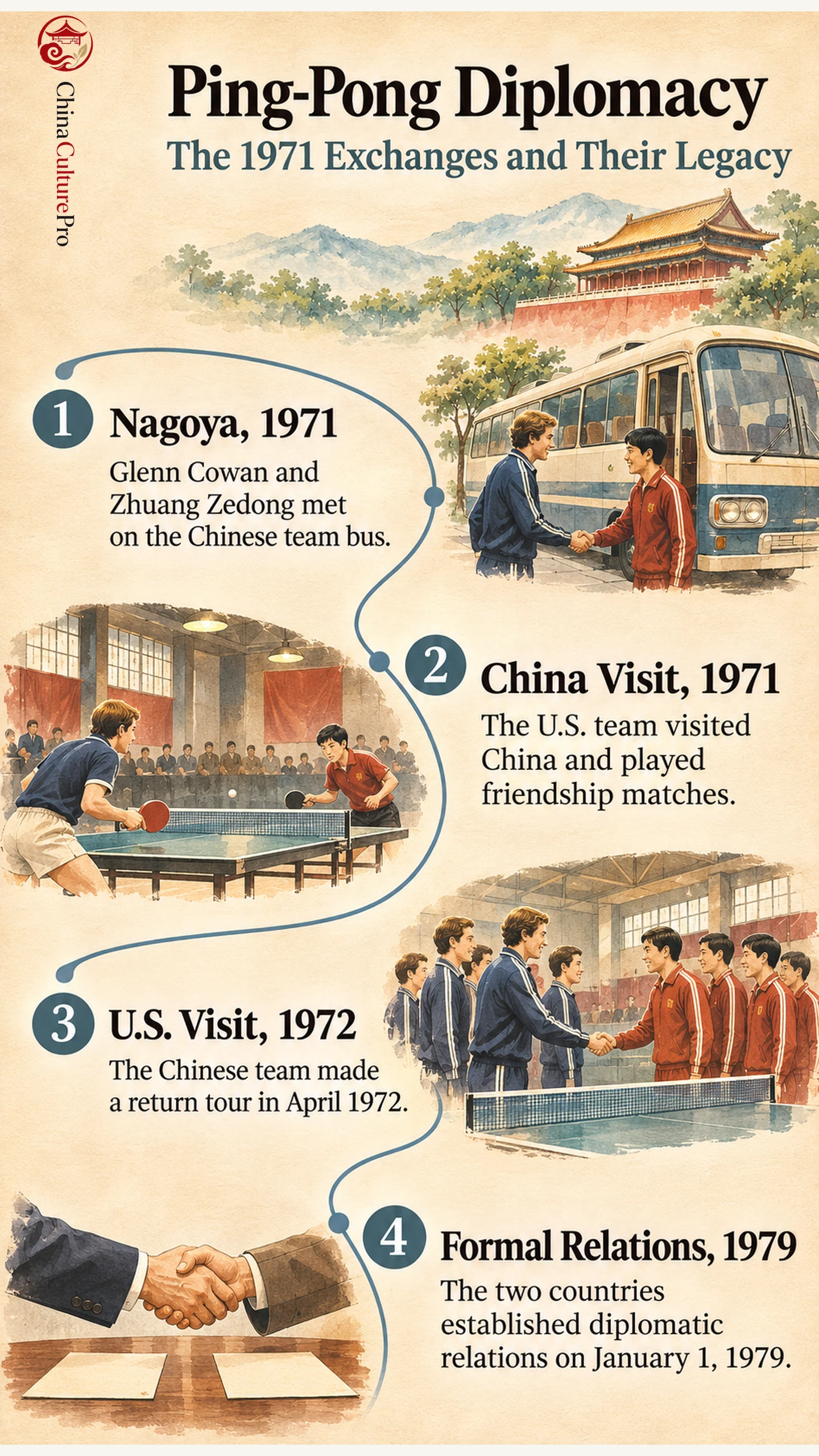
Ping-pong diplomacy (乒乓外交, pīngpāng wàijiāo) refers to early 1970s table tennis exchanges between the United States and the People’s Republic of China. After a photographed encounter that attracted media attention at the 1971 World Championships in Nagoya, China invited the U.S. team to visit. The Chinese team made a return trip to the United States in April 1972. The visits made renewed contact visible to the public as officials pursued a political opening. [1][2][3][4]
- Nagoya: American player Glenn Cowan and Chinese champion Zhuang Zedong met aboard the Chinese team bus. [1][2]
- The U.S. team in China: The team crossed from Hong Kong into mainland China on April 10, 1971, and played exhibition matches. [1][2]
- Formal relations: The sporting exchange preceded official U.S.–PRC diplomatic relations, which began on January 1, 1979. [3][5]
The matches became a public part of a much longer diplomatic process.
One of the objects from the 1971 trip is a U.S. passport with a country name crossed out. American player Connie Sweeris kept it, along with a pennant from a match and a translated banquet menu. Those objects show how quickly the U.S. team’s plans changed and what the trip meant beyond competition. [1]
How a Meeting in Nagoya Became Public
The 1971 World Table Tennis Championships took place in Nagoya, Japan. After practice, Cowan boarded the Chinese team’s bus. Zhuang approached him and offered him a woven silk image of Huangshan (黄山, Huángshān). Photographers captured the players together when they got off. The photographs took a gesture between two athletes beyond the tournament. The gift is a small example of how Huangshan imagery represents a recognizable place. [1][2]
On April 6, the U.S. team received an invitation from Chinese officials. The Americans accepted and made plans to continue from Japan. The athletes’ encounter became public, and officials turned it into a visit. On April 12, while the team was in China, Nixon and Kissinger discussed the invitation’s diplomatic implications in Washington. [1][3][6][7]
What the U.S. Team Did in China in April 1971
Before the team left, U.S. consular officials struck out “China” from a restriction printed in the players’ passports. The surviving document in Sweeris’s collection shows the change. On April 10 the party crossed a bridge from Hong Kong, then under British administration, into mainland China. Nine U.S. players made the trip. Their itinerary took in Beijing, Shanghai and Tianjin, and Premier Zhou Enlai (周恩来, Zhōu Ēnlái) greeted the delegation. [1][2]
The hosts billed the exhibitions as friendship matches. After a match in Shanghai, a Chinese player who had faced Sweeris gave her a pennant. Its inscription identifies the Shanghai women’s team and dates the match to April 1971. The delegation also visited sites such as the Forbidden City and attended banquets. Sweeris’s photographs and keepsakes document what the players did between matches, from sightseeing to meals with their hosts. The companion article on table tennis in China covers the sport’s separate history and everyday settings. [1][2]
The Return Visit and the Longer Diplomatic Opening
Washington and Beijing were already exploring ways to reopen contact. In July 1971, U.S. national security adviser Henry Kissinger made a secret trip to Beijing. President Richard Nixon visited in February 1972, when the two sides issued the Shanghai Communiqué. Later that spring, the sports exchange became reciprocal. The Chinese table tennis team toured the United States in April 1972, with the National Committee on U.S.–China Relations helping host the delegation. Zhuang led the Chinese team, and Nixon received the visitors at the White House. [3][4]
The United States and the People’s Republic of China established formal diplomatic relations on January 1, 1979. Nearly eight years passed between the first team visit and the establishment of formal relations. In the wider story of modern Chinese cultural history, the visits offer a well-documented example of athletes, hosts and ordinary spectators taking part in an opening that also involved private diplomacy. [1][3][4][5]
FAQs About Ping-Pong Diplomacy
Where did the famous meeting happen?
Glenn Cowan and Zhuang Zedong met on the Chinese team’s bus during the 1971 World Table Tennis Championships in Nagoya, Japan. Photographs of the two circulated afterward. [1][2]
When did the Chinese team visit the United States?
The Chinese team traveled to the United States in April 1972. The National Committee on U.S.–China Relations co-hosted the visit. [4]
When did the U.S. and the People’s Republic of China establish diplomatic relations?
Formal diplomatic relations began on January 1, 1979, almost eight years after the American team’s 1971 tour. [1][5]
Sources
[1] National Museum of American Diplomacy. Ping-Pong Diplomacy: Artifacts from the Historic 1971 U.S. Table Tennis Trip to China
[2] International Table Tennis Federation. On this day: Ping Pong Diplomacy born
[3] Office of the Historian, U.S. Department of State. Rapprochement with China, 1972
[4] National Committee on U.S.–China Relations. Table Tennis Delegation (1972)
[5] Foreign Relations of the United States. Address by President Carter to the Nation, including the Joint Communiqué
[6] U.S. National Archives. National Archives Highlights Ping Pong Diplomacy in August
[7] Foreign Relations of the United States. Editorial Note, April 12, 1971