


Quick Answer: What Were the Ming Yellow Registers?
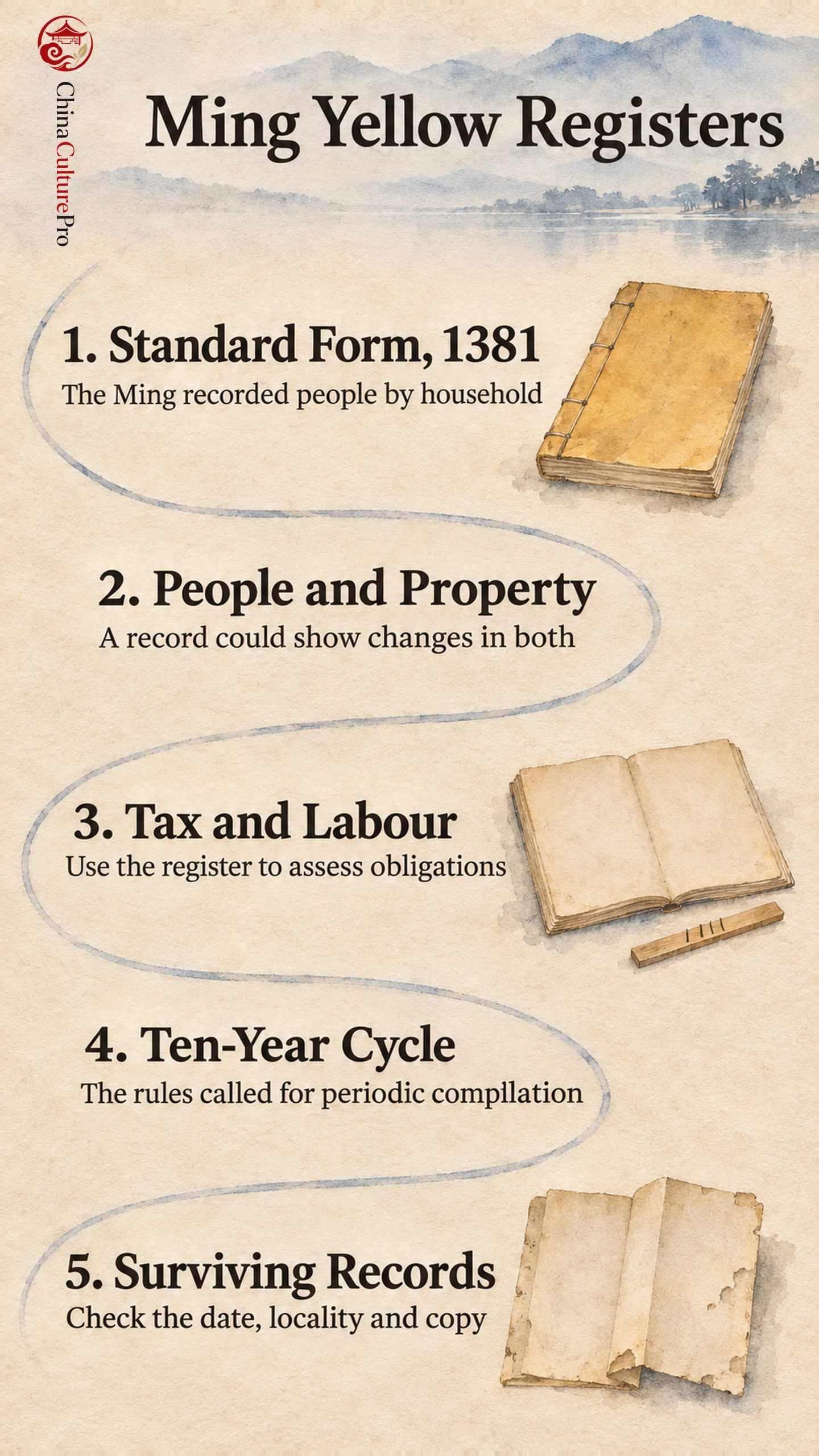
The Ming yellow registers (黄册, huángcè) recorded households for tax and labour obligations. A standard form was promulgated in 1381. The rules called for a new compilation at ten-year intervals, recording changes in people and property as part of an administrative cycle.[1][2]
- Unit: The household organized the entry.
- Purpose: Officials used the information to assess taxes and required service.
- Survival: Rare surviving fragments and archival copies show how particular records were made.
An entry records what officials registered. It cannot by itself establish everyone who actually lived in a place.
A family grew, a house changed hands or people moved away. On the next compilation, officials could enter such changes against the earlier record. A yellow register is valuable partly because it shows what the Ming state expected local officials to keep track of.
What a Household Entry Could Contain
Surviving records and studies describe people and property by household. Entries could record changes in membership and in assets such as land and buildings. The register grouped these details so that obligations could be assigned to an administrative household.[1][2]
Read the entries as categories made for officials. Registered population and people physically present are different measures. Changes could occur after an entry was made, and some people or property could escape reporting. For individual fields, inspect the particular register rather than treating a model form as proof of uniform practice.
How the Rolls Fit Local and Central Administration
The lijia (里甲, lǐjiǎ) organized households for local administration. The register and the lijia system worked together: one was a record and the other a way to organize obligations. The 1587 Ming statutes describe the planned ten-year compilation and its application to taxes and labour service.[1]
Copies could travel beyond the locality. The central repository at Houhu, today’s Xuanwu Lake in Nanjing, kept fiscal and service records. Those holdings were part of the record infrastructure of the Ming dynasty.[3]
What Survives and How to Read It
Scholars have identified rare surviving original registers, including some linked to the Houhu holdings. For many places the evidence is fragmentary, and historians also rely on statutes, gazetteers and discussions of the system.[2][4]
Use a surviving entry to ask what changed between two recorded dates. Check its locality, whether it is a draft or submitted copy, and what surrounding pages survive. For a question about the boundaries of a specific plot, Ming fish-scale land registers offer a different kind of record.
FAQs About Ming Yellow Registers
Was a Yellow Register a Census?
It recorded population through administrative households and helped assess obligations. A modern census question may require information the Ming records were never intended to provide.
Do Original Ming Yellow Registers Survive?
Some originals and fragments have been identified. The survival is uneven, so date, place and edition matter when you use an example.
Sources
[1] Leif Littrup, translator. Collected Statutes of the Ming Dynasty, Chapter 20
[2] Luan Chengxian. Study of Ming Yellow Registers
[3] Jinling Library. Ming Yellow Registers and the Houhu Archive
[4] Yi Ruolan. Research on Ming Household Registers and Surviving Accounts