

Quick Answer: What Is the Tusi System?
The tusi (土司, tǔsī) system let imperial courts govern parts of China through recognized local authorities, especially in the southwest. In many jurisdictions the ruler came from a hereditary household. The court granted a title and expected obligations in return, while local institutions continued to handle much of everyday government.[1][2]
- Authority: A local ruling family exercised power under an imperial title.
- Succession: A family claim to office still required official recognition.
- Replacement: Some domains later came under appointed officials. The change proceeded at different times.
The system took shape under the Yuan, expanded under the Ming and changed significantly under the Qing. Practice differed by place.
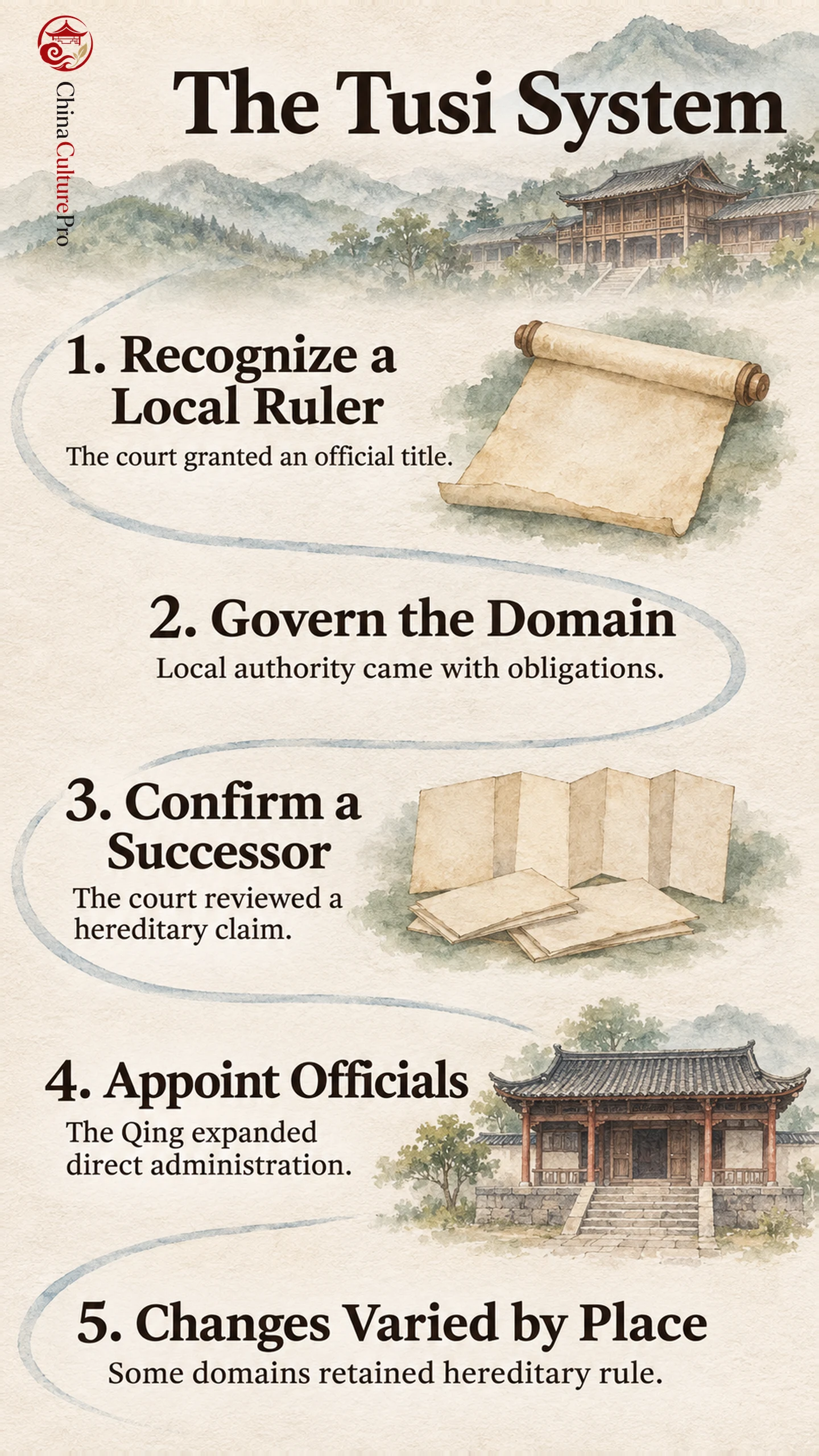
A ruling family might have the allegiance of its district and still need the court to recognize its next leader. This double relationship helps explain both the durability of the system and the disputes that arose when a title changed hands.
Appointment and Everyday Authority
A tusi could administer a local domain while acknowledging court authority. Rules linking the two levels covered matters such as taxes, tribute and succession. Titles and responsibilities varied, and local families drew authority from their own communities as well as from the imperial appointment.[1][2]
This arrangement helps explain part of the political history behind Chinese regional cultures. A single administrative label could cover communities with different languages and local customs. The ruler’s title gives evidence of an official relationship without identifying a whole community’s way of life.
How a Hereditary Claim Was Confirmed
A successor could inherit a family claim, but a new ruler still needed confirmation. Documented Ming procedures called for advance reporting of possible heirs and scrutiny of an applicant’s identity, including family records and local attestations. Provincial offices and central departments could both take part.[3]
The review mattered because families and branches could compete for the same office. The court’s decision could change which claimant had recognized authority. Read a particular succession in the context of court politics as well as family genealogy.
Qing Conversion to Appointed Rule
Gaitu guiliu (改土归流, gǎitǔ guīliú) meant replacing hereditary offices with regularly appointed officials. The Qing undertook a major push from 1726 under the Yongzheng emperor, creating or reorganizing regular administrative units in affected territories.[3]
The Nine Surname jurisdiction shows the uneven process. In 1731, Yongzheng reversed part of a local reorganization and restored significant administrative responsibilities to Ren Siye, its hereditary ruler.[4] The case places negotiated exceptions alongside broader state expansion in Chinese history.
FAQs About the Tusi System
Was Every Tusi an Independent Ruler?
A tusi had local authority with an imperial title and obligations. The balance of local power and court supervision varied across domains and reigns.
Did the Qing End the Tusi System at Once?
Replacement took place at different times. The Yongzheng government accelerated it, and some jurisdictions kept hereditary authority or recovered it after a dispute.
Sources
[1] UNESCO World Heritage Centre. Tusi Sites
[2] Yang Weibing. Research on Tusi Historical Geography and Southwest Frontier History
[3] Cao Zhenghan. Centralization and Decentralization in China
[4] Chinese Social Sciences Net. From Tusi Gazetteer to Township Gazetteer