


Quick Answer: Why Does the Chinese Phoenix Perch on Wutong?
The Chinese phoenix (鳳凰, fènghuáng) is traditionally said to favor the wutong (梧桐, wútóng) as a perch. In court imagery the pair can evoke a well-governed realm or a ruler whose virtue attracts talented people.[1][2]
- The tree. Some catalogues call it paulownia, while others use Firmiana.[1][3]
- The bird. A long tail and crest often set it apart from attendant birds.[1][2]
- The setting. Cranes, peonies or other companions can affect the emphasis.[1][4]
The work’s inscription or title can help identify the pairing.[2][3]
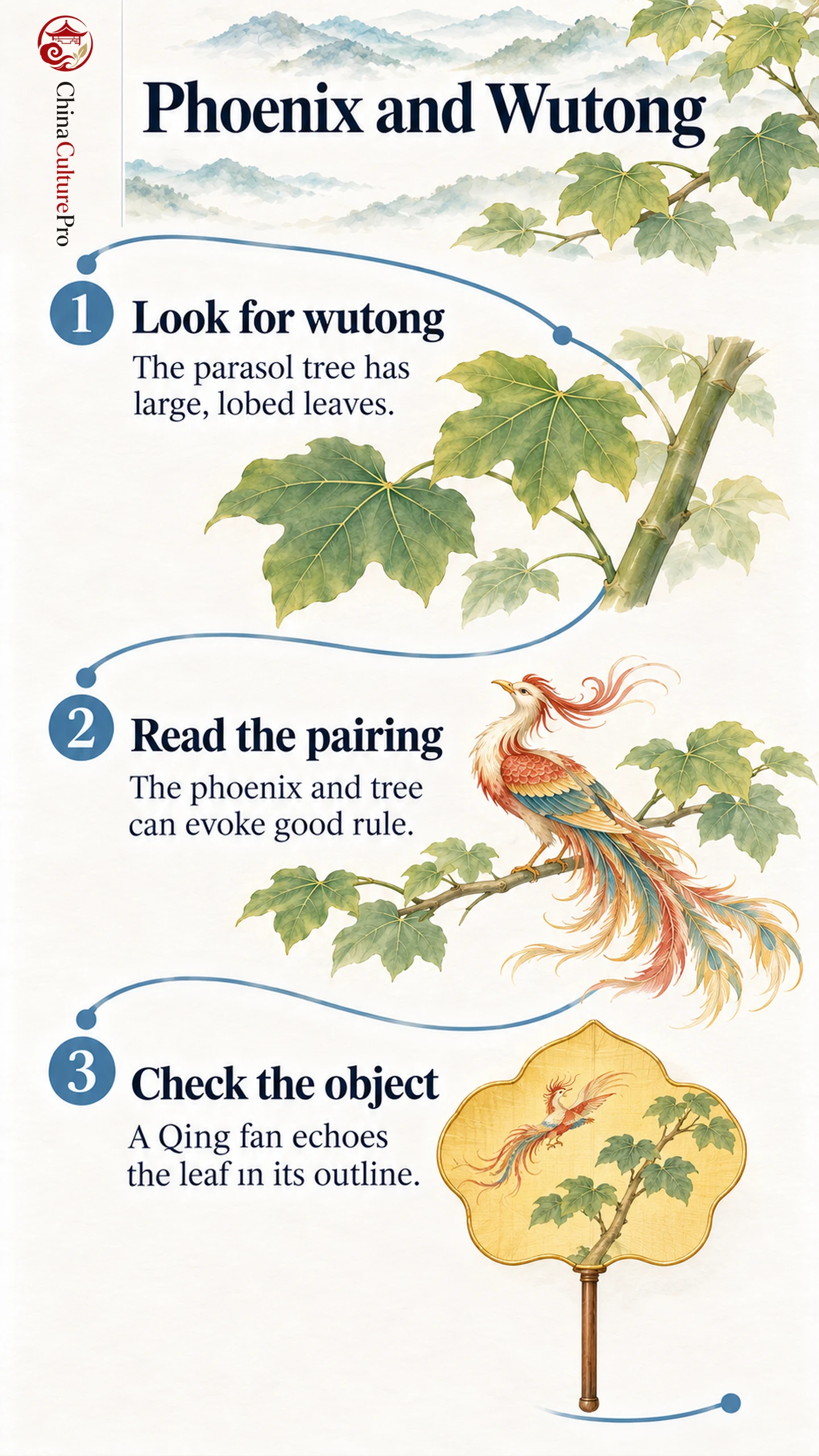
The same pair appears in a tall Qing hanging scroll and on a small fan with a yellow woven ground. In both, the tree gives the Chinese phoenix a place to appear. The object’s shape and its additional motifs change what a viewer notices first.[3][4]
Why Wutong Has Two English Names in Art Catalogues
The Smithsonian uses “paulownia” for wutong in its note on a phoenix and two cranes. The National Palace Museum calls the trees in Yang Dazhang’s painting Firmiana. In modern botanical usage, wutong usually refers to the Chinese parasol tree, Firmiana simplex. Paulownia is a separate genus that includes the empress tree. An English translation in a catalogue can identify the traditional motif without settling a precise botanical identification.[1][3][5][6]
What the Phoenix and Tree Can Say About a Court
The poem “Juan A” in the Classic of Poetry brings together a calling phoenix and wutong growing on a sunlit slope. A Qing commentary reads the flourishing tree and the bird’s arrival as a parallel for an honorable ruler attracting worthy people.[2][7]
Other birds can give the royal association a visible form. In a sixteenth- or seventeenth-century silk painting, a large phoenix towers over two cranes. An embroidered example uses the phoenix, wutong and several kinds of birds to evoke relationships including ruler and ministers. The hundred birds paying homage to the phoenix is a related composition in which the assembly itself becomes central.[1][2]
A Woven Fan and a Tall Painted Scroll
A Qing tapestry-woven fan at the Palace Museum takes the outline of a wutong leaf. A phoenix stands on the tree beside peonies and a garden rock. The leaf-shaped support repeats the tree motif in the object’s silhouette, and the double-sided weave allows the pattern to be seen from either face.[4]
Yang Dazhang’s Phoenixes Under Firmiana Trees, at more than three meters tall, gives the birds room to appear beneath the canopy. The fan turns the leaf into a physical frame. The scroll gives the trunks and canopy a vertical span of their own.[3][4]
FAQs About Paulownia and Phoenix Motifs
Does the bird have to be sitting on the tree?
A perch makes the pairing explicit, as on the Qing fan. The same association can be visible when the birds stand beneath the trees, as in Yang Dazhang’s scroll.[3][4]
Do broad leaves prove that a painted tree is wutong?
Large lobed leaves are a clue to the Chinese parasol tree. In stylized art, a title, inscription or the bird accompanying the tree can provide stronger evidence for the motif.[1][3][5]
Sources
[1] Smithsonian National Museum of Asian Art. A Phoenix and Two Cranes Under a Tree
[2] National Palace Museum. Study of the Song embroidery of the five relationships
[3] National Palace Museum. Yang Dazhang, Phoenixes Under Firmiana Trees
[4] Palace Museum. Yellow tapestry-woven fan with a phoenix in a wutong tree
[5] NC State Extension. Wutong, Firmiana simplex
[6] NC State Extension. Princess tree, Paulownia tomentosa
[7] Chinese Text Project. Imperially compiled commentary on the Classic of Poetry, volume seventeen