

Quick Answer: What Was the Nine-Rank System?
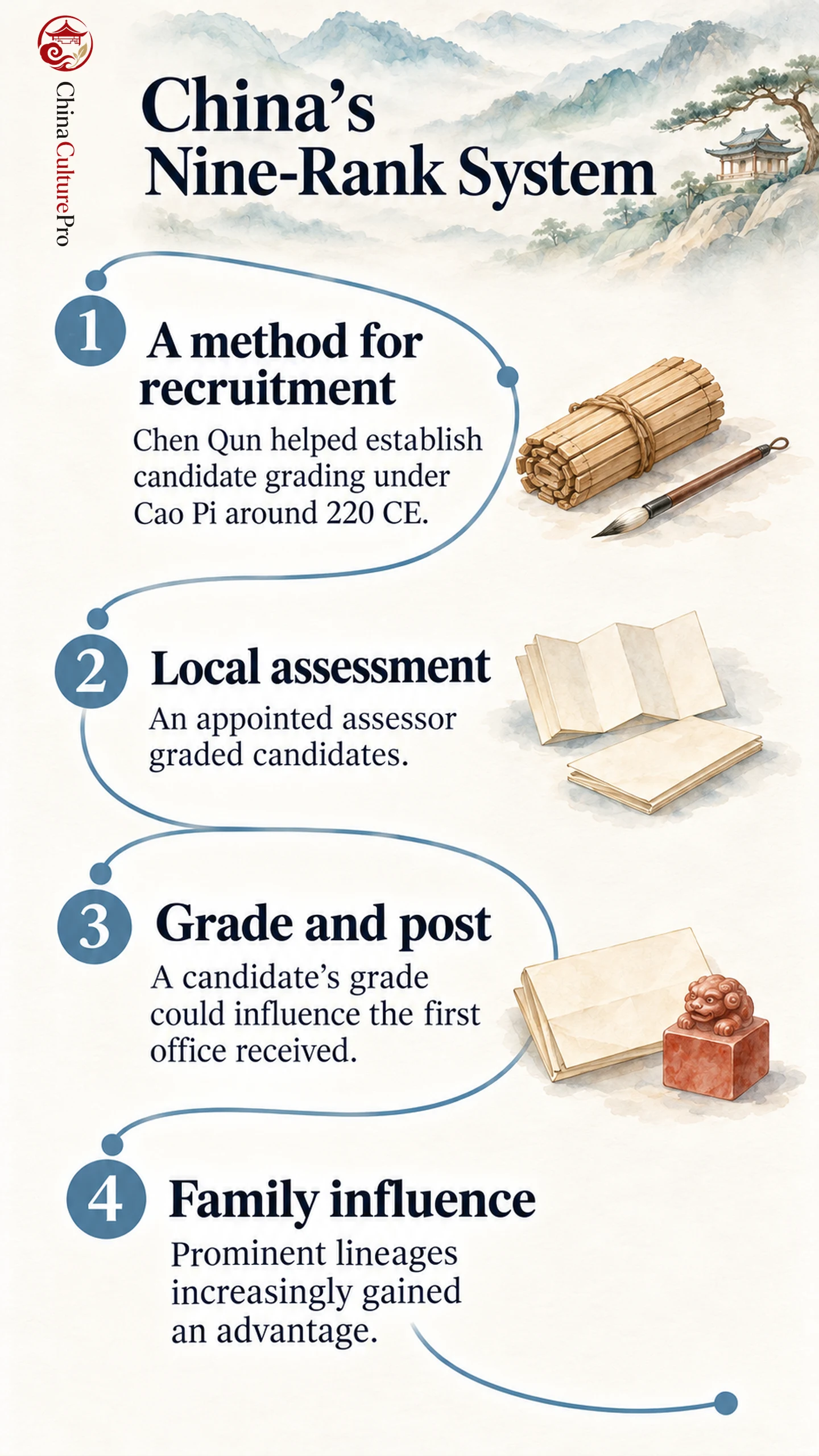
The Nine-Rank System (九品中正制, Jiǔpǐn Zhōngzhèng Zhì) was a method of evaluating men for government service. It took shape under Cao Pi around 220 CE. Appointed assessors gave candidates one of nine grades, which helped the government decide what jobs they could enter.[1][2][3]
- Assessment: Officials drew on local knowledge of a candidate’s reputation, ability and background.[2][3]
- Appointment: A candidate’s grade influenced the choice of first post.[2]
- Family standing: Elite lineages gained an advantage as the system developed.[2][3]
When reading about a rank, identify whether it belongs to the person’s assessment or the office.[2]
A candidate could be known in his home region and still need a government appointment. The Nine-Rank System connected those two stages by turning a local assessment into information that officials responsible for appointments could use.[2][3]
Chen Qun and the Cao Wei Recruitment Problem
The Records of the Three Kingdoms credits Chen Qun with establishing the method under Cao Pi. The political setting was the transition from the late Han to Cao Wei, part of the Three Kingdoms period. The grading system gave the government a common framework for comparing candidates from different localities.[1][2][3]
An assessor called a zhongzheng (中正, zhōngzhèng), often rendered “rectifier,” graded men associated with his locality. A central official might hold this responsibility alongside another appointment. Assessments combined knowledge of individuals with information about family standing and then entered a process of higher-level review.[2][3]
Candidate Grade and Office Rank
| Stage | What the rank refers to |
|---|---|
| Candidate assessment | The grade assigned to a person for purposes of recruitment.[2][3] |
| Entry appointment | The rank of the post the personnel authorities assigned. The candidate grade could influence this assignment.[2] |
| Later career | The positions a person held and the opportunities open to them. Starting grade and post could shape advancement.[2] |
A high assessment typically improved access to a desirable first office. To interpret a number in a record, first identify its subject. Someone’s assessment may help explain an appointment. The office rank describes the position the person actually held.[2][3]
How Family Standing Shaped Access
Character and ability appeared among the criteria. A family’s standing could offer an advantage of its own. Prominent lineages increasingly supplied assessors and benefited from favorable grades. Under the Western Jin and in parts of the later divided period, high candidate grades were closely tied to established families. The pattern differed across regimes.[2][3]
Changes in recruitment took shape over time. The older grading system ended in the Sui, and Chinese imperial examinations became increasingly important under later dynasties. The shift changed how a candidate’s qualifications could be demonstrated, while family status continued to matter in society.[2][3]
FAQs About Nine-Rank System
Who introduced the Nine-Rank System?
The Records of the Three Kingdoms credits Chen Qun with setting up the system under Cao Pi, around 220 CE.[1][2][3]
Was a candidate’s grade a government position?
The grade evaluated a person for recruitment. It could affect what post a candidate might receive, while the rank of that post described its place in government.[2][3]
Did examinations replace the system all at once?
Recruitment changed over the late Northern and Southern Dynasties and the Sui and Tang. Examinations gained importance over time alongside other channels.[2][3]
Sources
[1] Records of the Three Kingdoms, Chinese Wikisource. Juan 22, biography of Chen Qun
[2] Cambridge University Press. The Political Economy of China’s Imperial Examination System, section 2.2
[3] Berkshire Encyclopedia of China. Nine-Rank System for Government Recruitment