
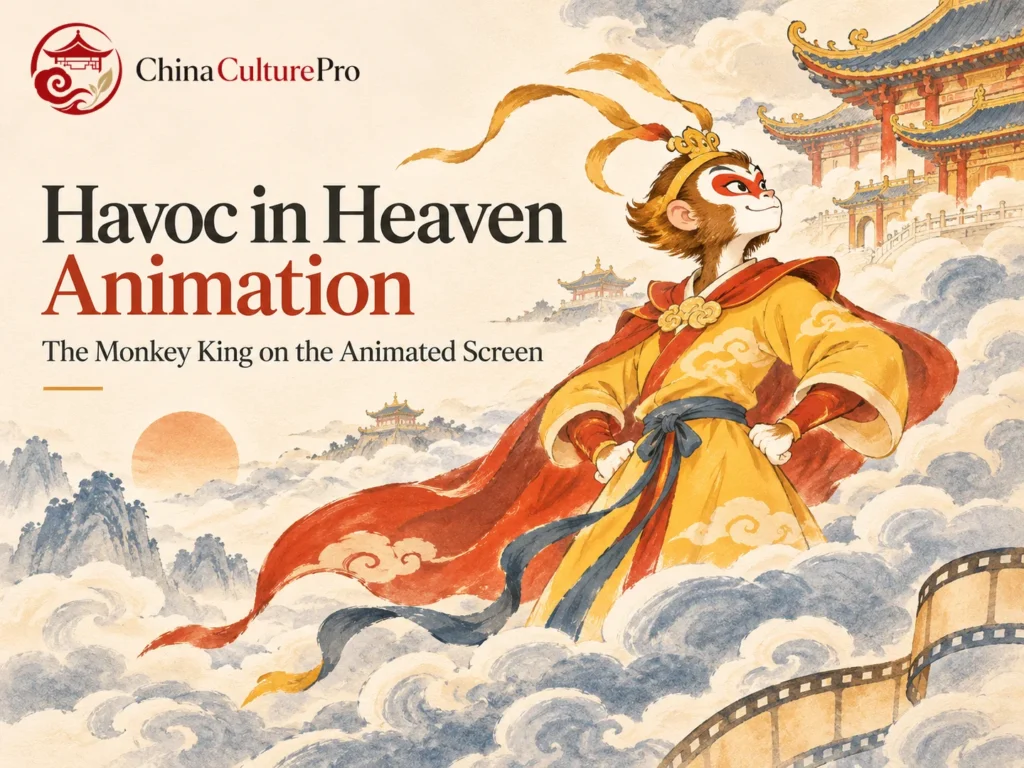

Quick Answer: What Is the Havoc in Heaven Animation?
Havoc in Heaven (大闹天宫, Dà Nào Tiāngōng), also catalogued as Uproar in Heaven, is a Chinese animated film based on the early episodes of Journey to the West (西游记, Xīyóu Jì). Its hero is the Monkey King, Sun Wukong (孙悟空, Sūn Wùkōng).[3]
- The first and second parts were completed in 1961 and 1964.[6][7]
- Its face designs, gestures and percussion draw on Peking opera (京剧, jīngjù).[2][3]
- The film ends with the Monkey King returning to Flower-Fruit Mountain (花果山, Huāguǒ Shān) in triumph.[4]
The two dates identify the original production and help distinguish it from later editions.

The animated Monkey King wears his defiance in the turn of his head and the shape of his face. The film’s drawings and musical cues make those choices visible and audible even to a viewer who has never read the novel.
Who Made the Two-Part Film?
The production team was formed in December 1959 at Shanghai Animation Film Studio. Wan Laiming directed, working with Tang Cheng and an art team that included Zhang Guangyu. The two parts were completed in 1961 and 1964.[1][6][7] Those credits distinguish the studio project from the broader history of the Wan brothers’ work.
Zhang supplied multiple proposals for the Monkey King. Archival accounts describe a production problem with one design: fine lines in the headdress made it difficult to animate. Wan asked animator Yan Dingxian to rework the model with clearer lines and stronger colours.[1] The simpler outline made the model more practical for a character repeatedly drawn in motion.
How the Film Changes the Novel
Wukong acquires his staff in the Dragon King’s palace. He is given an office in heaven, discovers its low rank and defies the celestial court.[6] The Jade Emperor belongs to the court he confronts.[2] The film focuses on the Monkey King’s contest with that court.
The film closes with Wukong back at his mountain home and the banner proclaiming him Great Sage Equal to Heaven raised again.[4] Chapter 7 of the novel takes the story in another direction. The Buddha holds Wukong under the Mountain of Five Phases.[5] The difference gives the animated story a stopping point that makes the Monkey King’s return its final image.
Where Peking Opera Enters the Animation
The connection is both visual and musical. The face is organized around large areas of colour and clear outlines, making it legible at a distance, a visual quality shared by stage makeup. Poses and changes in pace recall stylized stage action. The percussion supplies audible accents for changes in movement and emphasis.[2][3]
The cast includes Nezha as a figure in the celestial conflict.[2] The later animation Nezha Conquers the Dragon King gives the character a film of his own. It is one way to see how Chinese animation uses mythology to build different stories around familiar figures.
How to Identify a Version
Catalogues give different runtimes, including 112 and 114 minutes.[2][3]
Use the production dates together with the title and credits to distinguish the film from later editions.
The 2012 3D edition involved restoration and digital processing of earlier footage.[7] Its date refers to that edition. A listing for Uproar in Heaven can still refer to the 1960s film when the credits and version match.[3]
FAQs About Havoc in Heaven
Are Havoc in Heaven and Uproar in Heaven the same film?
Yes. The American Film Institute lists the two as alternate titles.[3]
Why do I see both 1961 and 1964?
The first part was completed in 1961 and the second in 1964.[6][7]
Does the film end as Chapter 7 does?
The film ends with the Monkey King returning triumphantly. In the novel’s seventh chapter, the Buddha pins him under a mountain.[4][5]
Sources
[1] Shanghai Municipal Archives. Archival history of Havoc in Heaven
[2] Hong Kong Leisure and Cultural Services Department. Havoc in Heaven screening programme
[3] American Film Institute. The Monkey King: Havoc in Heaven
[4] Shaopeng Chen, University of Southampton. Thesis on Chinese animated film and the Monkey King
[5] Journey to the West. Chapter 7: Sealed Under the Five Phases
[6] Tsinghua University Press. A study of the two parts of Havoc in Heaven
[7] Shanghai municipal release reprinted by Changjiang Daily. 100 Shanghai animation classics