


Quick Answer: How Did Early Chinese Steelmaking and Quenching Differ?
Early Chinese steelmaking changed the carbon content of iron. Quenching (淬火, cuìhuǒ) changed the structure of suitable steel through rapid cooling, which could make it harder. Both are documented in archaeological research on early Chinese ironwork.[1][2][3]
- Starting with cast iron: Some workers removed carbon from cast iron to make steel or lower-carbon iron.[2][4]
- Starting with lower-carbon iron: Other workers added carbon to iron made by a different route.[3][4]
- Changing the finished metal: Evidence from some objects points to quenching, including treatment concentrated in selected areas.[1][2]
A dated find documents a technique at that site. Establishing where it began takes more evidence.[1][2][3]
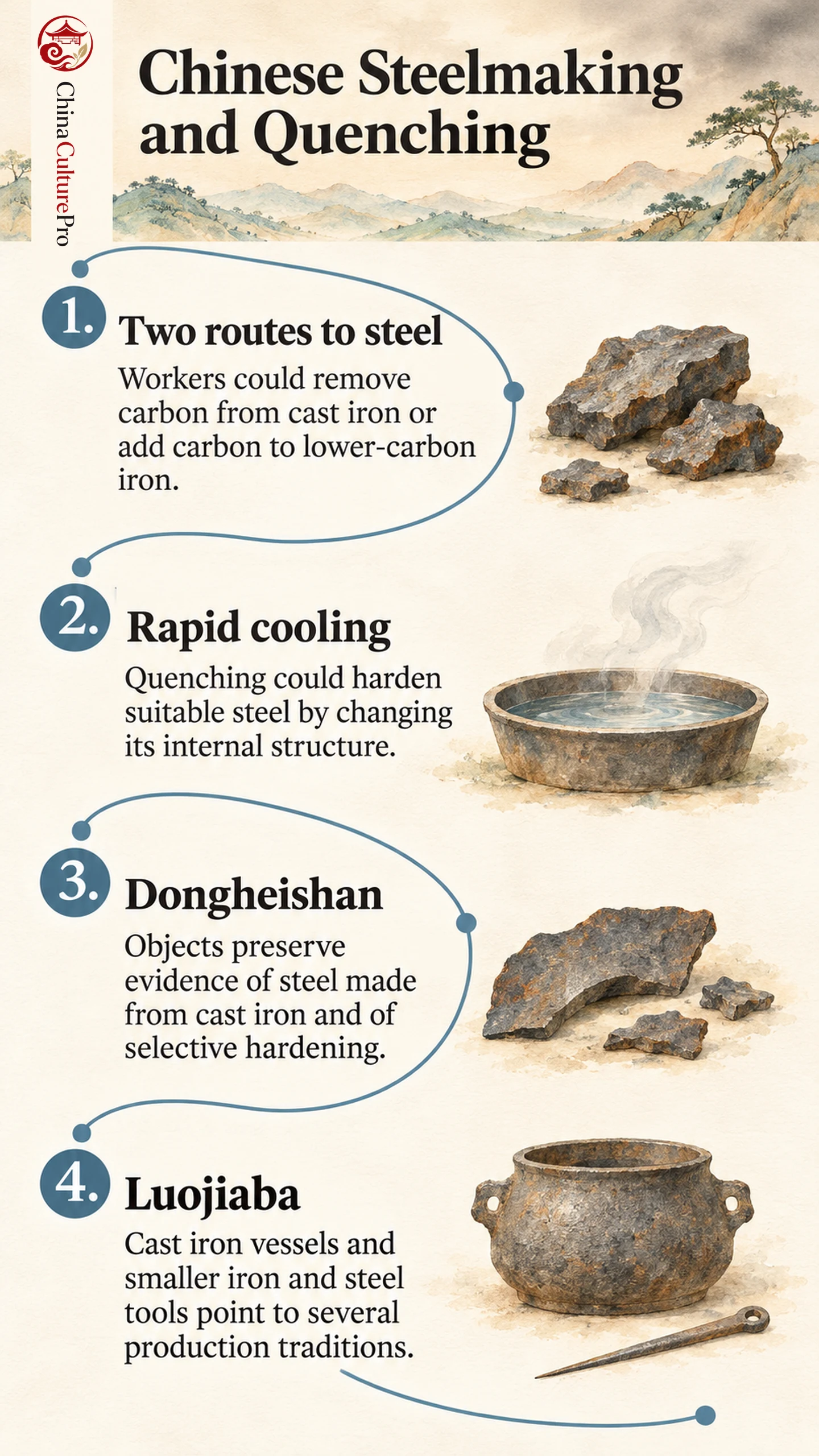
A Han iron container and an awl can look alike under corrosion. A section through the metal may reveal that one was poured into a mould and the other forged or enriched with carbon.[3][4]
Two Routes to Early Chinese Steel
One route began with the material used in Chinese iron casting. Cast iron contains more carbon than typical steel, and molten iron could be poured into a mould. Some excavated objects preserve evidence of decarburization, the removal of carbon from that starting material. Depending on how much carbon remained, the resulting metal could be steel or lower-carbon iron. Some museum samples show this transformation had taken place in the solid state after casting.[2][4]
Another route began with lower-carbon iron. A bloomery yields a solid, slag-bearing mass that smiths can consolidate by working. Iron could also be produced by refining higher-carbon furnace iron. Some low-carbon pieces were then carburized, which means they took up carbon. In a cross-section, carbon can vary between the outside and the interior. These variations and the inclusions trapped in the metal help researchers assess how a piece was made.[3][4]
Finished objects can combine more than one metal or treatment. Microscopic examination of early Chinese pieces has found layers joined by forge welding. A catalogue term such as “iron tool” often identifies the object at a broader level than a materials study can.[4]
What Quenching Changed in the Metal
Rapid cooling can harden suitable steel by changing its internal structure. This differs from removing or adding carbon. A sample can carry evidence of both operations, since a worker could first produce steel and then harden a selected part of the object. Evidence from northern China indicates quenching was among the treatments early metalworkers used.[1][2]
Why harden only part of a piece? A hard working surface can resist wear while the rest of the object retains other useful properties. Archaeologists can compare different areas in the same sample to see whether the structure changes near a working surface. They also consider whether a difference could come from carbon content, separate joined pieces or a later heating event. An identification depends on the distribution and character of those features.[1][2][4]
A recognizable object shape helps establish probable use. It rarely settles how the metal was made. A thin cross-section can expose structures hidden by corrosion, while slag inclusions can preserve traces of production. An awl’s form can suggest piercing, for example, while a cross-section can indicate whether the working end and the body had different structures. The find context helps date the object independently of those metallurgical observations.[2][3][4]
What the Finds at Dongheishan and Luojiaba Show
At Dongheishan in Hebei, researchers studied iron objects from the former Yan region, largely dating to the Warring States period and the Han dynasty. They combined radiocarbon dating with examination of metal structure and slag inclusions. The objects included cast iron and steel derived from cast iron. Their study also identified early evidence of quenching and selected quenching. Most radiocarbon results agreed with the dates inferred from the finds’ archaeological context.[2]
Luojiaba in eastern Sichuan presents a different picture. The study examined 17 iron objects from Han dynasty contexts. Cast iron in the sample was used chiefly for vessels and plates. Lower-carbon iron and steel were associated with smaller implements such as awls and knives. The researchers found evidence for bloomery iron and steel made through refining, and some materials may have arrived from outside the area.[3]
The two studies are strongest when read object by object. Dongheishan supplies evidence of quenching alongside a cast-iron route to steel. Luojiaba shows several production traditions represented at one site. For a broader picture of how ironworking fits among Chinese inventions, the most useful comparisons start with dated objects. The guide to Chinese historical sources explains how to weigh an excavated object alongside the modern study that interprets it.[2][3]
FAQs About Early Chinese Steelmaking
Did all early Chinese steel come from cast iron?
Early Chinese ironworkers also made steel by adding carbon to lower-carbon iron. Archaeological and museum studies identify several routes, and their relative importance varies by site and sample.[3][4]
Can an excavated object reveal the quenching liquid?
A metal sample can retain evidence of rapid cooling. Identifying a particular liquid usually requires evidence beyond the surviving internal structure, such as a reliable account tied to the work or production site.[1][2]
Was steelmaking established before the Han iron monopoly?
Evidence from iron objects indicates steel production and hardening were already in use before the state monopoly introduced in 117 BCE. Excavated workshops from the earlier period are much scarcer than finds from after the monopoly, so some details of production remain uncertain.[1][2]
Sources
[1] Donald B. Wagner. Ferrous Metallurgy in Han China
[2] Haifeng Liu and colleagues. Iron and Steel Making in the Yan Region
[3] Gaobo Li and colleagues. Scientific Analysis of Han Dynasty Iron Artifacts from Luojiaba
[4] Michael Wayman and Carol Michaelson. The Metallurgy of Early Chinese Wrought-Iron and Steel Objects from the British Museum