

Quick Answer
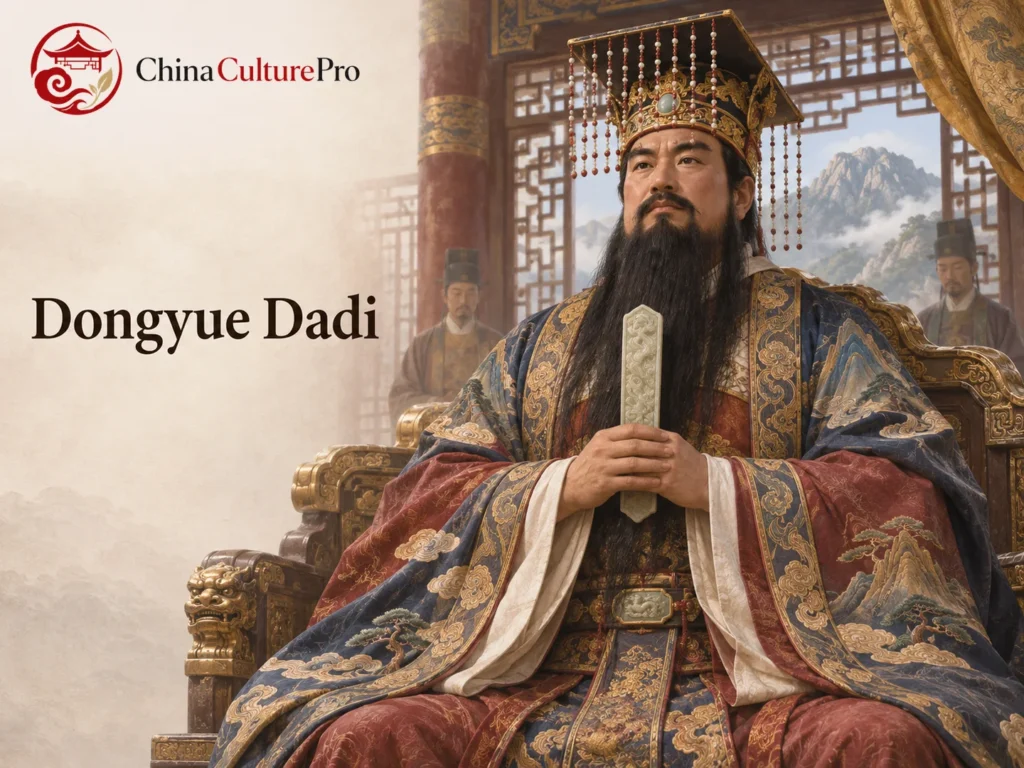
Dongyue Dadi (東嶽大帝, Dōngyuè Dàdì), the Great Emperor of the Eastern Peak, is the deity of Mount Tai (泰山, Tàishān) in Shandong. In Daoist and folk traditions he also oversees matters of life, death, and judgment. Temples and devotional prints often depict that authority in the language of a human court.[1][2][3]
- Sacred mountain: The Eastern Peak in his title is Mount Tai.
- Divine jurisdiction: Stories and rites link his court with human lives and the dead.
- Images: A court tablet, crown, and attending officials can identify his authority.
The details of his court and relationships with other deities vary by tradition.[1][2]
A black-ink devotional print catalogued in Taiwan shows Dongyue Dadi in a chair, holding a court tablet. Two officials flank him, and words wishing peace and household protection appear beside his head. The wish is written beside a figure whose authority extends beyond the household.[3]
How the Eastern Peak Became a Local Temple God
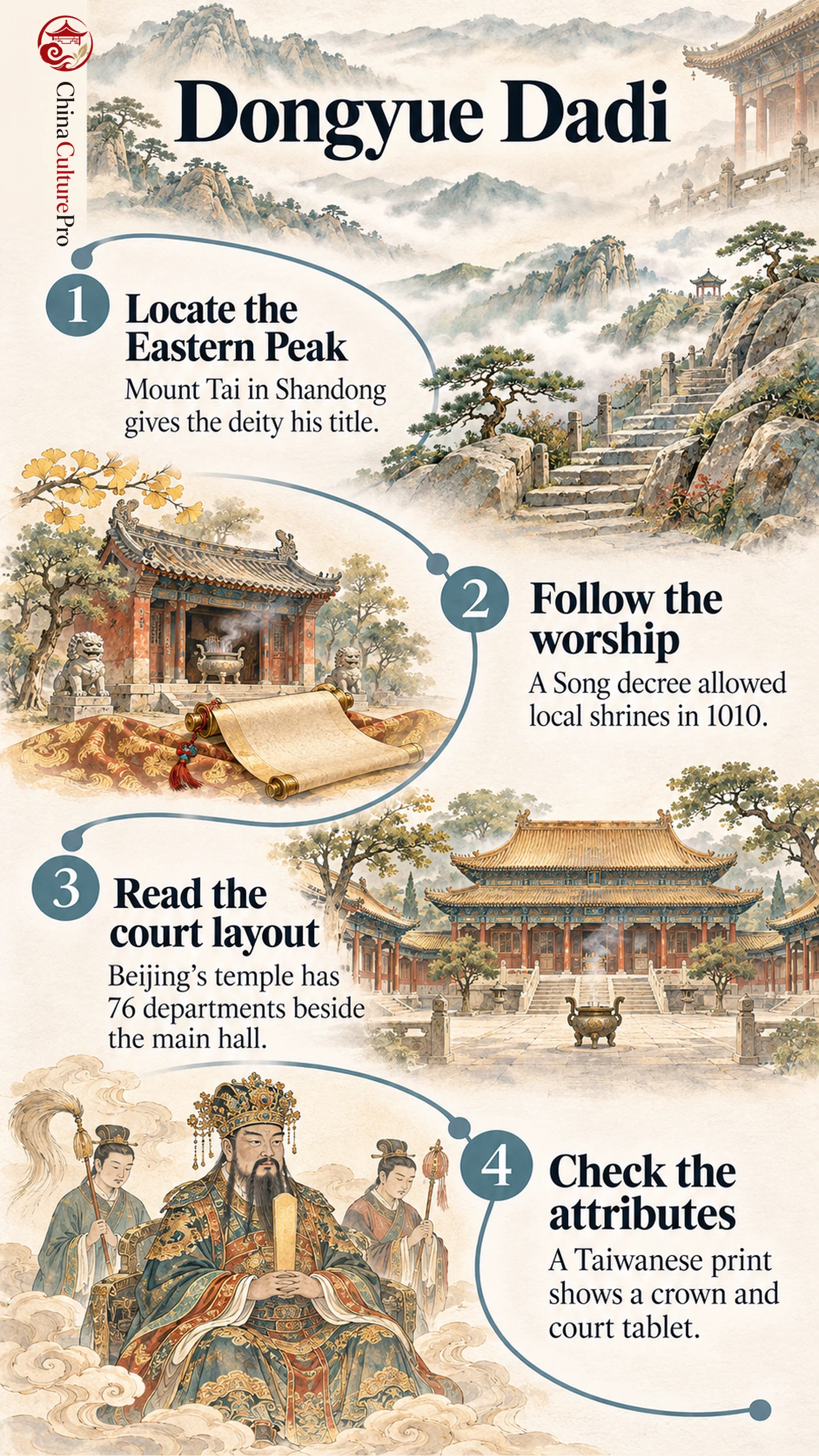
Mount Tai was a site of imperial rites and popular pilgrimage. In 1010, Song emperor Zhenzong granted permission for local temples to the Eastern Peak deity in response to a request from people in Shanxi who found pilgrimage to the mountain too distant. A local shrine could bring worship of the peak within reach.[1]
The title “Eastern Peak” therefore identifies the mountain even on an image made far away. The guide to China’s sacred mountains gives the wider geographic context. Worship on Mount Tai itself also includes Bixia Yuanjun (碧霞元君, Bìxiá Yuánjūn), a goddess with a distinct following.[1][2]
Why Dongyue Dadi Has a Court
Records and ritual traditions associate the deity with jurisdiction over the dead and the length of human lives. The structure of the court can differ across accounts. Some Buddhist texts include the Eastern Peak deity among the Ten Kings, while other traditions portray him supervising kings or departments.[2][3]
At Beijing’s Dongyue Temple, 76 departments are arranged on the two sides of the Daiyue Hall. Couplets outside the halls describe the duties of the departments, connecting their organization with ideas of conduct and recompense. The layout makes the court metaphor visible. For related forms of divine administration, see Chinese folk religion.[4]
How to Recognize the Deity in a Print or Statue
On the Taiwanese print, the title is written beneath an illustrated roof. The seated deity has a long beard and ceremonial crown, and the figures beside him hold tablets. Those details evoke a court. The inscription is the strongest clue that this particular official is Dongyue Dadi.[3]
A camphorwood statue in a different Taiwanese collection shows him standing in military dress, his left hand pointing upward and his right hand at his waist. Its catalogue records a Taiwanese association with the figure Huang Feihu (黃飛虎, Huáng Fēihǔ). The two objects show why a seated pose and a court tablet are useful clues without being universal features.[3][5]
FAQs About Dongyue Dadi
What does Dongyue Dadi mean?
The title means “Great Emperor of the Eastern Peak.” The peak is Mount Tai in present-day Shandong.[1][2]
Is Dongyue Dadi the same deity as King Yama?
They are distinct figures in the traditions discussed here. Some accounts place both within the courts of the dead, while others give the Eastern Peak deity a supervisory role.[2][3]
Is worship of Dongyue Dadi limited to Mount Tai?
His mountain gives him his title. By the Song, devotees could worship the deity at local shrines far from the mountain, and later temples are documented in places including Beijing.[1][3][4]
Sources
[1] Journal of Chinese Humanities. Communicating Civilization Through Rituals: Mount Tai Pilgrimages in Song China, 960–1279
[2] Religions. Form Follows Function in Community Rituals in North China
[3] National Museum of Taiwan History. Dongyue Dadi devotional print, 2007.001.0024
[4] Beijing Municipal Ethnic and Religious Affairs Commission. The history and architecture of Beijing’s Dongyue Temple
[5] Taiwan Historica. Camphorwood Dongyue Dadi figure, 19930010388