


Quick Answer: What Are the Ancient Koguryo Sites in China?
The Capital Cities and Tombs of the Ancient Koguryo Kingdom preserve three city sites and 40 tombs associated with Koguryo (高句丽, Gāogōulí), an ancient polity also written Goguryeo. The Chinese World Heritage property includes Wunu Mountain City in Liaoning and the Ji’an group in Jilin, where Guonei, Wandu and the tombs are located. [1][2]
- Terrain: The city sites include distinct ways of using a mountain setting and an area beside a river. [1][2]
- Burials: UNESCO classifies 14 as royal tombs and 26 as tombs of nobles. Some preserve paintings or distinctive chamber ceilings. [1]
- Written evidence: The Gwanggaeto Stele, called the King Haotai Stele in the nomination, preserves an account associated with the royal court. [1][3]
The listing describes specific sites in present-day China. The ancient kingdom extended across a wider area.
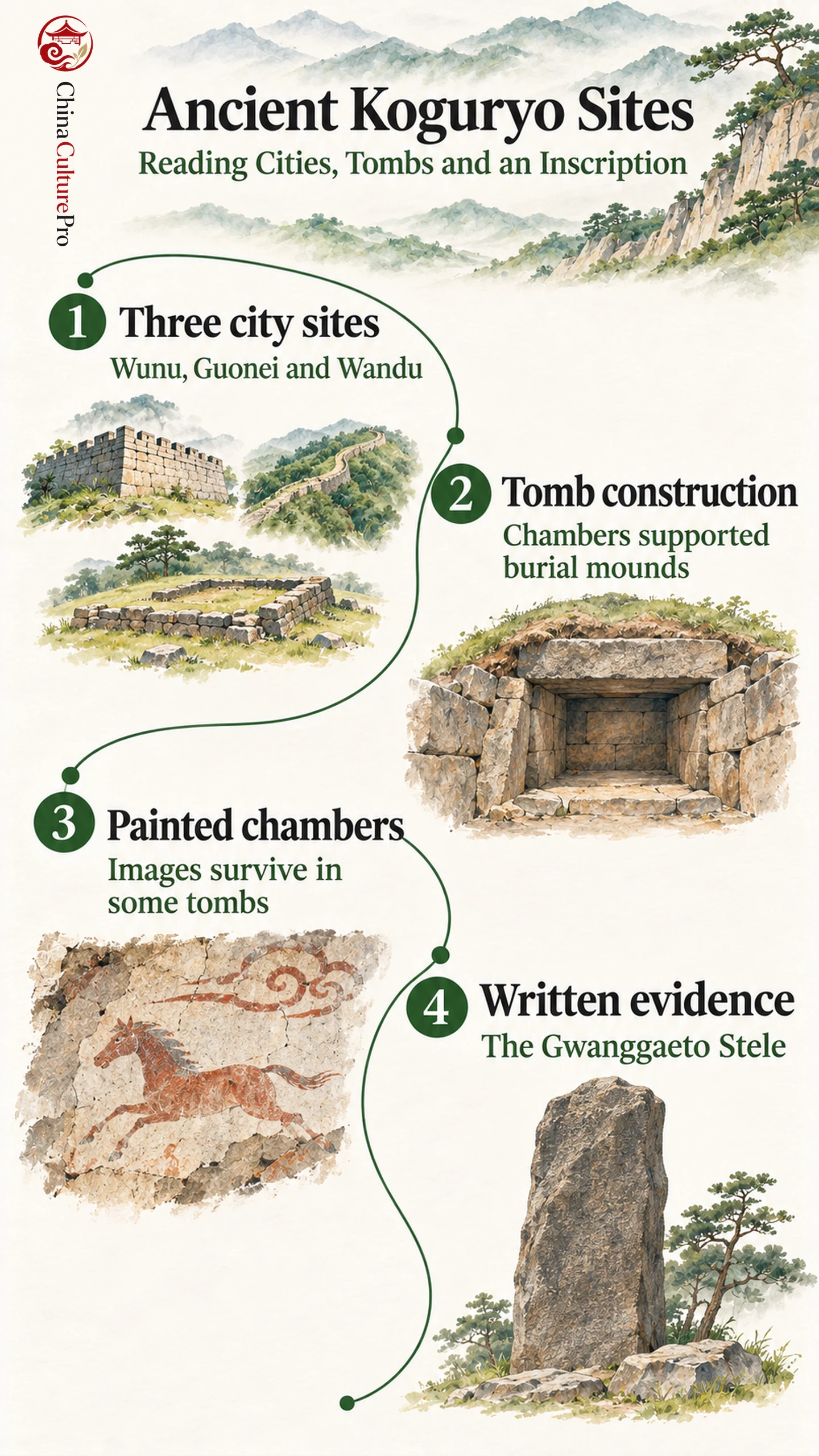
A city wall, a painted burial chamber and an inscription can all tell you about Koguryo. Each has a different relationship to the people who commissioned it and to the place where it survives.
The Three City Sites Compared
| City site | Present-day location | What the remains show |
|---|---|---|
| Wunu Mountain City | Huanren County, Liaoning. [1][2] | A mountain site whose excavated sections preserve traces of an early Koguryo capital. [1][2] |
| Guonei City | Within present-day Ji’an, Jilin. [1][2] | A fortified city that also remained a supporting capital after the move to Pyongyang. [1] |
| Wandu Mountain City | Near Guonei in Ji’an, Jilin. [1][2] | A mountain enclosure with palace remains and associated burials. [1][2] |
Guonei and Wandu served as centers for centuries. ICOMOS dates the transfer of the principal capital to Pyongyang to 427 CE. The way an urban site and mountain site sit near each other matters as much as either site’s walls alone. A different capital landscape survives at the much later site of Xanadu, where grassland and enclosures show how a seasonal court used space. [1][2]
What the Tombs and Stele Record
Among the tombs are chambers whose ceilings span the burial space without columns while supporting a substantial mound. That structural achievement can be observed separately from a chamber’s decoration. The complexity of construction puts these remains in conversation with other elite tomb architecture in China. [1][2]
Some tombs preserve painted chambers, and others are known chiefly for their structure. The surviving painted scenes can reflect selected settings and images associated with elite burial. Their selection and the expense of the chambers also show why they cannot stand for an entire society. [1][2]
The inscribed Gwanggaeto Stele gives a royal view of the kingdom’s past and activities. The nomination names it as a separate piece of evidence in Ji’an. Compare its claims with city remains and burials, which record a different side of court and elite life. [1][3]
FAQs About the Ancient Koguryo Sites
Are Koguryo and Goguryeo different kingdoms?
They are spellings used for the same ancient kingdom. The English name of the World Heritage property uses Koguryo. [1][2]
Are the tombs in both countries covered by the same listing?
The sites in China form one World Heritage property. UNESCO lists the Complex of Koguryo Tombs in the Democratic People’s Republic of Korea separately. [1][4]
Where were the 40 tombs in the China inscription found?
UNESCO puts the 40 listed tombs in Ji’an municipality in Jilin. Wunu Mountain City is a separate city component in Liaoning. [1]
Sources
[1] UNESCO World Heritage Centre. Capital Cities and Tombs of the Ancient Koguryo Kingdom
[2] ICOMOS. Evaluation of the Ancient Koguryo Kingdom Nomination
[3] UNESCO World Heritage Centre. Capital Cities and Tombs of the Ancient Koguryo Kingdom Nomination
[4] UNESCO World Heritage Centre. Complex of Koguryo Tombs