


Quick Answer: What Time Do People Eat in China?
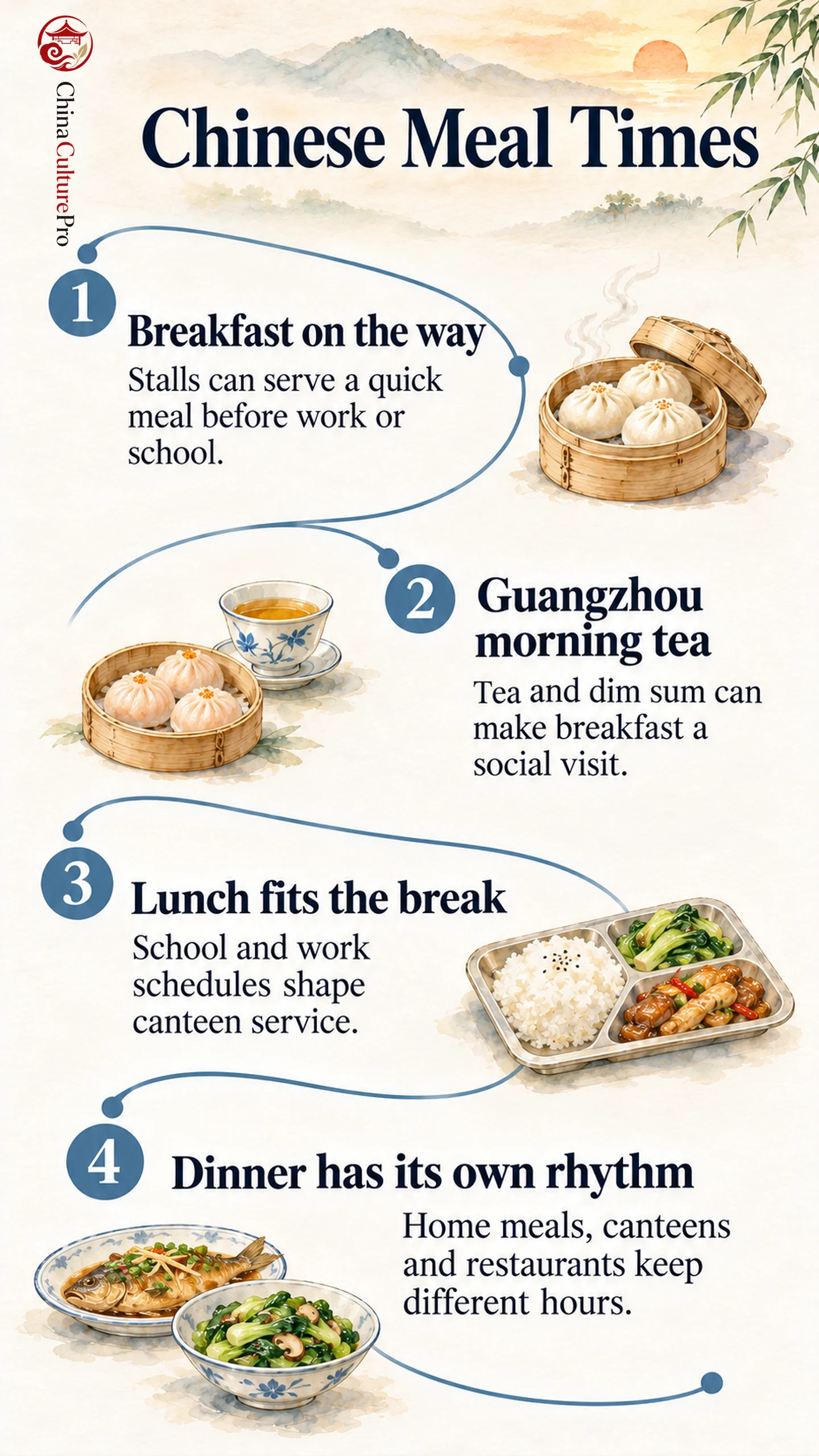
Breakfast before work or school, lunch around a midday break, and dinner in the evening form a familiar pattern in China. The actual hour depends on place, occupation and venue. Campus canteens can serve in strict windows, while an evening restaurant or a breakfast teahouse follows its own schedule.[1][2][3][4]
- Breakfast: A quick stall meal and a longer teahouse gathering fit different routines.[3][4]
- Lunch: A school timetable or a work break can concentrate demand around midday.[2][4]
- Dinner: A family meal, a canteen and a restaurant can all start at different hours.[2][4]
Look at the place and its actual serving hours.[2][4]
A Beijing campus canteen may close between services while another food outlet in the same complex stays open all afternoon. This small example explains why it helps to think in meal windows and venue types.[2]
Breakfast Before Work and Guangzhou Morning Tea
Breakfast stands and shops offer foods such as steamed buns, porridge, fried dough or rice noodles, depending on the city. A customer fitting Chinese breakfast into a commute can choose a place on the way to work. On a campus, breakfast may start considerably earlier than lunch: at one Beijing university canteen it runs from 06:30 to 09:00.[2][4]
In Guangzhou, morning tea (早茶, zǎochá) can bring people together over tea and dim sum. A teahouse breakfast can be a planned social visit, with people lingering over shared plates.[3]
Lunch Follows Work and School Schedules
At Beijing University of Civil Engineering and Architecture, one Daxing campus student canteen lists lunch from 11:00 to 13:00. A different canteen on the same campus starts at 10:30 and finishes at 13:30. These different service windows give students more than one way to fit lunch between commitments.[2][4]
An eating-pattern study found that occupation and area of residence were associated with when participants ate across the day. In Xinjiang, the hour quoted for a meal may also depend on which local clock convention the speaker uses. Check Beijing Time and Xinjiang Time when arranging a meal there.[1][6]
Dinner at Home and in Restaurants
An evening meal can follow the return from work or school. At home, Chinese home cooking can bring several shared dishes to the table. Friends meeting in a restaurant may stay to talk or play a hand game such as Shiwushiwu.[4][5]
| Setting | What determines the time |
|---|---|
| School or workplace canteen | A scheduled break and a posted serving window.[2][4] |
| Home meal | When the people sharing it can get home, prepare food and sit down.[4] |
| Restaurant or snack stall | When the kitchen serves the meal and what it offers between lunch, dinner and late evening.[4] |
For a particular meal, ask when the kitchen is serving that menu. A business can stay open while some dishes or services stop for the afternoon.[2][4]
FAQs About Chinese Meal Times
Is there a national schedule for meals in China?
Meal times depend on routines, occupation and place. A menu’s service window is more useful than a national estimate when planning a particular meal.[1][2]
Can a canteen close between lunch and dinner?
Yes. At one Beijing University of Civil Engineering and Architecture canteen, published service ends at 13:00 and resumes at 17:00. Another space on the same campus lists continuous service.[2]
What is Guangzhou morning tea?
Morning tea pairs tea with dim sum in a teahouse. In Guangzhou it can be a social breakfast.[3]
Sources
[1] Heliyon. Eating windows and eating habits of adults in mainland China
[2] Beijing University of Civil Engineering and Architecture. Student guide and canteen service windows
[3] Baiyun District, Guangzhou. Local morning tea houses and breakfast traditions
[4] China Highlights. Breakfast, lunch and dinner in China
[5] Chinese Language Institute. The 15–20 game at a Chinese table
[6] IANA Time Zone Database. Beijing Time and Xinjiang Time in the Asia records