


Quick Answer: What Is Football Culture Like in China?
Football in China includes professional clubs with strong city identities, national teams people follow in international tournaments and local sides that give people a place to play. The men’s professional era began with the 1994 Jia-A season. The women’s team reached the 1999 World Cup final. In Rongjiang, Guizhou, a village tournament that drew broad attention in 2023 shows what amateur football can mean to a community. [1][2][3][4][5]
- Clubs: The Chinese Super League (中超, Zhōngchāo) became the men’s top professional tier in 2004. [1]
- Fans: Research on Beijing Guoan and Shanghai Shenhua connects club loyalty with attachment to a city. [2]
- Local play: Village teams, schools and youth programs give players different places to take part. [4][5][6]
Support can be as local as a village side or as broad as a national-team match.
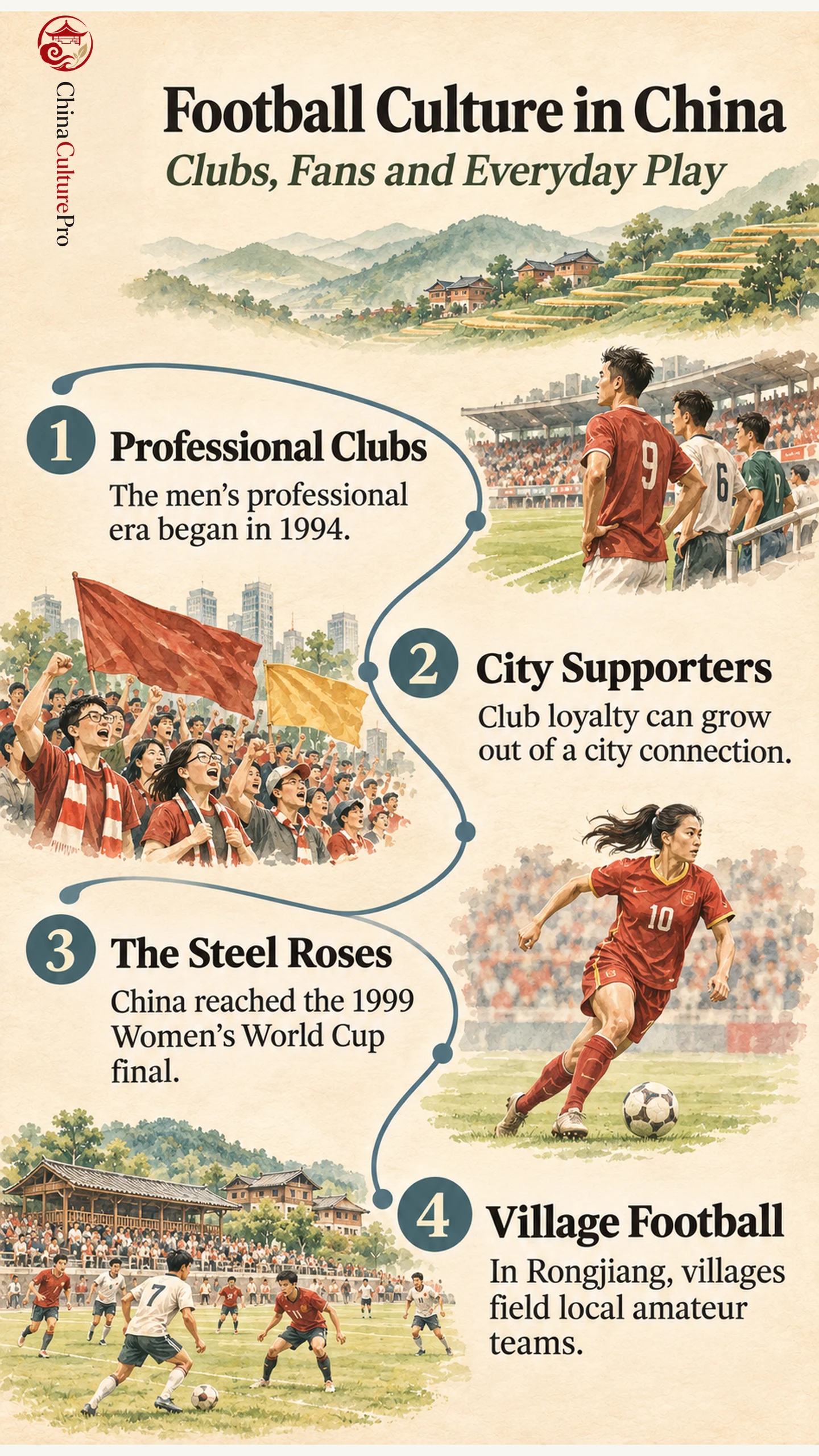
A person may watch a club match for its city rivalry, remember a national team for a World Cup run and still spend the weekend playing for a local side. The same supporter can feel attached to a city club, a national team and the people on a local pitch. In China, a look at the professional league, the women’s national team and a village tournament shows where those attachments come from. [1][2][3][4][5]
The Professional Clubs and Their City Supporters
League football existed in China before the professional era. The 1994 Jia-A season marked the shift to professional men’s clubs and a regular home-and-away schedule. In 2004 the Chinese Super League took over as the top professional division, with a second tier underneath. The professional system gave supporters a regular home venue for following their team. FIFA’s museum traces a much earlier kicking game, cuju (蹴鞠, cùjū), as part of the wider history of ball games. [1][7][8]
A study of Beijing Guoan and Shanghai Shenhua found that supporters’ ties to the club grew out of several things, including results, how long fans had followed the team and what the club meant to them as city residents. That helps explain why a club can carry a local identity even as its players and sponsors change. For the fans interviewed, loyalty accumulated over seasons of following a particular team. [2][8]
The Women’s National Team and the Steel Roses
China’s women’s national team, known as the Steel Roses, won silver at the 1996 Atlanta Olympics and reached the final of the 1999 FIFA Women’s World Cup. The United States won on penalties at the Rose Bowl in Pasadena. Sun Wen shared the tournament’s Golden Boot with Brazil’s Sissi and won the Golden Ball as its outstanding player. The run gave supporters a team and a set of familiar players to follow on the world stage. [3]
Domestic and international matches can have very different audiences. Recalling the final, Sun described the experience of playing before a huge crowd and recalled far smaller crowds at China’s domestic league matches at that time. That is an account of a specific moment in the women’s game. It shows how a tournament can make the same players visible to people who rarely see them play for a club. [3]
Village Football and Everyday Play in Rongjiang
In 2023 the Village Super League, or cunchao (村超, cūnchāo), brought together village sides in Rongjiang County in Guizhou. Players included people whose weekday jobs were outside football. Reporting from the tournament describes local food and performances around matches, and clips and livestreams took the event to people far from the ground. One June 2023 fixture pitted the teams of Fenghuang and Xinzhong villages against each other. The wider look at Guizhou culture gives those gatherings regional context. [4][5]
Rongjiang’s football also extends outside the tournament itself. One student player interviewed in 2023 described helping his village team train younger children. Schools and academies offer different routes into organized matches. The Asian Football Confederation describes the Chinese Youth Football League as a competition structure that brings together school teams and academy teams. Such routes sit alongside informal play and help explain where sport fits in modern Chinese culture. [5][6]
FAQs About Football Culture in China
Is the Village Super League the same as the Chinese Super League?
The Village Super League in Rongjiang is a grassroots tournament involving local amateur sides. The Chinese Super League is the men’s top professional domestic division. [1][4][5]
Did modern football in China come directly from cuju?
The FIFA Museum describes cuju as an earlier Chinese kicking game. Its exhibition distinguishes the historical ball games from modern association football, codified in nineteenth-century England. [7]
What is the nickname of China’s women’s national team?
The team is known as the Steel Roses. That is the nickname FIFA’s museum uses in its account of China’s 1999 World Cup campaign. [3]
Sources
[1] Birkbeck Institutional Research Online. Research on the governance and development of Chinese football
[2] Sport in Society. Chinese football fandom and civic identities
[3] FIFA Museum. One step away: China at the 1999 World Cup
[4] Xinhua. Village Super League held in Rongjiang, SW China’s Guizhou
[5] The Straits Times. A sleepy Chinese county wakes up to a tourism boom, thanks to village football
[6] Asian Football Confederation. AFC Elite Youth Scheme adds Chinese Football Association to three-star membership
[7] FIFA Museum. Origins: Pre-Histories of Football
[8] Soccer & Society. Becoming a Chinese football fan