


Quick Answer: What Does Yi Ye Zhi Qiu Mean?
Yi Ye Zhi Qiu (一叶知秋, yī yè zhī qiū) literally means to recognize autumn from a single leaf. Figuratively, it means noticing a small sign that points to a larger change. The image comes from a passage in the Huainanzi (淮南子, Huáinánzǐ) about drawing a broader inference from something close at hand.[1][2]
- The image: A falling leaf tells an attentive observer that the season is turning.[1][2]
- The modern sense: A small change in how people act can be an early clue to a wider shift.[2]
- The English sense: “An early sign of a wider change” works when the reader needs the meaning without the seasonal imagery.
The expression is most convincing when you can say why the detail matters. On its own, one chance observation may still leave several explanations open.
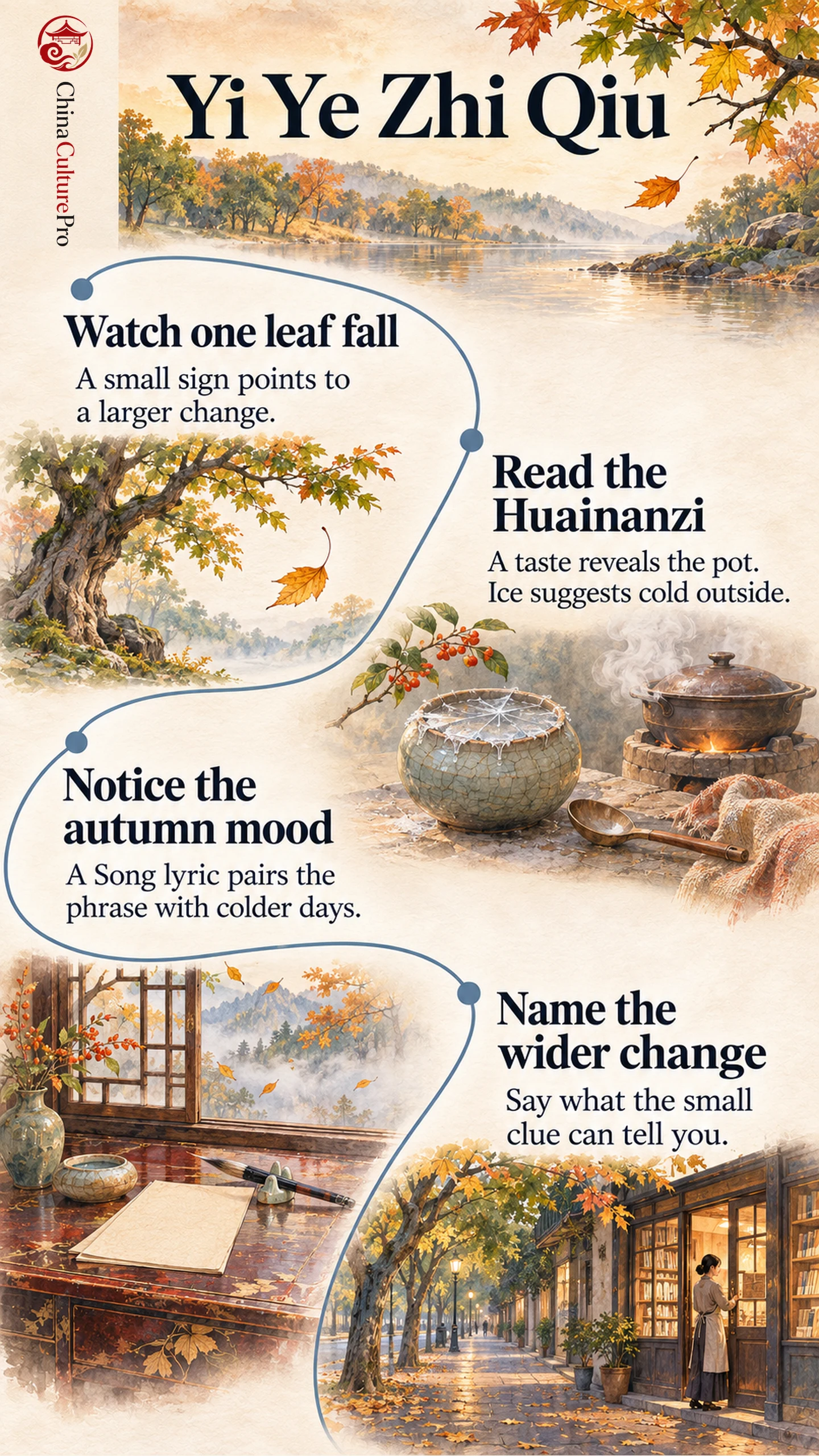
If a small detail tells you something about the whole, what makes it worth noticing? The classical passage puts a falling leaf next to less poetic clues, including a bite of food from a pot and ice in a vessel.[1]
What the Huainanzi says about the falling leaf
The leaf appears in Shuoshan Xun (说山训, Shuōshān Xùn), a chapter of the Huainanzi. One taste can reveal the flavor of what is cooking in a pot. Feather and charcoal can give clues to dampness or dryness. A fallen leaf suggests the year is growing late, and ice in a vessel suggests cold conditions beyond it. The examples show several ways a person can infer something outside their immediate view.[1][2]
The familiar four-character form says “autumn” directly. The older passage makes the reader take one more step, from a leaf falling to the year drawing to a close. The short phrase keeps the clue and conclusion together. Even if you have never read the full passage, you can picture the sign first and understand the change it suggests.[1][2]
The same compact form can also evoke an autumn mood. In a lyric by the Song writer Zhao Changqing (赵长卿, Zhào Chángqīng), it appears with the weather growing colder and an already sorrowful separation. That use gives the leaf a literary role alongside its wider sense of reading a clue.[2]
How to use a small sign to describe a larger change
The phrase can follow a small observation that your audience already understands, or it can describe the observer’s ability to connect the detail to a wider pattern. If the connection is unclear, state which change the detail points to. Readers can then judge whether the inference follows.[2]
- Identifying change: 连附近最晚打烊的书店都开始提前打烊了,一叶知秋,这条街的夜生活也在变。 “Even the bookstore that used to stay open latest has started shutting earlier. It’s a clue that nightlife on this street is changing.”
- Praising an observer: 她从两份会议通知里看出了分工的变化,真有一叶知秋的眼光。 “She saw from two meeting notices that responsibilities were shifting. She’s good at spotting a bigger change in a small detail.”
The first example draws an inference about a neighborhood. The second praises the observer for putting an ordinary document in context. If the bookstore closed early just once, the same observation might say more about that evening than about the street. Small evidence has more force when the audience understands why it stands out. See the guide to Chinese chengyu for other examples of how a concrete image carries an abstract judgment.
How to translate the leaf image into English
Keep the leaf in an explanation of the proverb or a literary translation where autumn is part of the scene. “From a single falling leaf, you can tell autumn is coming” supplies the action that the four characters leave implicit. In a translated report, “an early sign of a wider shift” is usually easier to understand. If the emphasis is on the person doing the noticing, “she picked up on a small but telling sign” puts the insight back with the observer.[1][2][3]
“A straw in the wind” is another English equivalent. It fits where a clue hints at what may happen next. For example, it fits a columnist who notices that a shop now closes early and wonders whether other shops will follow. If the reader already has strong evidence of the trend, “a telling sign” sounds firmer.[2][3]
FAQs About Yi Ye Zhi Qiu
Is Yi Ye Zhi Qiu always about bad news?
No. It can point to a welcome change, a worrying trend, or a neutral development. The surrounding sentence supplies the judgment.[2]
How do you pronounce the first two syllables?
The dictionary form is yī yè zhī qiū. In speech, 一 commonly changes to yí before fourth-tone yè, so you may hear yí yè zhī qiū.[2]
How is it different from Jian Wei Zhi Zhu?
Jian Wei Zhi Zhu (见微知著, jiàn wēi zhī zhù) is a near synonym for recognizing something significant from a subtle sign. Yi Ye Zhi Qiu makes the idea more visual and often suggests a shift that is just becoming apparent.[2][3]
Sources
[1] Wikisource. Huainanzi, Shuoshan Xun
[2] Taiwan Ministry of Education. Dictionary of Chinese Idioms, Yi Ye Zhi Qiu
[3] Chinese Text Project. Yi Ye Zhi Qiu dictionary entry