


Quick Answer: What Does Yi Gu Zuo Qi Mean?
Yi Gu Zuo Qi (一鼓作气, yī gǔ zuò qì) means to use a burst of energy to carry a task through in one sustained effort. It comes from a story in the Zuo Commentary (左传, Zuǒzhuàn), where the first drum signal raises the soldiers’ courage.[1][2]
- Literal image: The first sounding of the drum rouses courage.[1][2]
- Modern use: Say it when a person or group presses on while they have the energy to finish.[2]
- English equivalent: “Get it done in one go” describes continuous action. “Keep up the momentum” puts the emphasis on the energy that carries it through.
The phrase works for planned tasks as well as spontaneous ones. It describes how the work is carried through once the effort begins.[2]
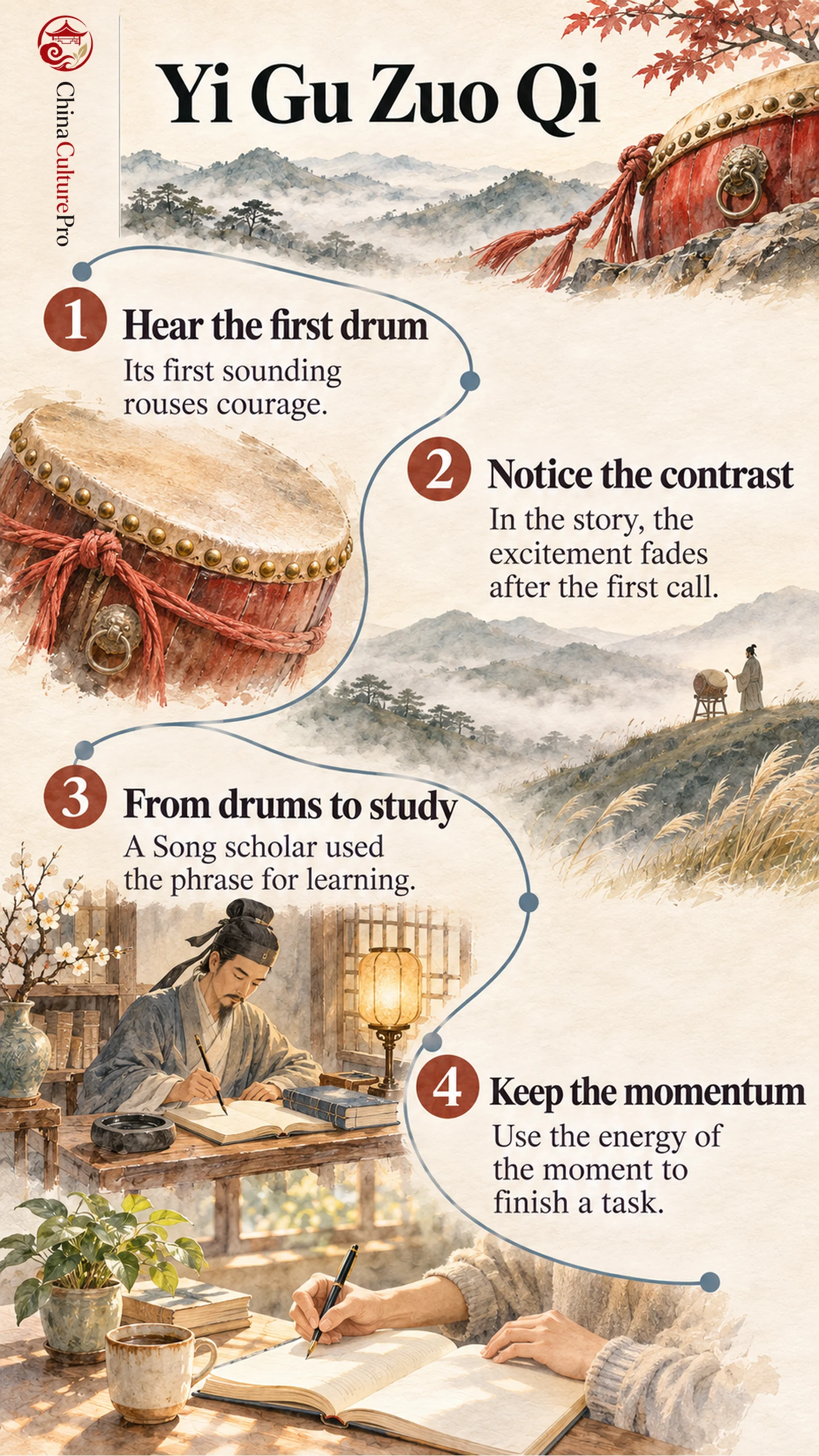
The first drum matters because the story sets it beside the second and third. Later writers found the same pattern in settings as far removed from a battlefield as a student’s desk.[1][2]
How an ancient drum signal became an idiom
The Zuo Commentary places the episode in the tenth year of Duke Zhuang of Lu. At Changshao (长勺, Chángsháo), the duke is ready to order his own drums sounded. Cao Gui (曹刿, Cáo Guì) advises him to wait. In the account, the state of Qi sounds its drums three times before Cao Gui gives the word. Lu wins the encounter, and the duke asks for an explanation.[1][3]
Cao Gui says courage rises when the drum first sounds, flags at the second sounding, and is exhausted by the third. In this sentence, 作 means to rouse, and 气 means courage or morale. The four-character idiom lifts the first clause of a three-part contrast. The first line became a useful phrase on its own, with the rest of the source explaining why the moment of high morale matters.[1][2][3]
By the Song dynasty, the expression could already describe studying. The scholar Lü Zuqian (吕祖谦, Lǚ Zǔqiān) used it to say that a learner should carry the original effort forward, and he echoed the next clause about what happens when it is interrupted. That use makes the shift visible. The drum belongs to the source story, while the rise and fall of effort can describe reading and study.[2]
Where the expression fits in modern Chinese
The phrase often sits immediately before the action being performed. “一鼓作气把……做完” works when a speaker wants to finish something that is already underway. In a report of what happened, it can precede an accomplishment to show that the person kept at it from start to finish. In a suggestion, it gives the request a note of encouragement.[2]
- Encouraging a team: 资料都齐了,我们一鼓作气把报告写完吧。 “We have all the material. Let’s keep the momentum and finish the report.”
- Describing a completed effort: 她趁思路还清楚,一鼓作气写完了三个章节。 “While the ideas were still clear, she wrote all three chapters in one sitting.”
These original sentences link the effort to a condition that makes it possible. The report team is ready to work, and the writer has a train of thought worth following through. When a task needs an outside decision before it can proceed, the idiom can still apply to a part of the work that can be finished now. The guide to Chinese chengyu gives more examples of how a literary image becomes a sentence about everyday life.
How to choose an English equivalent
“Finish it in one go” is useful when the endpoint matters. “Let’s keep the momentum going” fits a team trying to maintain its energy. “Strike while the iron is hot” says that a favorable opportunity might close. It can suit a particular context, but it puts the emphasis on when to act.[2][4]
Two nearby Chinese expressions help show the difference. Yi Qi He Cheng (一气呵成, yī qì hē chéng) can describe something produced in a single uninterrupted flow, especially a piece of writing. Chen Re Da Tie (趁热打铁, chèn rè dǎ tiě) is the image of taking advantage of conditions while they are favorable. Yi Gu Zuo Qi places the emphasis on the effort that carries the task forward.[2][4]
FAQs About Yi Gu Zuo Qi
Is it yī gǔ zuò qì or yì gǔ zuò qì?
Yī gǔ zuò qì is the citation form. Yì gǔ zuò qì represents the usual spoken tone change before the third-tone syllable gǔ. The characters stay the same.[2]
Does Yi Gu Zuo Qi mean to do something immediately?
It often encourages people to get on with a task while they have energy for it. Its distinctive meaning is a sustained push, so the phrase can also describe a successful effort in the past.[2]
Can you use Yi Gu Zuo Qi for a team?
Yes. It suits groups that have built up energy around a common task, as well as an individual working through a job in one push.[2]
Sources
[1] Wikisource. Zuo Commentary, Cao Gui Discusses the Battle
[2] Taiwan Ministry of Education. Dictionary of Chinese Idioms, Yi Gu Zuo Qi
[3] Hong Kong Education Bureau. Annotated reading of Cao Gui Discusses the Battle
[4] Taiwan Ministry of Education. Revised Mandarin Chinese Dictionary, Yi Gu Zuo Qi