


Quick Answer: What Does Shou Zhu Dai Tu Mean?
Shou Zhu Dai Tu (守株待兔, shǒu zhū dài tù) literally means “watch the stump and wait for a rabbit.” A farmer benefits from a chance event and stops working to wait for it to happen again. The idiom can criticize waiting for good luck or clinging to a method because it once worked.[1]
- The chance event: A rabbit runs into a tree stump in a farmer’s field.[1]
- The mistake: The farmer expects another rabbit to come the same way.[1]
- Modern use: The phrase can describe passively waiting for an opportunity to arrive.[1]
One lucky event gives the farmer too little reason to expect a repeat.
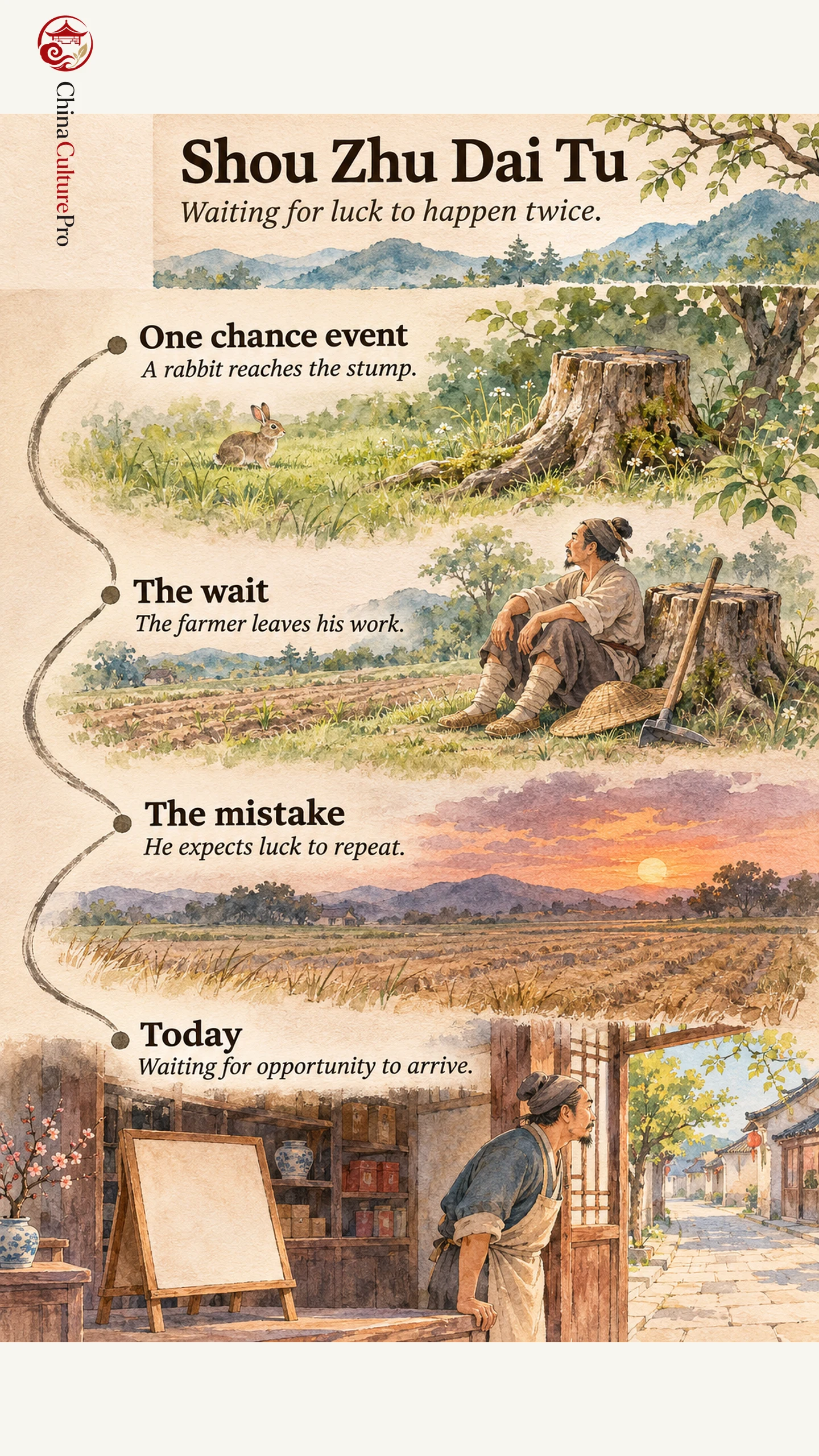
The first rabbit is an accident. The farmer’s mistake begins when he puts down his farming tool and treats the spot where it happened as a dependable source of another meal.[1]
The Farmer and the Tree Stump
In the Five Vermin chapter of the Han Feizi (韩非子, Hán Fēizǐ), a farmer from the state of Song sees a rabbit run into a tree stump and die. He leaves his farm work and waits by the stump. Another rabbit never comes, and people laugh at him. The text moves directly from that result to the purpose of the parable.[1]
Why Han Feizi Tells the Story
The chapter questions the wisdom of using the policies of ancient rulers to govern a different age. A practice can suit the conditions in which it arose. Its success then gives little guidance when those conditions change. The farmer’s wait shows what happens when a result is expected to repeat without the same conditions.[1]
Waiting for Luck and Clinging to an Old Method
One modern use points to hoping a benefit will arrive without effort. Another points to sticking with an old approach when there is no reason to think it will work again. Ke Zhou Qiu Jian also describes a failure to adjust. In that story someone relies on a mark after the boat moves. Here the farmer mistakes luck for a repeatable outcome.[1]
How to Use Shou Zhu Dai Tu
An editor might use the idiom for a shop that got an unexpected mention once and has stopped promoting itself while it waits for another. “Waiting for luck to strike again” fits that scene. “Clinging to a method whose time has passed” works when the passage is closer to the original argument about old policies.[1]
FAQs About Shou Zhu Dai Tu
What Does Zhu Refer To?
Zhū (株) is the base or stump of a tree in the field. It is the spot where the first rabbit came to grief and where he waits for another.[1]
Does the Farmer Catch a Second Rabbit?
No second rabbit appears in the parable. The wait turns the farmer into an object of ridicule.[1]
Does the Idiom Criticize All Waiting?
The idiom criticizes expecting something to happen just because it happened once, or waiting passively for a result that calls for action.[1]
Sources
[1] Taiwan Ministry of Education. Dictionary of Chinese Idioms entry for Shou Zhu Dai Tu