

Quick Answer: What Is Princess Roufu’s Court Case?
Princess Roufu (柔福帝姬, Róufú Dìjī) was a daughter of the Northern Song emperor Huizong. A woman who said she was Roufu was recognized by the Southern Song court around 1130. In 1142, the court reversed its decision after news arrived that the princess had died in the north. The resulting prosecution left a record of what the court accepted and when.[1][2][3]
- Displacement: The fall of the Northern Song separated members of the imperial household.
- Recognition: The court examined the claimant before granting her a princess’s title.
- Reversal: A later report and judicial inquiry led the court to treat her as an impostor.
The court’s conclusions are historical events. The surviving accounts still need to be weighed for what they can establish about identity.
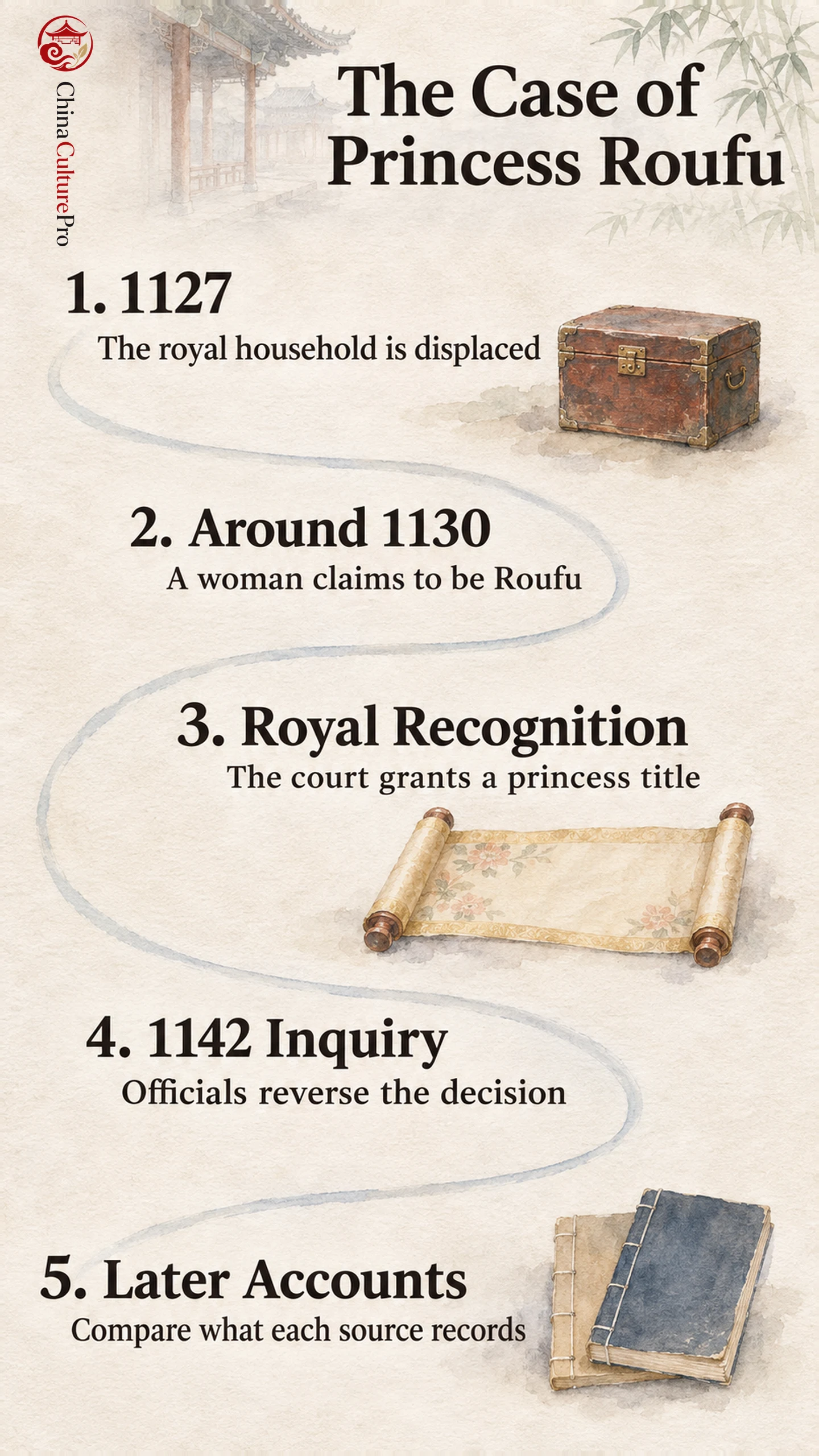
The court made two decisions about the same woman more than a decade apart. Reading the case means asking who could identify a missing princess at each moment and what evidence the officials had.
Why a Princess Could Be Missing
The Jingkang Incident of 1127 brought down the Northern Song court in Kaifeng. Members of the ruling family and their attendants were taken north into Jin territory. The new southern court had to learn the fates of people it could no longer readily contact.[1][2]
For the Song dynasty, the problem was both personal and official. Royal recognition could restore a title and affect marriage, residence and the use of court funds. That made the reliability of identification more consequential than simply deciding whether two faces resembled one another.[2][3]
How the Southern Court First Responded
Around 1130 a woman approached the court of Gaozong (高宗, Gāozōng) and claimed to have escaped the north. Accounts describe a review involving people with knowledge of the old palace. The woman was admitted and granted a title. She subsequently married Gao Shirong.[1][2]
The sources narrate the first examination differently. A memorable exchange about the claimant’s feet appears in some retellings. It shows how authors explained the decision to their readers, while the award of a title provides evidence of the decision itself.[2]
The 1142 Inquiry and Its Afterlife
When the emperor’s mother returned from the north in 1142, the court received word that Roufu had died there. The matter went to judicial officials. The claimant was condemned and executed. The official history places the princess’s death in 1141 and reports that remains were returned for burial.[1][3]
Later accounts speculated that the woman had been wronged. Compare each version with the sources it relies on. An alternative story can explain why the case remained memorable without supplying independent evidence for the claimant’s identity.[2][3]
FAQs About Princess Roufu’s Court Case
Was the Claimant Ever Recognized as a Princess?
Yes. The Southern Song court initially recognized her and conferred a princess’s title. It reversed that decision in 1142.
Do All Accounts Agree on What Happened?
Sources agree on the court’s reversal but tell different stories about earlier recognition and the evidence behind it. Later writers also questioned the verdict.
Sources
[1] History of Song. Chapter 248, Daughters of Huizong
[2] Oxford University Research Archive. War and the Representations of Women, Discussion of Roufu
[3] Chen Xi. The 1142 Impersonation Case in Song Legal History