


Quick Answer: Who Were Empress Wei and Princess Anle?
Empress Wei (韦皇后, Wéi Huánghòu) was Zhongzong’s wife. Princess Anle (安乐公主, Ānlè Gōngzhǔ) was their daughter. Both were influential after Zhongzong returned to the throne in 705. A palace coup in 710 killed both after the emperor died and the court faced another succession.[1][2][3][4]
- Empress Wei: Her position gave her access to government decisions.[1][3]
- Princess Anle: Her household and marriages connected her with other influential families, and a dynastic biography records that she sought the title of heir.[1][2][5]
- The turning point: Zhongzong’s death produced a short-lived succession, followed by a coup and the accession of Ruizong.[3][4]
The historical record describes real positions, appointments and alliances. Its accounts of the emperor’s death also contain allegations whose wording and political context matter.[3][4]
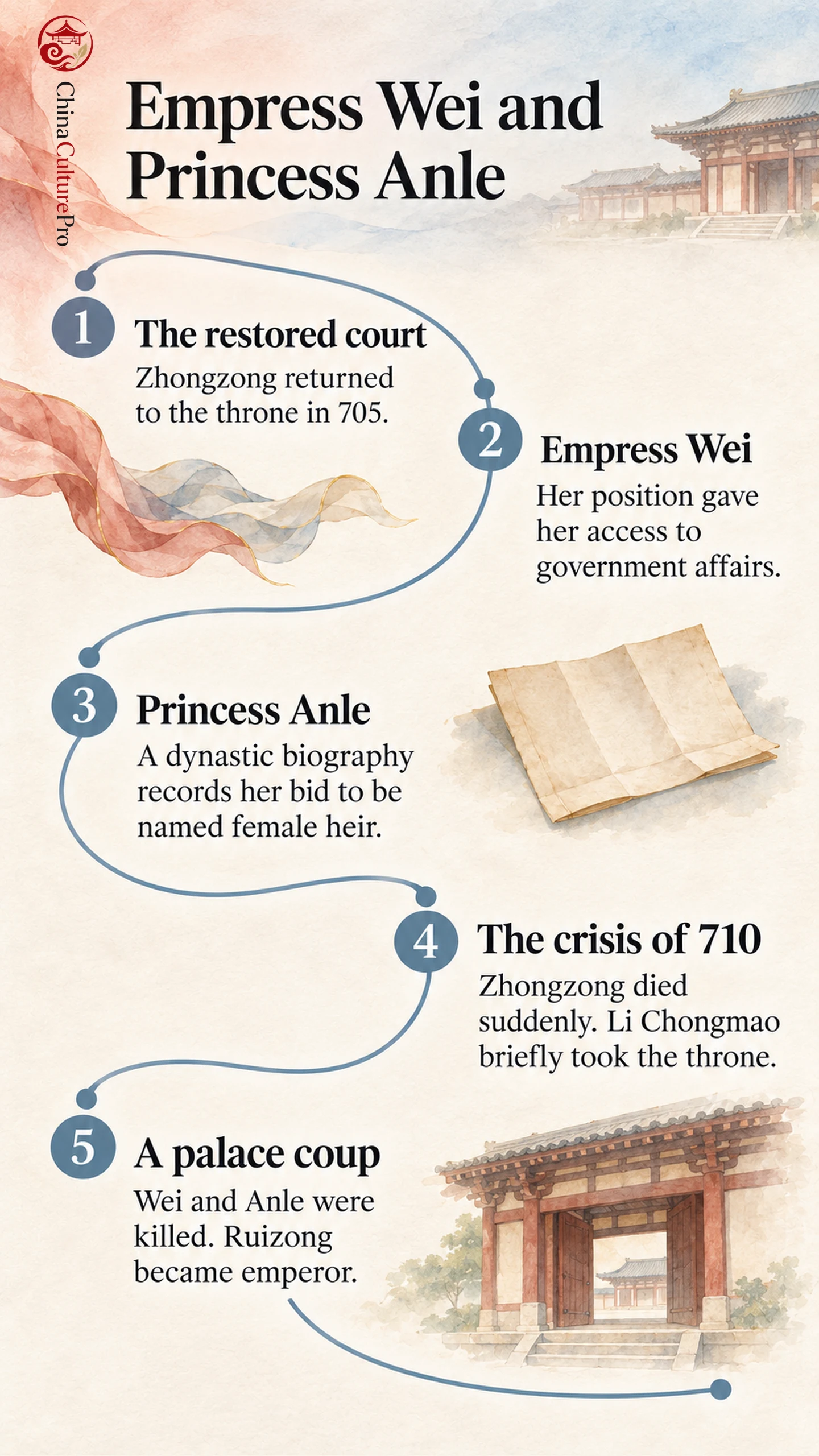
A mother and daughter were both close to the throne during Emperor Zhongzong’s second reign. The mother had the position of empress. The daughter had her own household and sought recognition as heir. Their influence became especially vulnerable once Zhongzong died.
How Empress Wei Gained Influence After 705
Zhongzong regained the throne in 705, and Tang rule was formally restored after Wu Zetian’s Zhou. Wei was again installed as empress. The chronicle reports that she attended court business and that a senior minister objected to her presence in government affairs. His objection gives a contemporary political argument as it appears in the later chronicle.[1]
Restoration of the Tang dynasty did not erase the Wu family’s court ties. Wei’s connections included Wu Sansi. Princess Anle’s marriage to his son Wu Chongxun also linked the families directly. These links helped create networks of influence alongside named government offices.[1][5]
What Princess Anle Sought at Court
Anle had a princess’s household. The New Book of Tang records her asking to be designated female heir apparent (皇太女, huáng tàinǚ) and describes official opposition. She was asking to be put in line for the throne. Zhongzong’s son Li Chongmao was the one briefly placed on the throne after his death.[2][3]
The dynastic biography also presents her as a source of patronage for office-seekers. Its account of her household, access and ambitions explains why she has a separate political story within the same court as her mother.[2][3]
How the Succession Crisis Ended in 710
Zhongzong died suddenly in 710. The Comprehensive Mirror in Aid of Governance transmits the allegation that Wei and Anle were behind a poisoning. The accusation also occurs in the account of the coup itself. It should be read as a claim preserved in the struggle over the next ruler.[3][4]
Li Chongmao briefly became emperor. A coalition led by Li Longji and supported by Princess Taiping then overthrew Wei’s group. Wei and Anle were killed, and Zhongzong’s brother took the throne as Ruizong. The new reign changed which branches of the family and which patrons had access to the court.[3][4][5]
FAQs About Empress Wei and Princess Anle
Did Princess Anle ever become heir to the Tang throne?
The New Book of Tang records that she asked to be named female heir apparent and met official opposition. After Zhongzong’s death, Li Chongmao briefly took the throne.[2][3]
Did Empress Wei rule as emperor?
She was Zhongzong’s empress and held power during the brief succession crisis. Li Chongmao was placed on the throne before the coup, after which Ruizong became emperor.[3][4]
Sources
[1] Sima Guang and collaborators. Comprehensive Mirror in Aid of Governance, Volume 208
[2] New Book of Tang. Volume 83: Biography of Princess Anle
[3] Sima Guang and collaborators. Comprehensive Mirror in Aid of Governance, Volume 209
[4] Xiaofei Tian. The Penumbra of the Great Tang
[5] Chen Jinhua. The Statues and Monks of Shengshan Monastery