


Quick Answer: How Do You Use the Chinese Text Project?
Open a work and its chapter in the Chinese Text Project. Find the Chinese passage, check the edition note and the translator’s credit, then record the exact location. If the wording matters, compare the transcription with the linked edition or page image when one is available.[1][2][3][4]
- Find the passage: Use the work and chapter titles, or look up a short string from the original Chinese.[1][2]
- Identify the source: Check the base edition for the Chinese and the credit for the English separately.[1][2]
- Save a useful reference: Record the passage number and link, plus the bibliographic details needed for a formal citation.[3]
A passage link helps someone find the text again. Formal writing may also require the printed edition, concordance or translation that supports the wording you quote.[3]
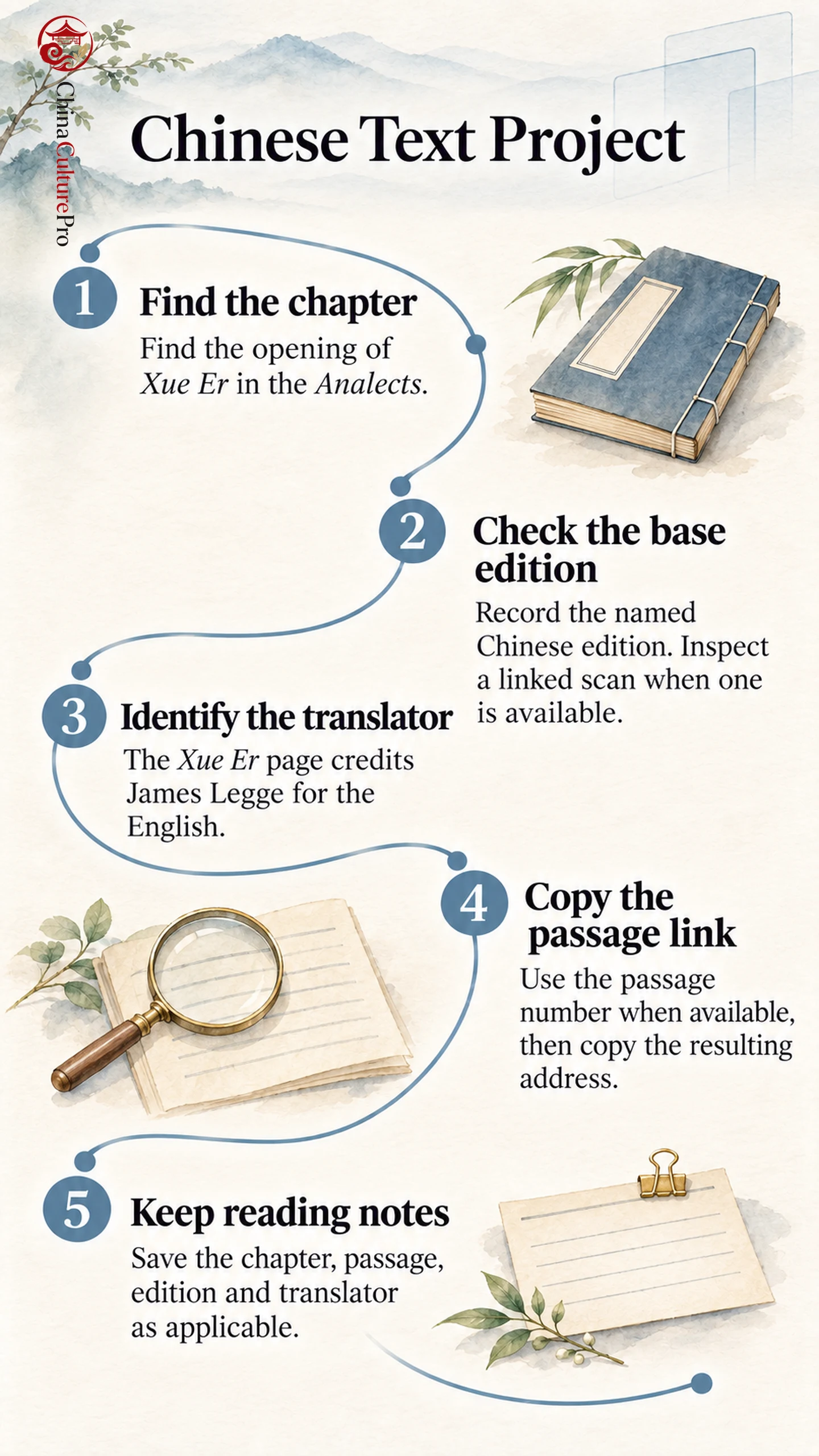
Finding a familiar line online is only the beginning. A reader who wants to quote it also needs the work, the passage and the edition or translation used. The Chinese Text Project makes these details easier to check once you know where to look.
How to Find, Check and Cite a Passage
1. Open the work and chapter
Begin with the work title and choose its chapter from the contents. For a worked example, find the Analects (論語, Lúnyǔ) and open its first chapter, Xue Er (學而, Xué Ér). Read the opening passage and check that its position in the chapter matches the passage you mean.[2]
You can also look up a short distinctive phrase. Try 學而時習之 from the opening of this chapter. Check the work and chapter on the result before assuming that the first match is the source you wanted. Commentary and later works can quote the same line.[2][4]
2. Check the named Chinese edition
Look for the source note on the work’s contents page and for available links under Library Resources. On the Xue Er page, the base text is identified as the Wuying Palace edition of the Thirteen Classics with Commentaries, in the Analects commentary. Record the label that applies to the transcription you are using.[1][2]
If a linked scan is available, compare the relevant words against its image. An edition label and a page scan can answer different questions: one identifies the text used for the transcription, and the other lets you inspect the characters and format of the particular edition shown.[1][4]
3. Read and identify the English translation
Read the parallel translation after checking the original passage. The Xue Er page credits James Legge. If you compare it with a different English rendering, keep the translators’ names in your notes so that another reader can tell whose wording you used.[1][2]
4. Keep the passage location and bibliographic details
Click the passage number where the site provides one, then copy the resulting address. Record the work, chapter and passage number. Add the named Chinese edition or English translator that matches the material you cite. For formal use, follow the project’s guidance on printed editions and concordances.[3]
What to Save in Your Reading Notes
For the example above, a useful short note would identify the Analects, Xue Er 1.1, the Chinese opening and James Legge where his English wording is used. Keep a page number or another edition-specific location when you have actually checked the printed edition. This makes the note reusable if your reader consults a different version of the work.[2][3]
Keep the site’s digital sources in context. A transcription is convenient for searching, while library databases and scans may give you a second view of the text and its publication details. The guide to studying Chinese culture suggests where to place this kind of primary-source reading within a larger study. Readers interested in the work itself can start with the guide to the Analects.[3][4][5]
FAQs About the Chinese Text Project
Is there an English translation for every text?
Translation availability varies across the collection. Look for a translation and its attribution on the work or chapter page before planning to cite English wording.[1][2]
Can I cite a Chinese Text Project URL?
The project accepts page or passage links for informal citation. For formal writing, consult its guidance on editions and concordances, and include the translator if quoting a translation.[3]
Sources
[1] Chinese Text Project. Frequently Asked Questions
[2] Chinese Text Project. The Analects: Xue Er
[3] Chinese Text Project. Citation Guidance
[4] Donald Sturgeon. Research Tools and the Chinese Text Project
[5] University of Chicago Library. Chinese Studies Primary Sources