


Quick Answer: What Is Fangzhang?
Fangzhang (方丈, Fāngzhàng) is one of three sea mountains associated with immortals in the *Records of the Grand Historian*. The name Fanghu (方壶, Fānghú) appears in the *Liezi* among five floating mountains. Museum records also use it as an alternative name for Fangzhang.[1][2][3]
- Three mountains: Fangzhang appears with Penglai (蓬莱, Pénglái) and Yingzhou (瀛洲, Yíngzhōu).
- Five mountains: The *Liezi* uses Fanghu and tells how two islands are lost.
- Paintings: Wen Boren and Wu Bin give Fanghu different forms in ink and color.[4][5]
Use the name and the source together when identifying the island.
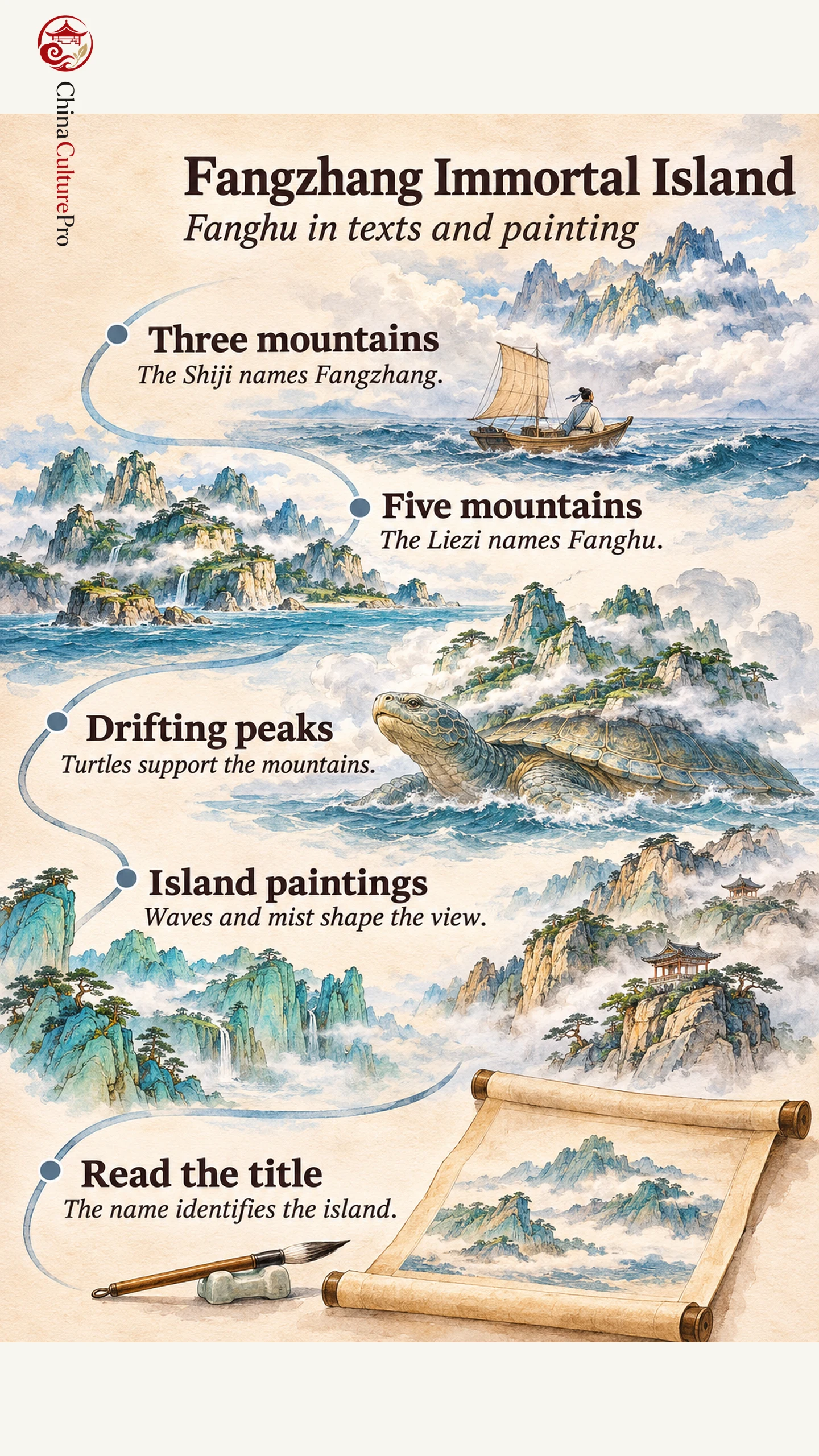
A sea mountain can rise out of waves, appear in a cloud and then slip from sight. Those qualities make Fangzhang hard to approach in a written account and give painters several ways to imagine it.
Fangzhang in the Records of the Grand Historian
The treatise on sacrifices in the *Records of the Grand Historian* names Fangzhang alongside two other sacred mountains. They are reported to be in the sea, inhabited by immortals and associated with a drug of deathlessness. The passage describes white creatures and palaces of gold and silver.[1]
The approach matters as much as the description. The mountains look like clouds at a distance. The account says that, as a vessel draws closer, the mountains appear below the water, and wind carries the boat away.[1] The narrative tells the reader why a destination that sounds near remains beyond reach.
These features are shared across the three mountains in the passage. To identify Fangzhang by itself, look for a name supplied by a text, title or catalog.
Fanghu and the Five Mountains in the Liezi
The “Questions of Tang” chapter of the *Liezi* places five mountains in the sea near Guixu, the Returning Ruins. It names Daiyu, Yuanqiao, Fanghu, Yingzhou and Penglai. The mountains drift until giant turtles are made to support them. A giant catches six of those turtles, and two of the mountains are lost.[2]
Fanghu is one of the surviving mountains. The difference between five mountains at the beginning and three survivors belongs to this particular story. The *Records of the Grand Historian* names a trio without telling the story of the turtles.[1][2]
The Palace Museum identifies Fanghu as another name for Fangzhang.[3] That usage helps a reader follow the subject across sources while retaining the spelling and grouping each text uses.
How Wen Boren and Wu Bin Painted Fanghu
The National Palace Museum describes Wen Boren’s *Fanghu* as a blue-and-green landscape. The island looks as if it drifts amid an expanse of waves. The water makes the mountain’s separation from ordinary land part of the composition.[4]
Wu Bin’s 1626 hanging scroll takes a different approach. Sharp mountain forms rise above rough seas, and cloud and mist hide parts of the peaks. Pavilions appear among the rocks.[5] The eye has to piece the island together from visible sections.
Wen Boren’s broad waves give a sense of distance. Wu Bin’s mist interrupts the view within the mountain itself. Both give a visible shape to the idea of reaching or glimpsing an immortal realm.
Fangzhang, Penglai and Yingzhou Compared
The *Records of the Grand Historian* links Fangzhang with Penglai and Yingzhou in a single maritime report.[1] A landscape of peaks and clouds can suggest any of the three. For Fangzhang, the link between the name and paintings explicitly titled *Fanghu* supplies a more specific clue.[3][4][5]
FAQs About Fangzhang
Are Fangzhang and Fanghu the same place?
The Palace Museum treats Fanghu as another name for Fangzhang. Fangzhang is the form in the *Records of the Grand Historian*, and Fanghu appears in the *Liezi*.[1][2][3]
How many immortal islands are there?
The first text names three. The *Liezi* begins with five and tells how two are lost.[1][2]
Can Fangzhang be located on a modern map?
Fangzhang belongs to literary geography. The maritime setting helps tell the story but supplies no verifiable modern coordinates.[1]
Sources
[1] Sima Qian. Records of the Grand Historian: Treatise on the Feng and Shan Sacrifices
[2] Chinese Text Project. Liezi: Questions of Tang, Passage Two
[3] The Palace Museum. Fanghu
[4] National Palace Museum. Whereto Paradise: Picturing Mountains of Immortality
[5] The Palace Museum. Wu Bin’s Fanghu Hanging Scroll