

Quick Answer: Who Is Diao Chan?
Diao Chan (貂蝉, Diāochán), also written Diaochan, is a character in Romance of the Three Kingdoms (三国演义, Sānguó Yǎnyì). She agrees to help the official Wang Yun (王允, Wáng Yǔn) divide the powerful Dong Zhuo (董卓, Dǒng Zhuó) from his general Lü Bu (吕布, Lǚ Bù). An earlier historical account mentions an unnamed attendant who had a relationship with Lü Bu. It does not identify that person as Diao Chan.[1][2][3]
- The novel’s plan: Wang Yun offers Diao Chan to Lü Bu as a concubine, then brings her to Dong Zhuo. Each man learns enough to suspect the other.[2][3]
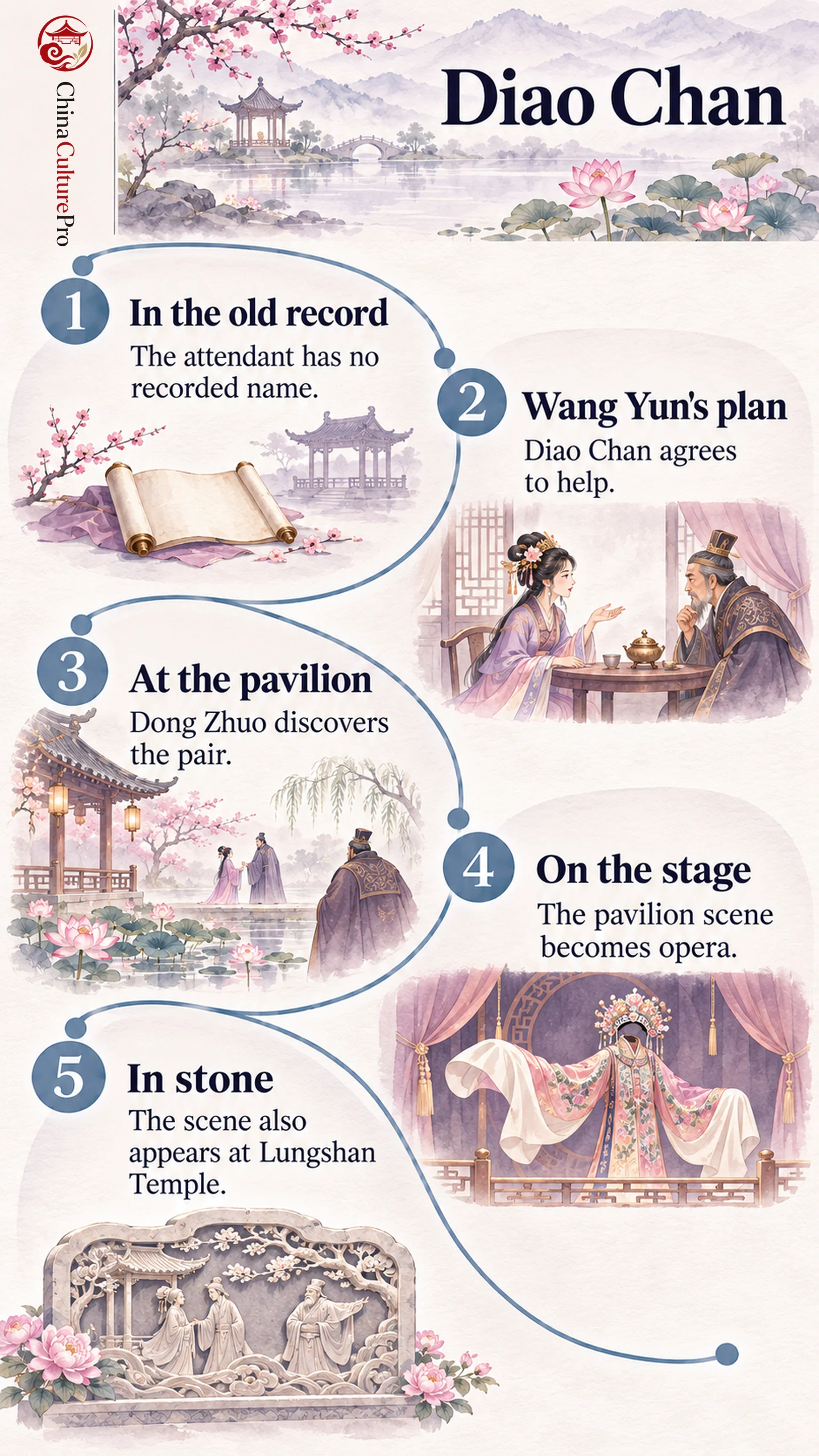
- The pivotal scene: Dong Zhuo discovers Diao Chan and Lü Bu together in his garden, turning private suspicion into an open quarrel.[2]
- Cultural afterlives: The garden encounter became an opera scene and appears in stone carving at Taipei’s Lungshan Temple.[4][5]
The discussion follows chapters 8 and 9 of the novel, including the outcome of Wang Yun’s plan.
Three people at a pavilion make an easily recognizable scene. To see why the encounter matters, start with the fears that Lü Bu has before Wang Yun makes any offer.
What the historical record says about Lü Bu
In Chen Shou’s Records of the Three Kingdoms, Dong Zhuo is already in the habit of keeping Lü Bu close for protection. Their relationship is uneasy. The biography says Dong Zhuo once threw a short halberd at Lü Bu in anger. It also says Lü Bu had a secret relationship with one of Dong Zhuo’s attendants and feared discovery. The attendant remains unnamed.[1]
Wang Yun draws Lü Bu into a plan against Dong Zhuo. The biography records a moment when Lü Bu hesitates because of the father-son relationship he and Dong Zhuo had claimed. Wang Yun reminds him that they have no blood tie and that Dong Zhuo already endangered his life. The history thus provides the close relationship, the fear and the conspiracy. The novel puts a named character at the center of the rupture and gives her dialogue, an assignment and scenes of her own.[1][2][3]
How Diao Chan works within Wang Yun’s plan
In chapter 8, Wang Yun hears Diao Chan sighing in his garden. She explains that she has noticed his distress and wants to help. He asks her to play a part in opposing Dong Zhuo and offers her to Lü Bu as a concubine. When Dong Zhuo later visits, Wang Yun arranges for Diao Chan to go to his household. The first promise makes Lü Bu expect that she will join his household. When he learns where she has been taken, Wang Yun tells him that Dong Zhuo meant to arrange the match. That explanation leaves Lü Bu to work out what Dong Zhuo intended.[2]
At the Phoenix Pavilion (凤仪亭, Fèngyí Tíng), Diao Chan speaks to Lü Bu as someone who has been placed in Dong Zhuo’s household against her wishes. The scene is interrupted by Dong Zhuo, who catches them together and chases Lü Bu. In chapter 9, Dong Zhuo’s adviser suggests handing Diao Chan over to repair the relationship. When Dong Zhuo questions her, she gives him a different account and he abandons the idea. She anticipates what each man fears, and Wang Yun can use that continuing distrust when he approaches Lü Bu again.[2][3]
Diao Chan accepts Wang Yun’s charge at the beginning and has room to shape her own performance. The men around her also keep discussing where she will go as though the decision is theirs. Her influence comes from what she can say when each man hears her alone.[2][3]
How the pavilion scene moved onto stages and temple walls
The Hong Kong Academy for Performing Arts documents Fengyi Pavilion as a scene from Lü Bu & Diaochan. In the annual report’s photograph, the embroidered costumes, long sleeves and physical poses tell viewers that they are looking at an encounter in which a gesture can carry part of the story. Taiwan’s National Cultural Memory Bank also identifies a stone window at Lungshan Temple that depicts the episode. In the carving, Dong Zhuo occupies the left side, while Diao Chan and Lü Bu share the center and right. One scene can tell its story through a pair of performers on a stage or through three simultaneous positions on a wall.[4][5]
FAQs About Diao Chan
Was Diao Chan a real person?
The historical biography of Lü Bu mentions an unnamed attendant. It does not identify her as Diao Chan or give her the role she plays in the novel.[1][2]
Does Diao Chan kill Dong Zhuo?
Lü Bu kills Dong Zhuo as part of Wang Yun’s conspiracy. In the novel, Diao Chan helps bring about the breach between the two men before the killing.[2][3]
Is Diao Chan one of the Four Beauties?
Yes. Diao Chan is commonly included among the Four Beauties of ancient China, a traditional grouping that also counts women from other periods and stories.[6]
Sources
[1] Chen Shou. Records of the Three Kingdoms, book 7, Lü Bu’s biography
[2] Romance of the Three Kingdoms. Chapter 8, Wang Yun’s plan and the pavilion
[3] Romance of the Three Kingdoms. Chapter 9, the killing of Dong Zhuo
[4] Hong Kong Academy for Performing Arts. Annual report featuring the Fengyi Pavilion scene
[5] Taiwan National Cultural Memory Bank. Lü Bu and Diao Chan stone window at Lungshan Temple
[6] Duke University Repository. Jing–Kun and the Hundred Operas, on traditional groupings of four