

Quick Answer: How Did Early Chinese Philosophers Understand Emotion?
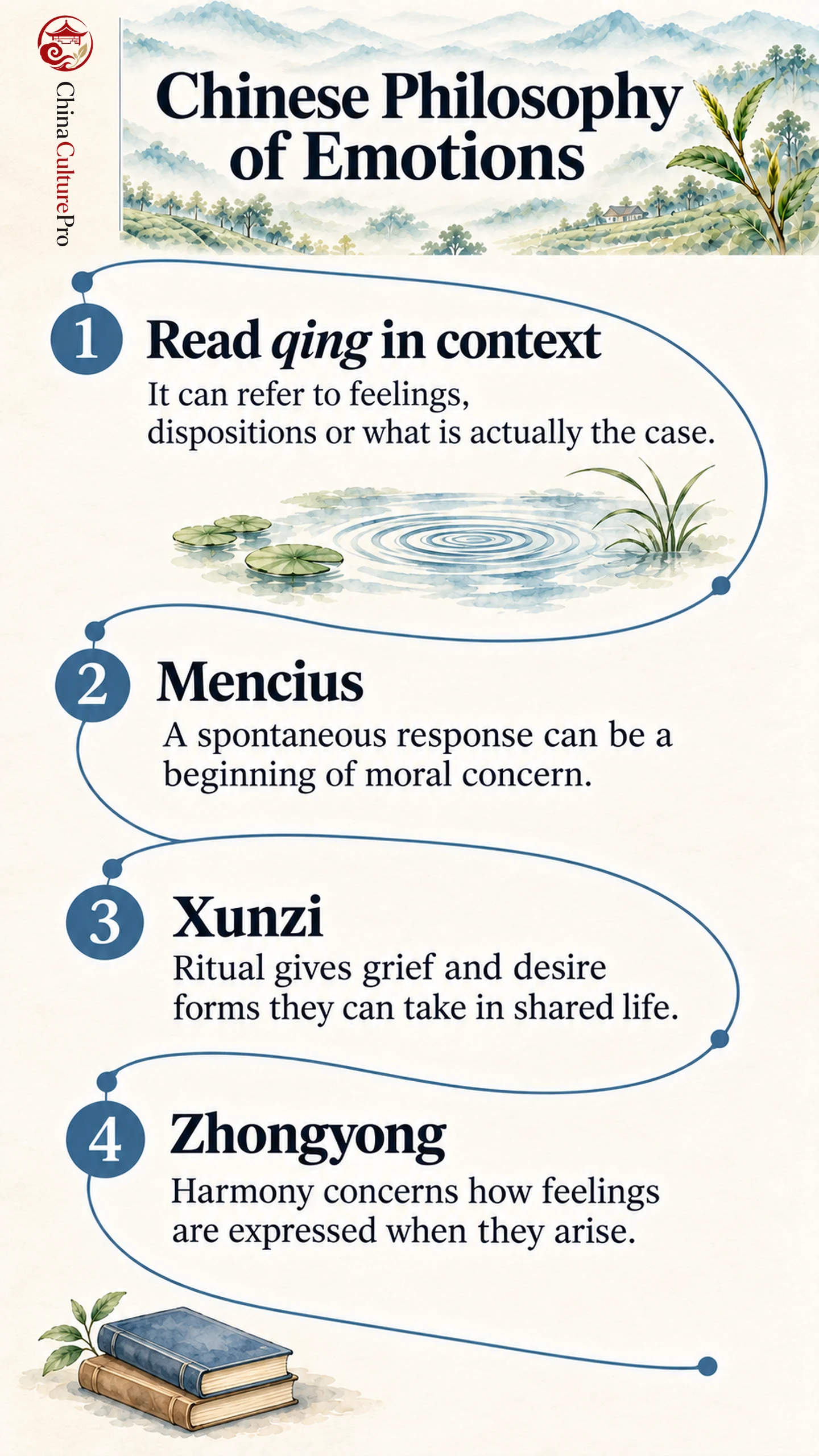
Qing (情, qíng) can refer to feelings and dispositions in early Chinese philosophy. In some texts it refers to the real circumstances of a situation. When the subject is a feeling, early writers often ask what calls it forth and how it shapes conduct.[1]
- Mencius (孟子, Mèngzǐ): A spontaneous response to someone in danger can be a beginning of moral concern.
- Xunzi (荀子, Xúnzǐ): Shared forms of conduct give emotions such as grief an appropriate expression.
- Zhongyong (中庸, Zhōngyōng): Feelings can fit an occasion when they are expressed in due measure.[1][2][3][4]
These are accounts from particular early texts. Each asks a different question about the place of feeling in ethical life.
Seeing a child in danger, grieving someone’s death and being angry at an injustice are different experiences. Early Chinese texts give readers reasons to compare what prompts the feeling, what it reveals and what happens when it enters shared life.
What Qing Can Mean in a Classical Text
In a passage about what someone likes, dislikes or desires, qing may name an affective disposition. In a passage about the state of a situation, it can refer to the facts or to what is genuinely the case. A translator who supplies “emotion” in the second passage would turn a claim about circumstances into a claim about an inner state.[1]
One reason the distinction matters is that a text can ask how people respond to actual circumstances without treating feelings as entirely private. The heart-mind (心, xīn) is involved in how someone attends to a situation and what they make of it. The same response can include recognition, feeling and an inclination to act. The exact contribution of each depends on the writer’s argument.[1][3]
Mencius: A Feeling Can Be a Moral Beginning
In 2A6, Mencius asks readers to imagine suddenly seeing a child about to fall into a well. Alarm and concern arise before a person has time to calculate what the child’s parents or neighbors might think. The example makes the moment of recognition important. Concern is directed toward the child in danger.[1][3]
It is one of the Four Beginnings (四端, sìduān), capacities that can grow into more stable virtues. In this case compassion is a beginning of ren (仁, rén), often rendered as humaneness. A person who responds once still has to learn to carry comparable concern into situations where distress is easier to overlook. That difference between an initial response and a developed quality helps explain why the example is part of an argument about moral cultivation.[1][3]
Xunzi: Ritual Gives Feelings a Form
Xunzi’s chapter on ritual asks what happens when people have desires and pursue them without a measure for coordinating with others. Ritual li (礼, lǐ) gives desires a form and a limit. It can make room for what people want while keeping their pursuits from continually colliding. This is one answer to a broader debate about human nature in Chinese philosophy.[1][2]
Mourning offers a different example. Xunzi describes an extended mourning period as a form through which a person can express the depth of grief. The form gives grief a place in public life. Its shared form makes loss recognizable to other people and gives them a way to respond. This is a claim about the function of mourning in Xunzi’s argument. The guide to Chinese views of death places Xunzi’s account beside philosophical and religious approaches to loss. For the cultural practices themselves, see Chinese funeral traditions.[1][2]
Zhongyong: How Feelings Come Into Harmony
The opening chapter of the Zhongyong speaks of joy, anger, sorrow and pleasure. Before the feelings arise it speaks of equilibrium (中, zhōng). When they arise and are expressed in appropriate measure, it calls that harmony (和, hé). The second term therefore makes sense even in the presence of an active feeling.[4]
As a modern reading example, consider anger at a real wrong. The occasion might call for a forceful response. A reader applying the chapter’s distinction would ask whether the expression fits the circumstances and its effects on others. A quiet response could be poorly judged, just as a loud response could be excessive. This illustrates the question the text raises about proportion, rather than supplying one fixed level of feeling for all occasions.[4]
FAQs About Chinese Philosophy of Emotions
Does qing always mean emotion?
No. In some passages it refers to a disposition or feeling. In others it concerns the actual facts or character of a situation. Read what the passage is trying to explain before settling on a gloss.[1]
Did Mencius and Xunzi both value feelings?
Both take feelings seriously in ethical life. Mencius uses an immediate response to explain how a virtue can begin. Xunzi examines the learned forms through which feelings and desires can take a fitting place in shared life.[1][2][3]
Is harmony the same as being calm?
In the opening of the Zhongyong, harmony describes feelings expressed in due measure. The passage includes anger and sorrow among the feelings that can arise.[4]
Sources
[1] Stanford Encyclopedia of Philosophy. The Emotions in Early Chinese Philosophy
[2] Stanford Encyclopedia of Philosophy. Xunzi
[3] Stanford Encyclopedia of Philosophy. Mencius
[4] Robert Eno. The Great Learning and the Doctrine of the Mean