
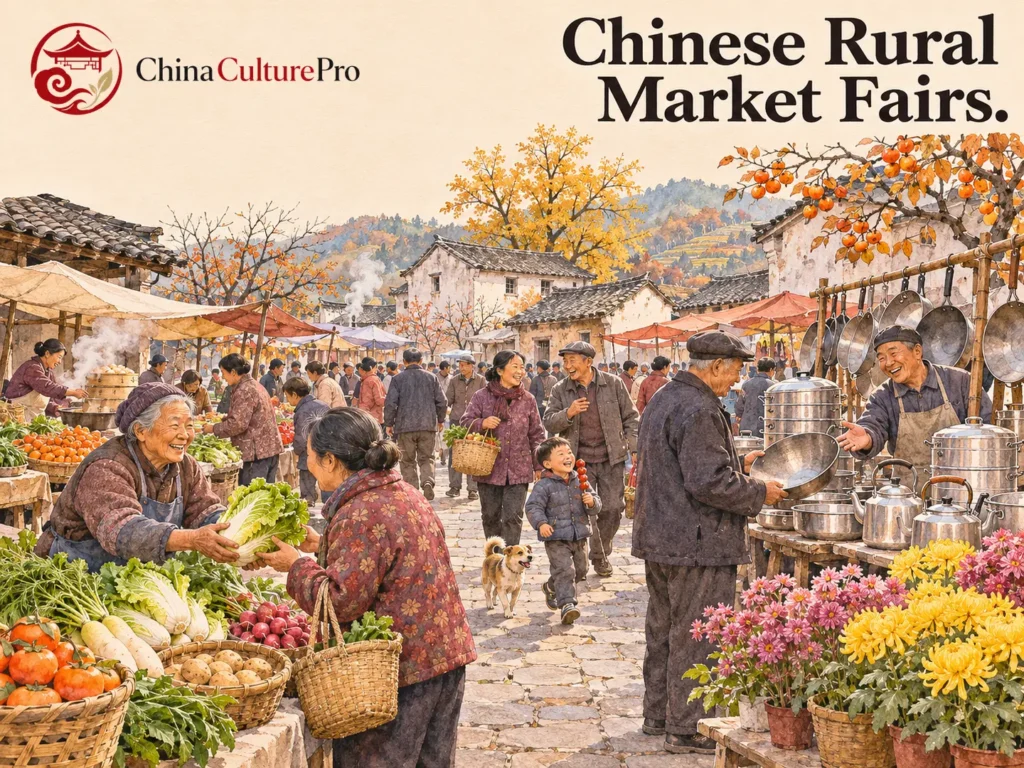

Quick Answer: What Is a Chinese Rural Market Fair?
Ganji (赶集, gǎnjí) means going to a recurring market in a town or village. On designated days, farmers, vendors and shoppers come together to trade produce, tools, household goods and other items. Market days can also bring neighbors together over food or an event.[1][2][3]
- Timing: The market can follow a local cycle, including dates in the lunar month.[1][2]
- Trade: Regular stalls can sell vegetables and cookware alongside new goods.[2]
- Revival: Some markets attract new visitors with crafts, performances and social media.[2][4]
The same market day can serve regular errands and new reasons to visit.

A market street can be quiet one day and filled with people and tables the next. Vendors and shoppers know when to come. That shared timing helps explain both the resilience of some Chinese rural markets and the difficulties facing others.[1][3]
Why Market Day Follows a Local Calendar
A periodic market gathers demand from several communities into one place on the same day. Villagers gain access to more sellers, while traders can reach several markets by following different schedules. The pattern helps explain why historical Chinese market towns mattered to residents far beyond the central street.[1]
Zhuqiao Township in Shandong offers one example. Reporting in 2026 described its fair as taking place six times in a lunar month. That schedule belongs to Zhuqiao. Each market has its own dates and hours, so check the local calendar before assuming two neighboring markets meet on the same day.[2]
What Residents Still Buy and Do
At Zhuqiao, stalls selling produce, hoes and cookware share the market with flower sellers. A shopper may arrive to replenish kitchen supplies and leave with a potted plant. The newer goods reflect what some customers choose to spend time looking at once other shopping options are available.[2]
The street can also be a meeting place. Ethnographic work in Qingyangba in southwest China found people still stopping to see friends or relatives even as the number of vendors and the hours of trade fell. For those shoppers, the trip still provides a chance to see people from nearby communities.[3]
How Fairs Are Finding New Customers
A market can make room for craft stalls, performances and foods that encourage visitors to stay. A 2026 report described Shandong’s Xindian market offering handmade accessories and coffee alongside existing trade. The same report described sellers livestreaming from another market in Shandong. These are examples of how crafts circulate on social media and can draw people to a physical stall.[4]
What a Crowded Market Day Can Tell You
Look at what has brought people to the market. Repeat trade in fresh produce tells you something about the role of a market for local households. A festival crowd or interest in a new stall tells you something else. In Qingyangba, the market dates remained familiar even as the trading area contracted. In Zhuqiao, new products appeared alongside established stalls. These cases show different kinds of change that a photo of a busy market might miss.[2][3]
FAQs About Chinese Rural Market Fairs
Is Ganji the Same as a Temple Fair?
A temple fair (庙会, miàohuì) is usually linked to a temple or festival and may happen on an annual cycle. Ganji refers to attending a market that meets on recurring trading days. A temple fair can include trade and food stalls too.[1]
Do All Rural Markets Follow the Lunar Calendar?
Local schedules vary. Zhuqiao is one example with six trading days each lunar month. The term ganji alone gives no fixed schedule.[1][2]
Are Village Markets Only for Tourists?
Residents continue to buy everyday goods and meet people they know. Some markets also draw day visitors through craft displays, performances and new kinds of stalls.[2][3][4]
Sources
[1] G. William Skinner. Marketing and Social Structure in Rural China, Part I
[2] Xinhua. China’s village fairs find new life as consumers seek more than bargains
[3] Meng Tan. Dynamics of ganji: A rural marketplace in Southwest China
[4] Wang Hao for People’s Daily. How rural markets are changing