

Quick Answer: How Did Chinese Migration to France Develop?
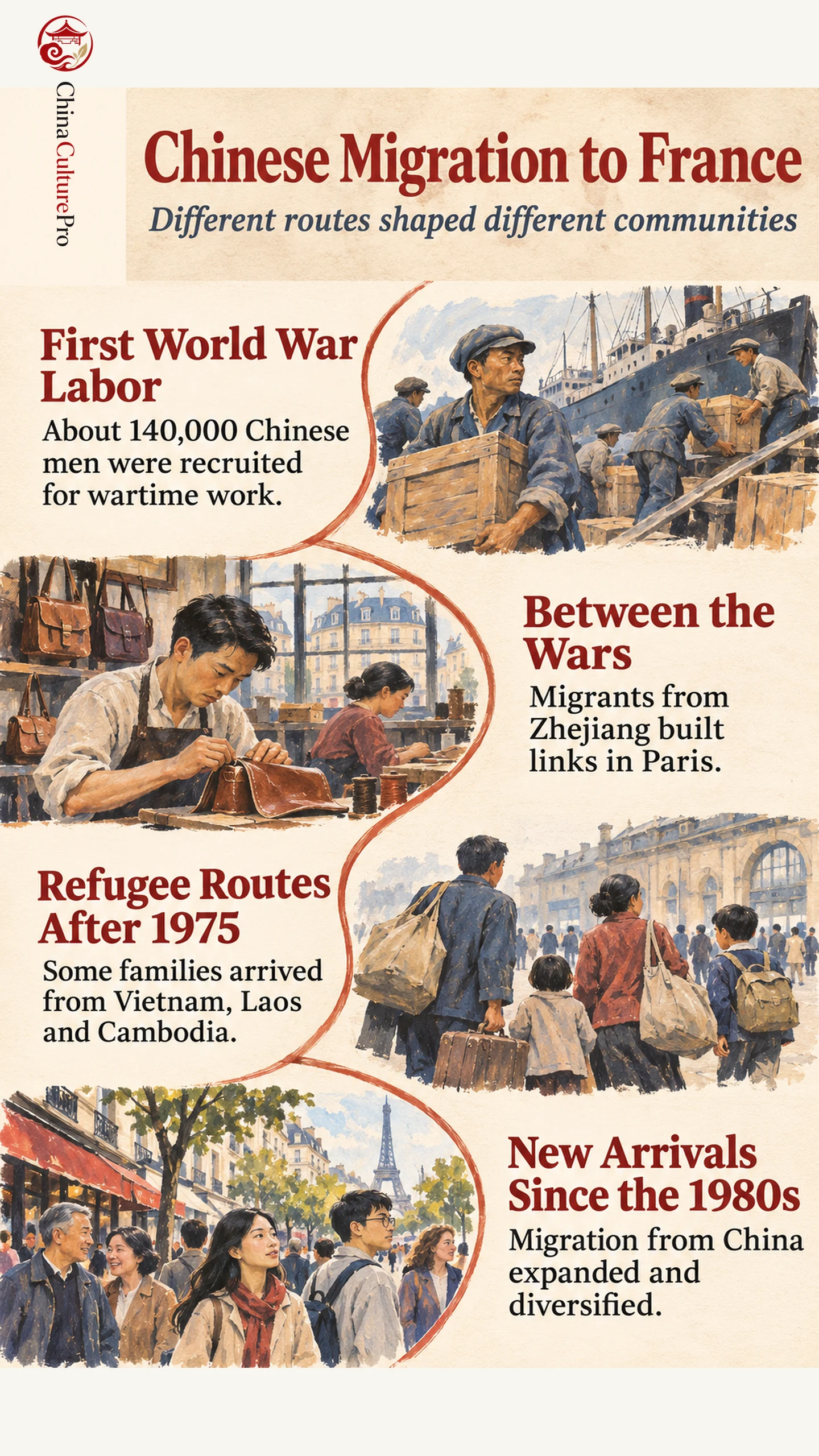
Large-scale Chinese migration to France began during the First World War, when about 140,000 men from China were recruited for wartime work. Some stayed after the war. Other arrivals included people from Zhejiang, refugees of Chinese ancestry from Southeast Asia after 1975, and a wider range of migrants directly from China from the 1980s onward. These routes help explain why Chinese communities in France have different languages, family histories and ties to Asia. [1][2][4][5]
- Wartime labor: Chinese workers supported Allied logistics and industry. A cemetery at Noyelles-sur-Mer preserves part of that history. [1][3]
- Refugee settlement: Some families had lived for generations in Vietnam, Laos or Cambodia before moving to France. [2][4]
- Direct migration: Networks from southern Zhejiang continued to grow as later arrivals also came from elsewhere in China. [2][5]
For a family or neighborhood history, ask where people lived before they reached France and when they arrived.
A Chinese cemetery near the Somme and the shops of Paris’s 13th arrondissement tell different parts of the history of Chinese migration to France. One reflects the recruitment of workers during the First World War. The other is linked to later refugee settlement from Southeast Asia. Neither place alone explains the origins of today’s Chinese communities in France. [1][2][3][4]
First World War Recruitment and the Chinese Labour Corps
France’s national immigration museum puts the number of men recruited from China during the First World War at about 140,000. That total covers recruitment by both the French and British sides. The Chinese Labour Corps was the British organization. Many workers were employed behind the front, in settings such as factories, workshops and construction sites. Their work kept supplies and industrial production moving while large numbers of French and British men were serving in the war. [1][3]
Noyelles-sur-Mer, on the Somme estuary, was a depot for the British Chinese Labour Corps. It had camps and a hospital. The Commonwealth War Graves Commission describes its Chinese cemetery as having more than 800 graves. Some workers stayed in France after the war. The cemetery records the presence of people who died in France. The interwar accounts describe some of those who stayed and formed communities. [1][3]
Between the Wars: Zhejiang Networks Took Root
Wartime workers who remained were part of the early Chinese population in France. The immigration museum also records students, artists and workers active in interwar France. Some used their time there to study or to organize newspapers and political groups. Their activities show why interwar Chinese migration also appears in histories of education, publishing and political organizing. [1]
Migrants from the Wenzhou region (温州, Wēnzhōu) in southern Zhejiang built a longer-lived network. A historical study traces settlement near the Gare de Lyon and then around Arts-et-Métiers. It records later migrants from Wenzhou finding work in leather goods in Paris’s 3rd arrondissement in the 1930s. The guide to Wenzhou diaspora communities follows the wider network beyond this early French example. [2][6]
After 1975: Refugees Arrived from Southeast Asia
Refugees fled Vietnam, Laos and Cambodia after 1975. Among those who settled in France were families of Chinese ancestry whose previous homes were in Southeast Asia. For those families, the journey to France was one part of a migration history that had already linked China and Southeast Asia. [2][4]
In Paris, the 13th arrondissement became associated with these arrivals. A study of Chinese migration to France contrasts that settlement history with migration from southern Zhejiang associated with Arts-et-Métiers and other parts of the city. For a related account of how a speech community could take root across countries, see Teochew diaspora networks. The language a particular family used depended on its own route and relationships. [4][5][6]
Since the 1980s: Direct Migration Grew and Diversified
As direct migration from China expanded again after the late 1970s, earlier Zhejiang connections helped some newcomers reach France. Later migration also brought people from other parts of China, including the northeast. Researchers describe arrivals with different backgrounds, including students, workers and business owners. The older Zhejiang connection remained important alongside these newer routes. [2][4][5]
A neighborhood label is a starting point for family history. A family in the 13th arrondissement may trace its journey through Southeast Asia. A business record near Arts-et-Métiers may point toward Zhejiang. Neither location establishes an individual’s birthplace or home language. Use the guide to Chinese diaspora languages and the Chinese diaspora history guide to put those local clues in context. [4][5][6]
FAQs About Chinese Migration to France
When did large-scale Chinese migration to France begin?
Recruitment for the First World War brought large numbers of Chinese workers to France. Some stayed and were part of the interwar Chinese population, alongside people who arrived for study, work or other reasons. [1][5]
Did all Chinese migrants in France arrive from China?
Some arrived directly from China. Others were of Chinese ancestry and came from Southeast Asian countries, including Vietnam, Laos and Cambodia, during refugee movements after 1975. [2][4]
Why are there several areas associated with Chinese migration in Paris?
Different migration routes and periods shaped different neighborhoods. The 13th arrondissement is strongly associated with refugee settlement from Southeast Asia, while Arts-et-Métiers has historical links to migrants from the Wenzhou region. [4][6]
Sources
[1] Musée national de l’histoire de l’immigration. 1914–1945: D’une guerre à l’autre
[2] Musée national de l’histoire de l’immigration. Diversité des migrations asiatiques
[3] Commonwealth War Graves Commission. The Chinese Labour Corps on the Western Front
[4] Chloé Cattelain, Marylène Lieber, Claire Saillard and Sébastien Ngugen. Les Déclassés du Nord: Une nouvelle migration chinoise en France
[5] Ya-Han Chuang, Hélène Le Bail and Emilie Tran. From Silence to Action: The Chinese in France
[6] Hommes & Migrations. Ces Chinois de Wenzhou qui ne jurent que par la France