

Quick Answer: What Is San Francisco’s Chinese New Year Parade?
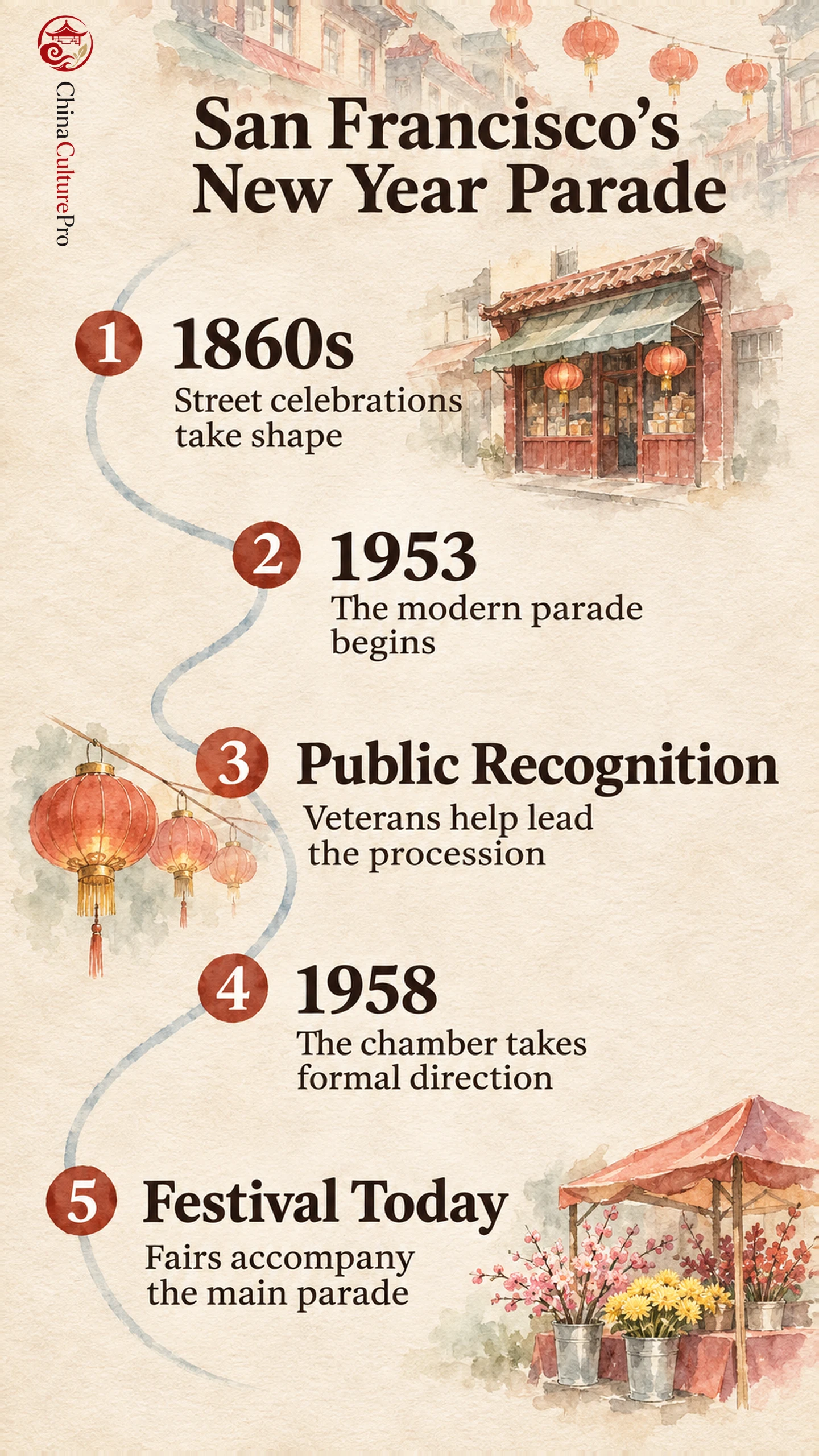
San Francisco’s Chinese New Year (春节, Chūnjié) parade grew out of celebrations in Chinatown that date to the nineteenth century. Historians identify 1953 as the first parade in the modern festival’s form. The Chinese Chamber of Commerce began formally organizing the parade in 1958.[1][2][3]
- Early roots: New Year festivities moved into public space in nineteenth-century Chinatown.
- Modern festival: The 1953 procession linked neighbourhood traditions to a broader civic audience.
- Organization: The chamber’s 1958 date refers to its formal role in running the event.
The nineteenth-century roots, the start of the modern parade and the chamber’s involvement mark three different developments.
In San Francisco, the New Year procession makes Chinatown’s celebration visible far beyond the households that observe the holiday. The streets became a place where community organizers could speak to residents, visitors and city institutions at once.
Nineteenth-Century Chinatown
San Francisco’s Chinese community began incorporating an American-style street parade into its New Year festivities in the 1860s. A photograph of a Chinatown procession on Dupont Street, now Grant Avenue, from around the 1880s documents this earlier world of public celebrations.[1][3]
The street event grew alongside family and community practices of Chinese New Year. The photographs are useful for seeing who and what occupied public space. The image alone may not establish the route, organizer or calendar year of a specific event.
What Changed in 1953
One starting point for the modern festival is February 15, 1953. Corporal Joe Wong, a wounded Korean War veteran, served as grand marshal, and enlisted air force officers Jessie Lee and Anna Tome joined him at the front. Their roles connected Chinese American military service to the public celebration.[2]
Organizers also wanted visitors to come to Chinatown. The mix of civic recognition, tourism and community expression makes the procession part of the history of Chinese American culture. In the early Cold War, it gave organizers a public stage for asserting belonging, even as they faced suspicion and discrimination.[2]
What 1958 Refers To
The Chinese Chamber of Commerce traces its formal direction of the parade to 1958. This records a change in responsibility. It helps explain why an organizer’s history of the event and an academic study of its earlier format can give different dates.[1][2]
The chamber describes a festival extending beyond the main procession, with a flower market fair and community street fair. A history of the parade should distinguish these related events when interpreting a photograph, news article or programme.[1]
FAQs About San Francisco’s Chinese New Year Parade
Why Do Sources Give Different Start Dates?
They date different developments. Public celebrations reach back to the nineteenth century, the modern procession dates to 1953 and formal chamber organization dates to 1958.
Has the Festival Always Been Just a Parade?
The parade is one event in a wider seasonal festival. The chamber also organizes fairs and other events associated with the celebration.
Sources
[1] Chinese Chamber of Commerce of San Francisco. Events and History of the New Year’s Parade
[2] Chiou-Ling Yeh. Making an American Festival, Chapter 2
[3] SFO Museum. San Francisco: City of the World, Chinatown Exhibition Text