

Quick Answer: Which Lion Dance Styles Spread Through the Chinese Diaspora?
Southern lion dance (南狮, nánshī) is widely performed in Chinese diaspora communities. In Singapore, Cantonese migrants passed on the Foshan (佛山, Fóshān) and Heshan (鹤山, Hèshān) styles, and local dancers combined their movements. Northern lion dance (北狮, běishī) also took root in Singapore through a martial arts association. In Malaysia, high-pole routines became a prominent competition format for southern lion dancers. [1][3][4]
- Lineage: Look at the costume head and how the lion moves. A longer, toothier head can suggest Foshan, while a flatter mouth can suggest Heshan. [1]
- Performance format: A southern lion can dance on a shopfront pavement or on raised poles in a competition. [1][4]
- Local setting: A clan association, a sports championship and a museum festival each give a troupe a different audience. [2][5][6]
For a firm identification, check how the troupe names its lineage and the event names its performance category.
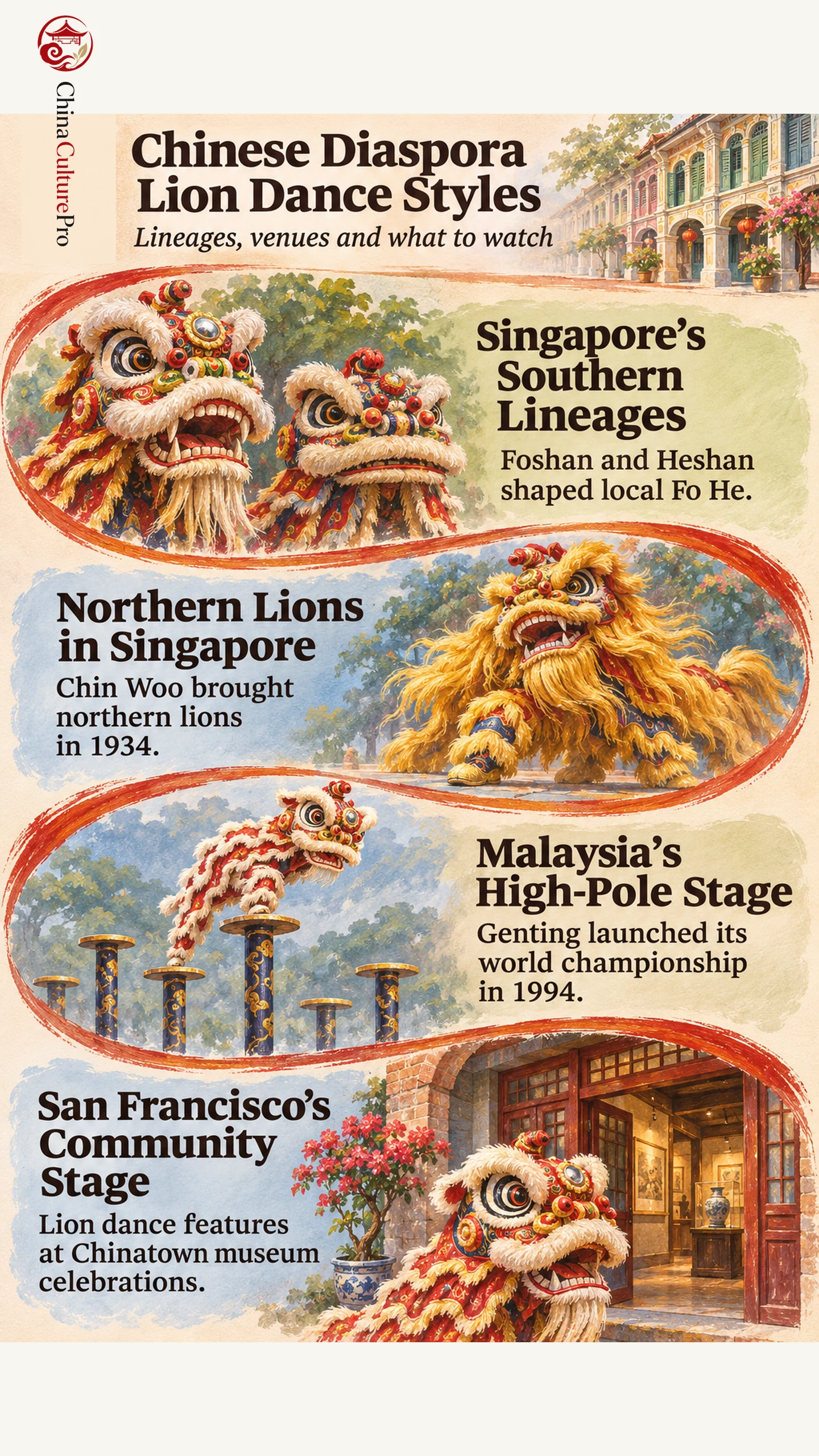
A lion may stoop to pick up lettuce at a Singapore shop opening, spring between narrow platforms in Malaysia or welcome families to a Chinatown museum in San Francisco. The venue tells you what the performance is there to do. The costume and movements give you clues about what the troupe learned and where that tradition came from. [1][4][6]
Singapore’s Southern Lion Lineages
Hok San is the name used by a Singapore association for Heshan, a place in Guangdong. Singapore’s Urban Redevelopment Authority dates the troupe to 1920. It traces the group to immigrants who shared their Heshan style as a form of recreation. The troupe grew into a clan association in 1939. This is one way Chinese diaspora associations kept a performance tradition tied to a place of origin. [1][2]
Look first at the mouth. In the Singapore Chinese Cultural Centre’s account, the Foshan lion has a longer head and shows its upper teeth. The Heshan head is flatter, with a bill-like mouth that hides the upper teeth. Its characteristic movement draws on the gait of a cat. These are clues to the styles as documented in Singapore. Costume makers and troupes can combine features, so a head shape alone cannot establish a lineage. [1]
Kong Chow Wui Koon offers a local example. Dancers there combined Foshan and Heshan movements into Fo He (佛鹤, Fóhè), a Singapore southern lion style. A routine may include plucking the greens (采青, cǎiqīng). At a business opening, that may involve retrieving lettuce and a red packet as a wish for prosperity. Listen to the lion dance drum as the lion approaches the offering, pauses and changes pace. [1]
The same cultural centre documents another use for the southern lion in Singapore. The Hok San troupe helped a Chinatown school group take up lion dance, and that school fielded ten lions at the first National Day Parade in 1966. [1]
How the Northern Lion Took Root in Singapore
Singapore’s northern lion tradition has a separate institutional history. In 1934, martial arts instructor Wei Yuan Feng, formerly with Chin Woo in Shanghai, brought a pair of northern lions to Singapore. The Singapore Chin Woo troupe later became known for its Golden Lions. Their flowing manes and animated movements give viewers a second point of comparison within the same city. [3]
The costume also changed locally. After replacement heads from Shanghai proved difficult to move, Wei and fellow instructor Fang You Chang made lighter heads with bamboo, golden paper and wool. The lighter construction made it easier for the dancers to animate the head while moving. A historical photo of a golden northern lion can therefore show both a style carried across borders and a costume remade for local performers. [3]
What Makes Malaysia’s High-Pole Lion Dance Different
The Malaysian heritage inventory describes lion dance on poles as a performance in which two dancers animate one lion while moving on a set of elevated platforms. The performer in front works the head. The performer at the rear animates the hindquarters, coordinating each landing with the performer at the head. The drum, gong and cymbals accompany the routine. The poles make balance and coordination especially visible while the dancers keep the illusion of a single animal. [4]
Genting’s first world championship in 1994 drew 13 teams, according to the organizer’s event history. That contest gives a concrete example of how a Malaysian venue brought troupes from different countries together. A program that says high-pole tells you about the staging. If you want to know whether the troupe performs Foshan, Heshan or a local blend, look for the troupe’s own description. [1][4][5]
Why a San Francisco Museum Hosts Lion Dance
The Chinese Historical Society of America invited Wong Gar Hung Keun to perform at its 2025 Year of the Snake celebration in San Francisco’s Chinatown. The program paired the performance with calligraphy, children’s crafts and museum exhibits. For a visitor, a lion dance at this kind of event is one way into the history of the neighborhood and its Chinese diaspora community. [6]
A celebration program can identify the troupe and explain why it was invited even when it gives no lineage. To compare the costumes or learn how a lion differs from a dragon carried by a line of performers, use the visual cues in the lion dance and dragon dance guide. The broader guide to Chinese lion dance covers the costumes, music and festival settings in more detail.
FAQs About Chinese Diaspora Lion Dance Styles
Is high-pole lion dance a third style alongside northern and southern lion dance?
High-pole dance is an acrobatic format associated with the southern lion. Northern and southern identify broader traditions, while the poles describe the stage and the demands of the routine. [3][4]
Is lion dance only performed for Lunar New Year?
Troupes also perform at shop openings and other public events. At the Genting championship, the audience watches teams compete. At an opening, the lion’s performance helps mark the occasion. [1][5]
Can I identify a lion dance style from the costume alone?
The shape of the head or the length of the mane can help. Some local styles combine traditions, so the troupe’s own description and the movements in the routine can settle an uncertain identification. [1][3]
Sources
[1] Singapore Chinese Cultural Centre. Southern lion dance
[2] Urban Redevelopment Authority, Singapore. 21 Kreta Ayer Road
[3] National Library Board, Singapore. Historical Photos of Chin Woo’s Golden Lions
[4] Department of National Heritage, Malaysia. Lion Dance on Poles
[5] Resorts World Genting. History of the Genting World Lion Dance Championship
[6] Chinese Historical Society of America. Year of the Snake Celebration