


Quick Answer: How Did Chinese Mathematicians Use Decimal Fractions?
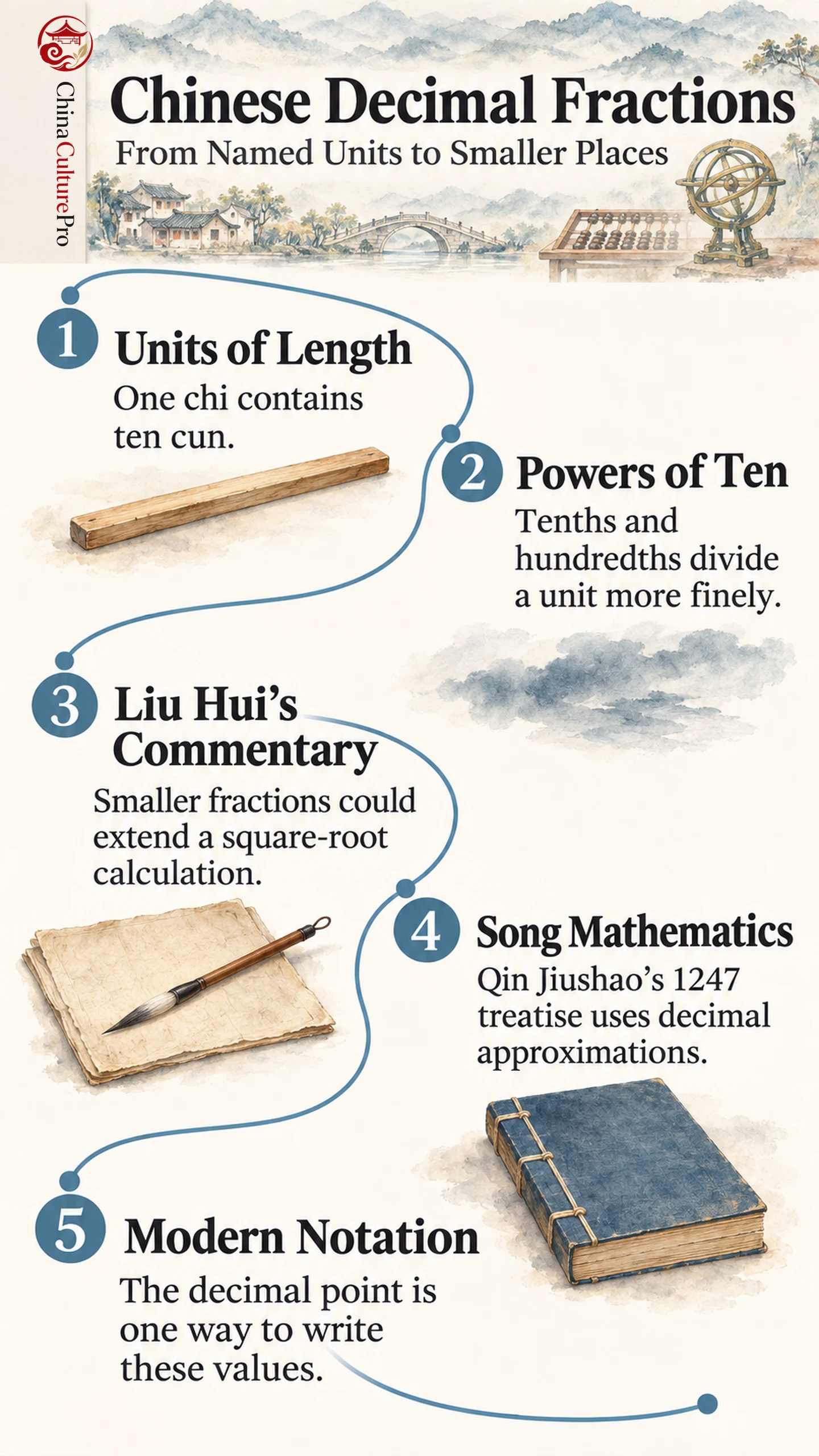
Chinese mathematicians used relationships based on tenths, hundredths and smaller powers of ten. Some named units embodied those relationships. Liu Hui’s commentary on square-root extraction describes how to express smaller fractions when the calculation continues beyond the main units.[1][2][3]
- Length units could be divided successively by ten.[1]
- Root calculations offered one reason to work with ever smaller fractions.[2][3]
- A modern decimal point can translate the value of those fractions into familiar notation.[2]
The history of a fractional value and the history of the symbol used to write it are separate.
A length of two and a third units can be hard to express exactly with finitely many decimal places. Two units and three tenths is different. Named units, small fractions and positional calculations could all express values based on powers of ten.
Decimal Subdivisions in Measurement
One zhang (丈, zhàng) was divided into ten chi (尺, chǐ), and one chi was divided into ten cun (寸, cùn). A cun is therefore one hundredth of a zhang. Other units did not all follow this rule. For example, a historical system of weight used sixteen liang to a jin.[1]
Take two chi and three cun. Since three cun are three tenths of a chi, the total is 2.3 chi in modern notation. This example translates a relationship between units. A historical writer could convey the same value by naming both units.
Liu Hui and a Square Root With a Remainder
Liu Hui’s commentary on The Nine Chapters describes obtaining smaller quantities in square-root work. The commentary connects one further place with tenths and two with hundredths. It gives a way to describe a result more finely when the process cannot stop at a whole unit.[2][3]
Compare a modern approximation of the square root of 2 as 1.41. The 4 stands for four tenths and the last 1 stands for one hundredth. This is a modern illustration of place values, separate from Liu Hui’s historical example and wording.
Decimal Fractions in a Song Treatise
Qin Jiushao completed the Mathematical Treatise in Nine Sections in 1247. Historians discuss its use of decimal fractions in approximating roots. The later treatise shows how the same basic principle could serve numerical problems whose quantities were not tied to named lengths.[4][5][6]
That treatise differs from the earlier classic in title and content. The broader history of Chinese mathematics includes both works and other methods of calculation.
Three Ways to Recognize Decimal Reasoning
Ask whether the passage uses units related by ten, describes repeated tenths and hundredths, or assigns values by position. These are different clues. The positions used with counting rods supported numerical representation, while the tianyuan method used positions for a different task, representing coefficients of powers of an unknown.
FAQs About Chinese Decimal Fractions
Did Chinese writers need the modern decimal point?
Named decimal subdivisions and expressions for tenths and hundredths conveyed values without that symbol.[1][2]
Were all historical Chinese measurement units decimal?
No. Several length and volume relationships were decimal, while the weight relationship between the jin and the liang could be based on sixteen.[1]
Did Liu Hui use fractions when explaining roots?
His commentary explains how tenths, hundredths and smaller fractions can express finer results in square-root extraction.[2][3]
Sources
[1] Mathematical Association of America. A Classic from China: The Nine Chapters, Numbers and Units
[2] Notices of the International Congress of Chinese Mathematicians. On Mathematical Symbols in China
[3] East China Normal University. Shanghai History and Pedagogy of Mathematics newsletter
[4] University of St Andrews, MacTutor. Qin Jiushao
[5] Chinese Social Sciences Net. Versions and transmission of the Mathematical Treatise in Nine Sections
[6] Biographies of Chinese Scientists. Qin Jiushao