


Quick Answer: What Shapes Chinese Culture in Trinidad and Tobago?
Chinese migration to Trinidad includes the arrival of the Fortitude in 1806, organized indenture from 1853 and later movement through family and trading networks. In the twentieth century, associations and artists made distinct contributions to local life. [1][2]
- Early migration. The 1806 voyage preceded the mid-nineteenth-century indenture program. [1]
- Community organizations. Newer migrants joined relatives, opened shops and organized in Port of Spain. [1]
- Art. Amy Leong Pang helped found the Society of Trinidad Independents. [1][2]
The dates distinguish different ways people reached Trinidad and the associations and cultural circles they later built.
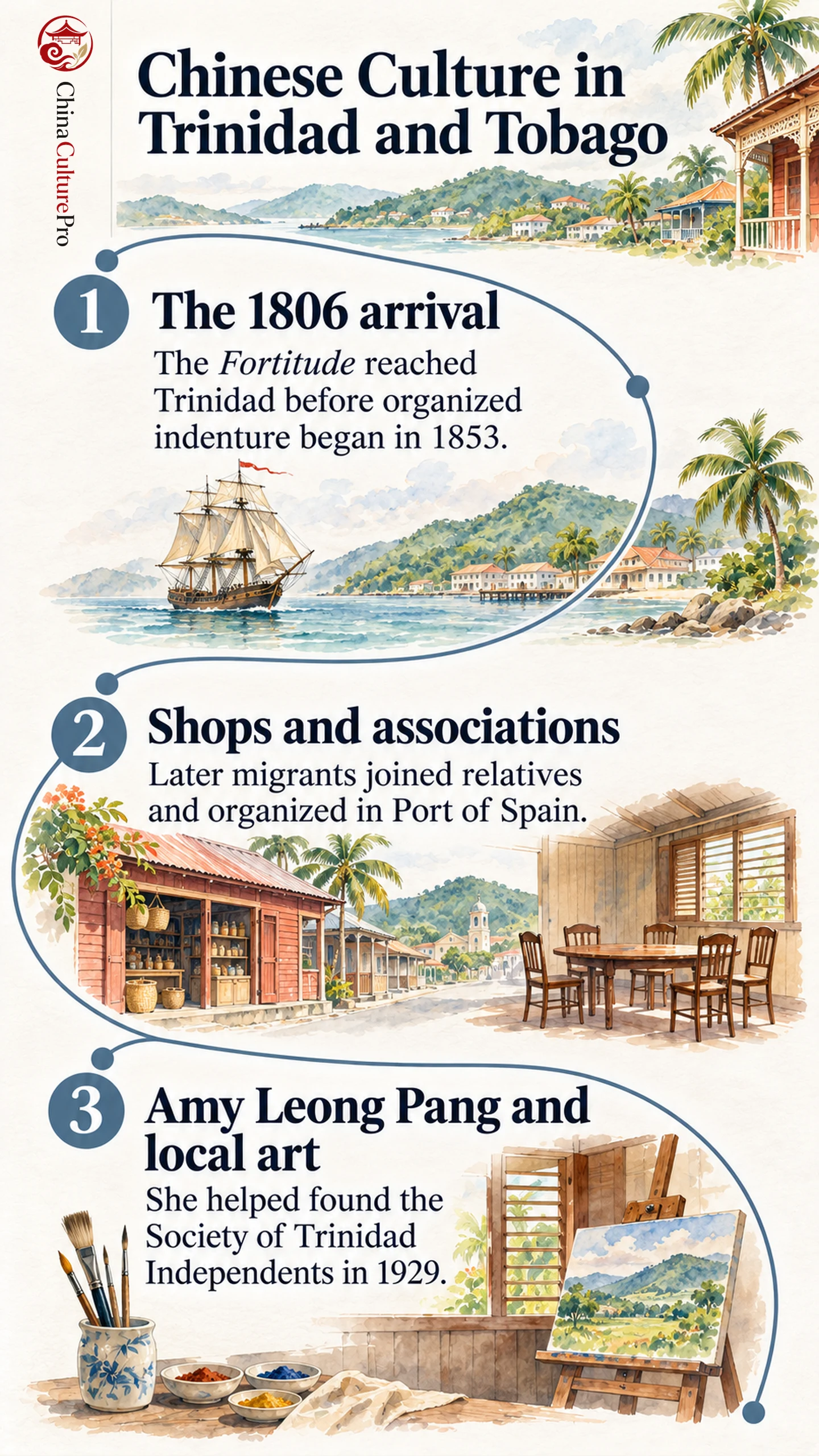
A ship list and an artist’s circle preserve different chapters of Chinese Trinidadian history. One records arrival. The other shows how descendants took part in shaping local culture.
From the Fortitude to Organized Indenture
The Fortitude docked in Port of Spain in October 1806 with a group of Chinese migrants. A separate organized indenture program began in 1853, when ships including the Australia, Clarendon and Lady Flora Hastings brought workers. Some worked on estates, and the organized program ended in 1866. [1]
The migration routes continued beyond any one voyage. Some people came to Trinidad from Guyana after their contracts there ended. These movements connect Trinidad with other Caribbean societies shaped by indenture. [1]
Family Migration and Associations in Port of Spain
In the early twentieth century, relatives and friends of earlier migrants arrived and worked in trade and retail. The Fui Toong On Association, established in 1919, brought together Hakka (客家, Kèjiā) speakers in Port of Spain. The same regional name appears in the history of Chinese families in Jamaica. [1][3]
Amy Leong Pang and Trinidadian Art
Amy Leong Pang was a founding member of the Society of Trinidad Independents in 1929. The artists met in private homes to paint and discuss ideas. Leong Pang explored West Indian subjects and experimented with different styles. Her work belongs to the history of Trinidadian art as well as to Chinese Trinidadian heritage. [1][2]
FAQs About Chinese Culture in Trinidad and Tobago
When did Chinese migrants arrive in Trinidad?
The Fortitude arrived in 1806. The organized Chinese indenture program followed in 1853, almost half a century later. [1]
What was the Fui Toong On Association?
It was an association established in Port of Spain in 1919 that brought together Hakka-speaking migrants. [1]
Sources
[1] National Library and Information System Authority. Chinese Arrival
[2] Citizens for Conservation Trinidad & Tobago. The art of Trinidad and Tobago: Early twentieth century
[3] Chinese Benevolent Association of Jamaica. Ancestral villages